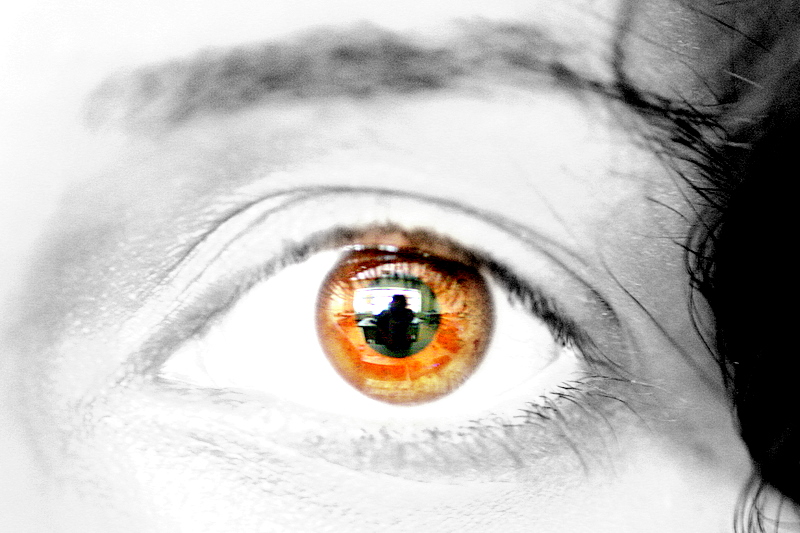
There’s a hole in my eye. I don’t think people notice it but that’s probably good. It might freak them out, especially if they got close enough to look through the hole to the other side.
My good eye sees the people talking to me, clear as day, like you see me now. But through that peephole in my other eye, I can see the coming darkness. The creeping doom and crawling chaos set to engulf us all.
Yeah, all of us.
It’s not pretty. And it’s not a fun power, or whatever, to have.
“Goodbye,” I think to myself, as people talk about new cars, new homes, old girlfriends, rich husbands, medications, and jobs.
Do they notice the sad set of my mouth when they talk about their children? I hope not. I don’t want to bum anyone out. You know?
“That’s so sad,” I say to myself when they talk about the future, about dreams and aspirations. I have to concentrate on not shaking my head and pursing my lips.
Does that sound fun to you?
Plus, it’s hard knowing what to say to people. I don’t want to lie, of course, but I don’t think they’re ready to hear about the end, either. I’ve opted to be polite, like when someone asks you if their new haircut looks good or when someone shows off a new car. You say something polite, right? Even if you hate it.
So, like, when my brother told me he and his wife had decided to have children, I said, “Won’t that be wonderful.” It’s not going to be anything, of course. But I can let them enjoy the thought of it. I even smiled to add to the moment. He’s my brother.
Or, when a colleague said she was pursuing her dream of starting her own business, I told her, “That’s going to be great.” Didn’t do me or her any harm, pretending like that.
One day, my friend Frank told me how bad things have gotten with his wife. She kicked him out. He never saw his kids anymore. In a dark moment, half-drunk, he said, “Maybe I should end it all. No one would miss me.”
“No. Don’t bother, Frank,” I said. I patted him on the back, tried to be reassuring. “It’ll all be over soon.”
He didn’t seem reassured. But he took my advice, so maybe I was helpful without saying too much.
I have looked into the mirror, you know. To satisfy my curiosity. I looked closely. Right down into that hole in my eye.
I wasn’t going to tell you this but I think I figured something out. Remember when I told you I can see what’s coming, the end that’s coming? Now I think I know where it’s coming from.
I’m not proud of it. It’s just a fact. Like when you’re the fastest runner in your class. Or you did really well in the stock market. I looked inside there and now I know it’s getting bigger and there’s no stopping it, so don’t bother trying.
Well, this isn’t something I feel the need to brag about, that’s all I’m saying.
No, I’m not winking at you! Ha-ha! I’m just trying to get one last good look at you, that’s all.
With the good eye.
Levi Krain rose from a clear, cold northern lake and enveloped a small midwestern city. Since then, he has moved on to greater things and now resides in the heart of Lovecraft country where he spins tales and refuses to drink the water from the well. His fiction has twice placed in The Molotov Cocktail flash contests.
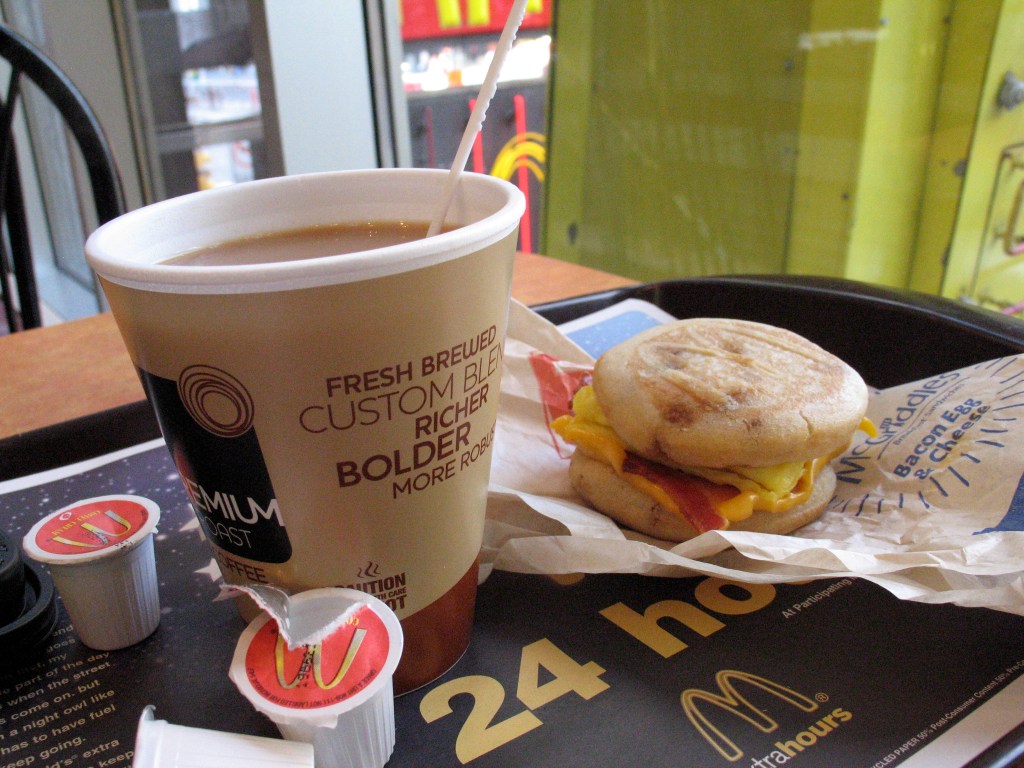
We don’t carry baggage, we carry lassos and the time has come to move on, rope someone else with our feelings, drag their nights behind our galloping will and hope they survive the long, painful cut through the mud. It’s not that I mind the gesture. It’s hard to sever ties, so we might as well start by trimming the fat before we remove the heart entirely. It’s just a picture. Two people smiling about something, with a filter that made us look like sepia gods, soaked in the sun of a beautiful, infinite day. But I can’t stop thinking about the morning of. We stopped for breakfast and you told me, in between bites of your McGriddle, that thing I promised I’d never repeat, I reciprocated and we cried, guiding our horses for another round of circling the barrels long-since filled with poison from our respective upbringings. But we drove and eventually, we parked. We found the sun and shed the greater weight for the smaller moment. For company so perfect we had to save it. Smile into your camera and preserve the day. Celebrate. Not because we found happiness, but because we’d found each other.
But fuck me, I guess.
Timothy Tarkelly is a poet from Southeast Kansas. He’s had two books published by Spartan Press. When he’s not writing he teaches English to Ninth Graders. One of them recently described his ponytail as “immaculate.”
Save for the few movie nights in my room or hers next door, or that awkward fight we had about how I wasn’t any fun because I didn’t go anywhere with her or Sarah — which made me cry for feeling inadequate as a friend, even though they lived life in a much faster lane, while I was preoccupied with depression and the kind of anxiety that makes you want to rip your skin off, even just walking across campus during broad daylight, and as a result of our different lifestyles, no one chose me as a roommate for the following year — Mindy didn’t know me all that well or the childhood experiences I had that forced me to become a shell of myself, never opening up in an unabashed, raw way, or share what I really felt or what I was really going through, or keep a journal because, deep down, I knew that my well-being depended on no one finding it, to know that shoving one of her leftover condoms (thank G.O.D. unopened) from her Spring break trip with Bill (the poor schmuck she strung along for months on end), into the plastic case holding my bed-in-a-bag, facing it upwards so my mother could see it when she helped me move out of my freshman-year dorm room for the summer, was not humorous. Mindy’s malicious “Oh, don’t forget your condoms!” as she stood in her doorway, while I made my way past her to the elevator, disgusted my mother and mortified me. Red-faced, I ripped it from the bag and threw it back at Mindy’s feet, insisting that the condom wasn’t mine, knowing the idea would be lost on Mindy that her move was a low-blow. And as convincing as I tried to sound that Mindy was playing a dirty trick on me, it mattered not. My mother’s scorn, coupled with my immeasurable embarrassment and guilt, hung over me during our short ride home, thick as clinging, overgrown ivy that never seems to die no matter how much you keep cutting and ripping.
Christine M. Estel lives and writes in the Philadelphia area. She tweets from @EstellingAStory.
On the sacred recommendation of the head chef in my kitchen, my best friend John and I traversed the breadth of Kansas state to the hum of Pink Floyd over the radio. Being immigrants, we were unfamiliar folk to the corn-sodden great midwestern expanse. For the satisfaction of our coastal curiosities, there seemed no method more appropriate to rectify this modern problem than the all-American road-trip, though in part too carefully curated with the technological luxuries of the 21st century. We bought a paper atlas, but even the desolate Black Hills are wired.
When we left the better half of Kansas City, my phone guided us to the long west. His was plugged umbilically into the aux. There was a sort of alchemic equivalency to this that seemed only fair and natural, like Newtonian physics, or well-established inheritance law. We needed direction, so we needed a soundtrack. My chef recommended the 1973 album, so we were obliged to abide.
I’m sure you’ve heard of it already, but don’t stop me. Let me have this moment. There’s the old rumor of non-causality that if you begin The Dark Side of the Moon at the same moment as the beloved Judy Garland film classic of 1939, a synergistic effect will present itself. Tornadoes tamed by screaming and brain damage resolved with basslines. Witnessing this act of alignment is something I have never done, fully intend to do someday, and lie about constantly that I already have. It’s a hyperactively celebrated rite of passage for era-hopping tab-eaters, the point of no return down the long-melting reality screen. What a load, right? Alan Parsons would agree with me. People microdose now anyhow and over-analyze these things. It’s not lost on me that we’re in Kansas. You can imagine it, if you squint.
That’s how it goes, yeah? You’ve listened to it once, at least. It always starts with a double-take. Speak to Me came in so quiet that we had to check the cable, pulling it out a couple times and blowing in the hole like bad porn or an old Sega cart. Don’t bullshit, we all do it. The only person on this Earth who never does is my chef, and I can assure you that’s only because he spends eight hours of each six days of work hitting dislike on the shop Pandora if it queues anything out of the Peter Gabriel—Neil Diamond musical range. This man is my spiritual father. Mine did alright, but I like this one’s taste in music better. He agrees that The Chain should have been the first song on Rumors. My father does not. No contest.
Rising with the track, the low morning clouds began to leak. A storm had followed us hot from the church-crack Sturgis lightning to the sweltering and sudden outpour of Chicago that soaked our socks and pruned our toes with warm, wet moisture as we hiked down Michigan Avenue. The first screams of the album welcomed in the rain and shook it like a sieve above us.
John rose from his slouch in the half-reclined shotgun seat and stiffened upright with messy angular contractions, the opening notes of a recognizable bit. Everything is a bit. His hands scrambled for purchase, slapping the center console, the right-hand handle, the child-safety lock, the glove compartment. His eyes widened, his lips tightened, he whipped his head from left to right, methodical and out of synch with the frantic ministrations of his palms against plastic. We have known each other enough, and I have yet to determine if this is social exaggeration or if this is as genuine as his anything. The adolescent textures of Roger Waters had his full attention.
The volume of falling water increased as the last chords of Breathe faded out and the driving beat of On the Run faded in. At the two-minute swell of distortion, my mouth began to creep along the edges of my face, rising up at the corners but never breaking its concealment of my teeth. The gentle drizzle had aggregated into a perpendicular firehose. The excitement in our carpeted Corolla was palpable in expletives. The death-portent of the Synthi AKS made us feel dangerous.
Around the third minute, we exited the thundercloud with the deep force bass of an airplane impact, suddenly crashing through the wall of rain and into the open sky. We were running now along the Kansas highway with the pattering fallout footfalls of the bomb behind us. With no hope of recovery from our synchronistic amazement, the cacophonous arrival of Time sealed us into a suggestible hallucinogenic state. It could only have been psychosomatic, but does that really matter? Just listen.
Sound never really dies. It exists in the aether, all around us, and under specific circumstances, it finds itself tapped and summoned. The same could be said of decades of collective hallucination, or that thing about if you crack your spine, all the acid you’ve ever taken will bubble right back up again. Nick Mason was guiding us down like Virgil through the rings, surrounded by the laughing ghosts of long-dead psychonauts and burners, all the way through to the frozen circle, where David Gilmour’s wrinkled fist punched upwards from the depths and loomed until it burst before us like a mortar.
Of a giddy shock, John pealed. I could see the little black pockmarks of his face expanding and reddening like an acidic vision. Certainly it was only the heat and our skin opened up like beggars’ hands to the atmospheric moisture, but the fantasy was fun to indulge. We spend more time dreaming about drugs than actually doing them.
Serenaded by overlapping reverb, the highway skipped us up and down, like the steady pulses of a waveform generator, bobbing us along the amps through to the sixth minute, where each respective lambda lengthened and trough shallowed until we were deposited again on level road. The grey canvas of the sky melted behind us, and Clare Torry began to scream, welcoming the reborn sun and splitting the west before us. I could catch in John’s eyes the frightened awe of God presented in the form of endless corn. She kept us tense for perceptive hours, brandishing a vocal knife and not quite sheathing it until we touched down at the bottom of the greatest gig there ever was: four seconds of silence.
Startled by the slamming registers of Money, snipping my nerves at their split ends enough for the hair to grow again, I was bumped back into the confines of my skull. I hadn’t noticed it until I pressed a finger into each eyelid that we were slick, sweating like pigs. We had finally hit the clarity threshold of the trip non-trip. If I had learned anything of the many kitchens I have fried in, there’s always a moment like this. We’d get back shortly to the shitshow, after our milk-crate smoke break. John dabbed his tee up to his blistering forehead and carded back loose hair. He was smiling with his teeth, grimacing, bopping his chin to the wicked baseline. This was the booth at the nightclub at the bottom of Judecca. John laughs. Fucking Gilmore, what a prick.
I should say here that John isn’t the shitbag that I am. He’s a good guy. Honest. His parents built their lives to take him home from school. I was emancipated for tax purposes. There’s a particular kind of insufferable that comes of prolonged close contact, and his I could love as fondness. Likewise, he chose me on the expectation that I’d offer a measure of wisdom to his developing deadhead sensibilities. I am not nearly the chaos wizard he presumes me to be, but he doesn’t need to know that.
What he did need to know is what I’d said the day before, responding to his orgasm in the dining room of Joe’s Barbeque about two hundred and thirty-six miles behind the state line. I wish I enjoyed anything in life as much as he enjoyed everything. Good food, better music. Chair cushions, air conditioning. The honest happy relish of no exaggeration. Is it the depression or is it too many lysergic daydreams and ketamine bathrooms? Am I doomed to a Charonic fate, psychopomping all my friendships through amping crests that I will never know again myself? Fuck these contemplations of a lifetime addict: ultimately futile, all the same result. I shouldn’t care so much. We’re ordering our last shots at five minutes fifteen. We’ve got to prepare ourselves for this shit, because we’re getting back into the heat any minute now. Henry McCullough tells us he was drunk at the time.
Our thoughts dissolved in the drone of the Hammond organ and were sucked by the circulating car fans. My skull vibrated in F minor by the time the saxophone appears ahead of us on the highway, notes rising out of the distant spots of steaming asphalt, like tiny pools of water, ever out of reach. We had fallen again into a perfect silence. I was nauseous and without fear. This was a late-stage familiarity so truthful to me that I almost forgot that this was only music and that was only Kansas. In God’s country, I marveled at the power of belief.
John surrendered himself to faith. Never in his life had I seen him lose that fine and anxious edge of an arm so ramrod straight against his side that the armpit ceases to exist. He relaxed in that moment, shoulders flush and curved against the cushion of the seat, slipping down until he was playing footsie with the gum wrappers and beef jerky in the abyss. I was pleased to be ferrying this Styx, but something nagged me as I watched him melt. We coasted all the way through Any Colour You Like, soothed by solos. It was long past the peak and we’d be alright.
I didn’t put it together then, but hindsight is a bitter mistress, making an education of me always, and I know now what it was. I hope John never does drugs. I fear I’ll lose him if I put him into the business, one way or another. I’d sooner bear the burden of guilty paternal control than the exponential guilt of squandering a young man’s potential. I was just out of it enough that I kept hearing Crazy Diamond on the track and expecting a rise, but it never came. That’s the wrong album, and there was only the brilliant mirage ahead. The nearest ocean was six thousand miles away and I couldn’t say I wasn’t nervous with the thought.
John didn’t notice me grip the wheel as we rolled into minute one second sixteen, Brain Damage exploding in our ears like the bewilderment at the end of the 8 hour ride. He looked like he should be gripping the wheel instead. Chill out, man, we’re almost at the bottom. We can go to bed soon, I promise. This, I can impart without remorse. We’re the only lunatics for miles around.
We were a little more prepared for minute two second thirty. John took the drum line in, gently slapping the console to the toms, and we dove in for a last little high as we entered Eclipse, rubbing our gums with what remained on the plate. He’d gained a little experience. By the end, you always feel professional.
The last word of the name is the last word of the album. It’s poetic, and we felt smart in our silly, momentary analysis of the thing. There’s just so much more to it, probably. The Hammond coasted to a smooth finish, an extended note, and, just like that, it was done. It was over. We were silent through the last heartbeats of the album, listening to our own, looking at the corn, the sea of the fucking thing. It looked so lovely, after the rain. The American dream of what heaven must be, the sprawling sun in the wide open, golden west.
That was pretty good, wasn’t it?
We put on Rumors. There were still thousands of miles to no place like home.
Adrian Belmes is a reasonably depressed Jewish-Ukrainian poet and book artist residing currently in San Diego. He is editor in chief of Badlung Press. You can find him at adrianbelmes.com or @adrian_belmes.
A Portrait of a Man Who Wanted to Be a Millionaire, Now Retired, Watching Who Wants to Be a Millionaire
The old man in apartment 254 settled into his recliner. It was 7:30 on a weeknight. The residents in the apartments beside, above, below knew this, without question, from the game show’s theme song penetrating the walls, the floor, the ceiling. This episode’s contestant was on his second night. Polka, and now with $300 dollars, on his way to a million. At commercial breaks the old man would mute the television. Closed captioning would scroll, and he’d watch for the stage to reappear, unmute the tv, in time for the bassline’s bombarding beat down throughout the second floor, parts of the first, parts of the third. The questions, like the banter, like the old man’s hearing, like the sounds seeping through the walls, the floor, the ceiling, were muffled, but the answers were always clear. Tombstone, $16,000, on his way to a million. The old man played along silently although he didn’t know many of the answers. However, this was alright by him because A) he felt he might be learning something in his ever growing fondness for game shows in these twilight years, B) he’d treated life like a game show with its chance for easy money based on skill, odds, and luck, C) this contestant’s name reminded him of that horror film the time he and Frankie laid low in that theater after a job well done on his own way to a million, or D) all of the above. D, final answer. That is correct. We’ll be right back after a word from our sponsors. (An interlude quieted apartment 254, the second floor, the apartments below, the apartments above. The old man watched a woman mop behind the captions he couldn’t see to read. He had no children. Nor anyone for that matter. But it was the life he chose. Or did this life choose him? He’d known a few women in his prime, even if they didn’t know him, not truly, not by name. His lies and life bridged by f—) He, the second floor, the apartments below, the ones above, heard the return of the bass heavy melody, of muffled banter, a question, I.M. Pei, $500,000, one question away from a million. But only the old man heard his heart invigorate in excitement. Waves of dramatic tension washed over the complex like the lights on the stage. The final question read. The contestant, who needed no help, phoned a friend, called his father. No one had ever won the million, but he was about to be a millionaire. The old man shared this feeling, himself winning many years ago. A guard and a vault his host to the prize. And even though he hadn’t played since, a SWAT team battered down the door. He, his neighbors, beside, above, below, heard the crash of the television off its stand. The game was over, the jig up. A phone call now his only lifeline. He never heard the final answer.
A Portrait of Don With His Best Friend In a Dimly Lit Dive Bar 258 Miles From Home
They were halfway on their trip towards blacked-out memories in New Orleans, crashing where they landed for the night in nowhere. The bar a few blocks down, Foxes & Hounds, shared its name with a strip club back home. The one traveler, black, had tattoos from his chin to his knuckles. The other, white, had shot glass sized holes in each ear. They both wore plaid shirts. Back home in the city, they blended in nothing special. But halfway from home, only their attire didn’t stick out amongst the peanut casings on the floor and the equal amount of burnt out bulbs as cowboy hats (4) on the heads of these don’t fuck with us blue collars in a state of rednecks. The air smelled like heartland, musk and sweat, salty with spit and dip and shells. A woman in what else but her finest rhinestone blouse and frilly boots, hair teased closer to God, sang Loretta Lynn in the open space that was the karaoke stage. They sat at the bar, ordered beers, avoided the peanuts. The karaoke DJ thanked our Mrs. Lynn for her rendition of “Don’t Come Home A Drinking.” Darn tootin’. Claps passed around the bar like an offering at church. The guy with tattoos said he was going to vomit the lizard. The guy with holes in his ears didn’t see him sign up for a song on his return from the bathroom. A beer and a half plus whiskies, for the taste of ambiance, later, they were no longer avoiding the peanuts, when “Welcome to the stage…” showtime. Darn tootin’. The old timey twang on repeat since they’d entered was replaced with shredded guitars blurred to distortion. The guy with tattoos screamed into the microphone the inaudible words that bounced across the screen as if it was this trip’s sole mission to fuck up these speakers. The guy with holes in his ears felt the air shift heavy, could see hate churn like the cigarette smoke around the bar, could smell that lard fried scent of them getting their asses kicked. So fuck yeah he wanted in. He rushed the stage, didn’t follow the words, didn’t matter, belted alongside his bash bro like a true fucking D2 Mighty Duck. The honky-tonkers boot scootin’ boogied their way to the make-shift stage, fists raised like pitchforks, their voices joining the vocal chaos, as in tune as red, white, and blue bald eagles eating apple pie. The charge was led by a God bless America Loretta Lynn, horns up, in all her rhinestone glory.
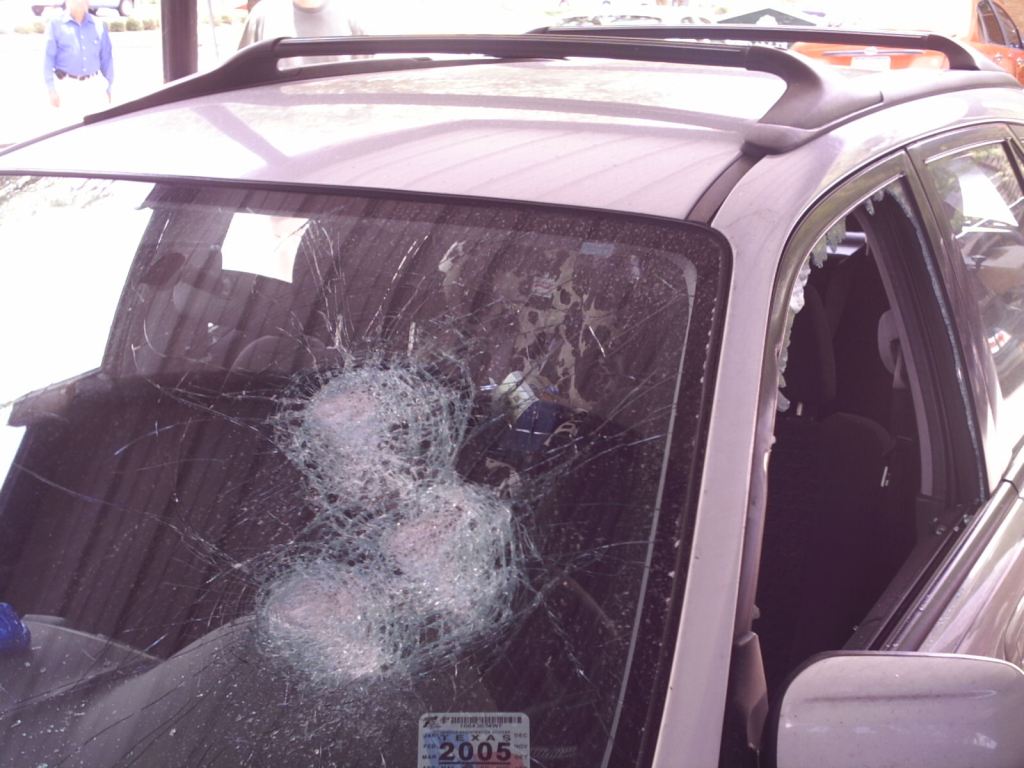
Motherfucker tossed a 10-pin bowling ball through neighbour Gord’s windshield by mistake there. August long weekend. I mean, motherfucker had every intention of tossing it through the windshield. Only Gord’s Aerostar wasn’t the intended target. Oh ya, motherfucker’d been drinking. Everybody was. Long weekend and all. No excuse. But what ya gonna do? Motherfucker figured buddy was stepping out with his ex. Probably was. But she’s free to do what she wants, right? 2020, baby. Live laugh love eh? So, buddy says something and motherfucker goes off. Fuckin right off, bud. Someone kept ‘em from fighting there out front of the Inn. Sent motherfucker packing one way, buddy stumbling back into the bar—thank Christ—or who knows what woulda happened. Remember last time? Anyways, motherfucker fucks off. Only, he’s back an hour later with the bowling ball. Dunno where he got it. No idea. Don’t wanna know. Gord, he was sleeping, passed out hard, at the time. Shitty news to wake up to. No fuckin doubt. He’s insured, though. Sure. But there’s your deductible right fucked. Nevermind explaining to insurance why motherfucker put a 10-pin bowling ball through the windshield and all. Gord’s still right pissed about it. Oh ya. Big time.
Sheldon Birnie is a writer, beer league hockey player, and father of two young children who lives in Winnipeg, Manitoba, Canada whose writing has appeared recently in BULL, Rejection Letters, Cowboy Jamboree, Riot Act, among others. Find him online @badguybirnie
I made it through. That’s the point of this story. Anything is possible. Perseverance and endurance are requirements. So is meeting a kind person. A helpful organization. Let me stop here and hit the rewind button.
January 2012
I’m fucking cold. Not it’s sort of chilly out. Not brrr or damn I need an extra layer. No, I’m talking bone cold. Your veins aren’t navigating the blood correctly. Your mind is a fucking ice block. Details: I’m in a parking garage. This is my current home. It’s connected to the courthouse. The temperature is in the teens. It’s early January in Ohio which means I’m freezing. I’m in the glass-encased stairwell, where it might be a couple of degrees higher than outside at best. I’m trying to sleep on concrete. I have no blanket, just a black peacoat which I received from a local church. Sleep is hard when you can’t get warm. And when you feel worthless. And alone. And scared. And suicidal because that’s always an option. It has to be when you have nothing, you are nothing. I fantasize about jumping off the top of the garage. Splat. Goodbye. My story over. Fade to black. But I didn’t actually jump or I wouldn’t be writing this. Let’s go a bit further back.
2009 – 2011
I’m a degenerate gambler. I love to bet the horses. And by love I mean the unconditional kind. Love gambling more than my children or why else would I spend every nickel to my name on a bet? Christmas gifts? Fuck that noise. Birthdays? A card with no cash. Everything else? I’m just a ghost at the track. A depressed ghost. A sick in the head ghost. A selfish piece of shit ghost. I am everything besides a good dad. I chase the dime instead of spending time with my tiny girl or older son. I care about nothing but exactas and trifectas and superfectas and longshots who are longshots for a reason. It’s a compulsion. I can’t stop nor do I truly want to. I sell my food stamp card to gamble. I con my mom out of money to gamble. I steal metal from factory dumpsters and sell it to a scrap yard for money to gamble. Like I said, chasing the dime, except the dime is an elusive rabbit and I’m an inefficient hunter. I’m awful at gambling because I honestly think I’m more intelligent than speed figures and breeding and past performances. I’ll chase that dime, that high until I land in a parking garage.
January 2012
I’m halfway asleep when I hear a car approaching. Headlights flash over my frozen body. Cops. Dammit. I get up and walk to the car. Two officers, but only one speaks. He’s young. He asked me what I was doing here and whatnot. I mumbled my usual bullshit answer and he eventually said something about we didn’t see you here. His way of saying go back to sleep, you’re not in trouble. I was relieved.
Roughly two hours later and another car approaching. I’m bathed in headlights again. Dammit. I get up and walk to the car. A familiar face, the young cop has returned in his personal vehicle. He has stuff for me. McDonald’s. A quarter pounder and fries. A gift certificate. Gloves and toboggan. A puzzle book and pen. I wanted to cry. I wanted to hug him. He told me about a place where I could get help, Transitional Living. He knew the woman who ran it, gave me her card and told me to call her tomorrow. He also said he was going to call her. This place helped the homeless and mentally ill. He knew I was in trouble and he went out of his way to intervene. An absolute saint. He pulled away and I tried to go back to sleep but couldn’t. I kept thinking about the kind and caring police officer. A good man. A good human. The opposite of me. I also thought about Transitional Living. Hope on a business card. I would eventually get in touch with them and start the long process of getting better. Years of therapy. A case manager who worked her ass off to transform me. Medication for depression. A new chapter began. A new me was born. I became a real dad again.
I made it through to the other side because of a young cop. Because of Transitional Living. Because I was resilient and wanted to change. I embraced it. This story ends with me in my own home, warm and cozy, writing about the past. And hope. Because hope is real. Clutch it like it’s a newborn and never let go. Hope saved me many moons ago. It can save you, too. You must believe in something you can’t see or touch but is always there.
—
Chris Milam lives in Middletown, Ohio. His stories have appeared in Jellyfish Review, X-R-A-Y, Lost Balloon, JMWW, Molotov Cocktail, and elsewhere, You can find him on Twitter @Blukris.Attachments area
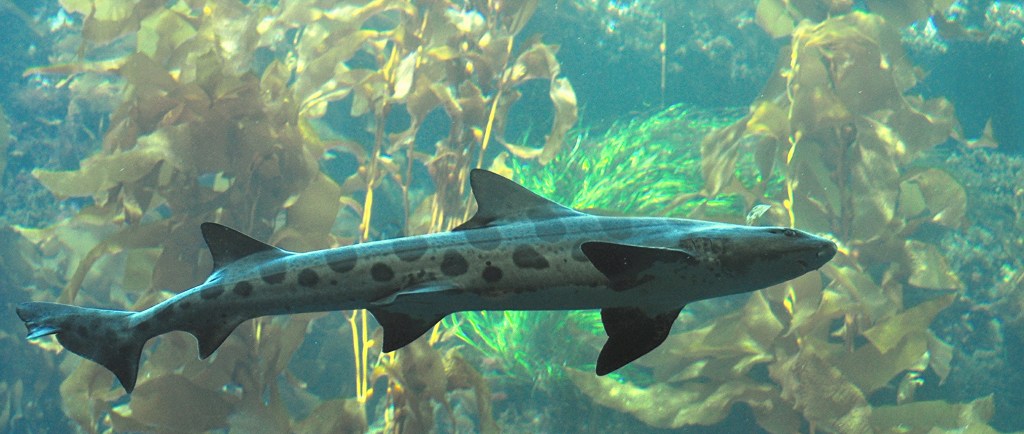
There is an Asian man on the subway He likes swimming with dog sharks I know this because I just overheard him He said this to his friend:
“I like swimming with dog sharks,” he said “It’s nice,” he said
I have never been swimming with dog sharks It is a regret I didn’t realize I had I don’t even know what a dog shark looks like I picture a German shepherd underwater It is gliding towards me with fangs exposed The dog shark has tiny fins and they are wagging frantically like so many tails
I should have asked the Asian man what dog sharks look like if only so I could picture them better and relay the details to you
If I was ever in the water with you and saw one I could say, “Look, there’s a dog shark” My knowledge of dog sharks would totally impress (I hope nobody asks any follow-up questions about dog sharks)
I guess I’ll just search “dog sharks” on the Internet but it’s not the same
I often eavesdrop—it’s something I can’t help but I’d never overheard anyone talking about dog sharks before So I really should have asked that Asian man on the subway
I should have asked him about dog sharks I think I would have learned something
Michael Crichton
I want to write the Jurassic Park of Great American Novels But I’m worried that might actually just be Jurassic Park
Library
I call the help lines on subway ads
Look for answers in phone books
I have an encyclopaedic knowledge of failure,
and I’m a glossary of defeat
What’s a synonym for all of this?
My life seems beyond definition
—only because nobody has come up
with terminology so bizarre,
vernacular so flawed
I read Web MD entries to satisfy my neurosis
There are sick plot twists in books
about the Bermuda Triangle
that I read as a kid
Josh Sherman does run the @iamdave_hello Twitter account.
light blowing through slatted bamboo | across faded carpet spottedwith reds | mustards | strands of pale pup fluff and shreds of shattered leaves | washing tides rolling and ebbing like the years of psychedelic trees inconsistent in design and direction independent of the moon
Leftover Beer
the last warm sip the next morning is even sweeter than golden nectar of dreamed up gods luring me again inside a predestined quicksand Wednesday by hungry overlapped voids unwilling to be shuttered unfed
Don’t Forget Breakfast
my nostrils flare & flap like dry gills suckling air unsettled with churning richness of butter- drenched popped corn sagging, stubborn, in its own congealment – salty, lip-puckering & liquified sunshine crème. or maybe it’s the peeled & boiled eggs I left in a foggy bowl next to the sulfur- dank sink, steam twisting, oblique, for the hills. I squeeze them between finger and thumb like plump cysts to be certain they’re ready and, pleased enough, I lock them away, droplets dangling, tucked roughly on a too-tight shelf that squeezes them like shackles on a beauty awaiting an unavoidable fate as the next scheduled snack for a giant, drooling ape.
Stephen Ground recently packed his life in his truck and drove to the centre of the continent, where he makes movies and writes poems about the weirdness in the air.
A few flakes still swirled down, danced on the nasty gusts of bitter wind that always flush city streets in winter. The parking garage across the street was dark, and most of the restaurants and bars had closed early because it was a weeknight, and cold.
I was catching a breath of air outside the Hyatt House in the Mosaic District of Fairfax outside Washington, DC. Probably I was trying to decide if I should walk a block or two to see if anything was still open, if it was worth it to brave the cold to eat alone, or go back up to my room and take the salad I bought at the fancy Super Target across the street, the one with the escalator, out of the mini fridge and finishing watching Beauty and the Beast.
Among the few stragglers on the street, there was a man smoking a cigarette outside the Hyatt who glanced at me once, twice, and made his way over.
Oh, here we go.
“Cold enough for you?” he asks.
“Yes.”
“From out of town? Here on business?”
“Yes.”
“Me, too. My name’s (insert name). I do sales. Travel a lot.”
Maybe his name was Larry. He looked like a Larry. I never remember names on the first or second go-round. Actually, I think he had a more surprising name, something hip or young, like Mike or Liam. He was a couple inches shorter than me, round beneath his expensive suit, probably 15 to 20 years older, bald with some graying hair around the edges.
“Yah. I travel all over. Been to Chicago, Grand Rapids, Dallas-Ft.Worth, and that’s just last month.”
“That’s fun.”
I waited to hear where this was going. It could be anything. It wasn’t that I automatically thought he was going to hit on me, although it was one possibility.
“Am I holding you up? Were you waiting on someone?” he asked, looking around like my phantom lover was about to appear. I looked, too.
“No. Just getting some air.”
He lit another cigarette, got a sad look in his eyes, kind of glanced across the street at the empty stores and sidewalks.
“So, yeah,” he said. “You travel all the time, kind of miss out on a lot. Aren’t always there for the family, wife and kids, you know?”
I thought of my own son at home, fending for himself for the first time, cooking ramen.
“Yeah.”
“My wife has to put up with a lot on her own, you know? See, my daughter, she’s had some problems…”
Ok. Stop. If I’m alone in this, it’s a curse.
In this case, it’s the fact that we are two travelers meeting in a strange city, alone. It’s the anonymity. He is never going to see me again. If I judge him for what he is about to say, it doesn’t matter much. I make a good stranger.
It’s part of the reason I avoid people. It’s also what will make me great at what I have come here to be trained to do. People ache to tell their stories. If you give them the chance, you don’t have to yank confessions like teeth. They just fall right out.
My card is The Fool. I’m just a weary wanderer stumbling through life, occasionally falling off cliffs. Somehow I come off like The High Priestess. I pick up my tramp sack and sling it over my shoulder, and it gets heavier all the time. I can’t set it down. It would leak secrets and those secrets are acid. They would eat a hole in the pavement right through the core of the earth. Maybe if someone could feel how heavy this pack is, they might carry it for a while.
There was a man who bought me a drink in a bar I used to frequent. I must’ve been about 19. He was quite a few under the table already. When I said I wouldn’t go out with him, he told me he just murdered his wife and buried her up off GA-400. His story turned out to be true. People tell me everything — people who’ve had things happen that never should have, people who have done things that you don’t ever want to know people actually do. People. The dark undercurrents of humanity flow like a cesspool into the steaming sewer called reality, while the citizens above walk the paradisiacal paved streets dressed in Armani and Louis Vuitton.
Every once in a while someone says or does something that shakes me to the core, something beautiful, innocent, surprising. Once in a blue moon. I never wanted to be this jaded. Every time a new dark secret gets added to my bag, I feel like I’ve been robbed of something else.
So the wind still bites and I’m sure Beauty has run to save her Beast from the villagers’ torches by now, and it’s kind of disappointing that he is actually a handsome prince when she was just getting used to the Beast.
The man standing beside me, Mike or Liam or Larry, blinks back tears because of his daughter’s battle with anorexia. If I were a better person, a more honest person, I would probably say exactly what I’m thinking which is maybe he should send her out to the bush because anorexia is a culture-induced entitled white girl problem and if she had to go survive on her own without attention or comfort or food for a few weeks she would be eating grub-worms quick enough and quit breaking her father’s heart. But, instead, I feel sorry that he is sorry, so I don’t say anything.
“You’re shivering,” he says. “Better get inside where it’s warm.”
I slip under the stainless white comforter in my suite and prepare to fall into a dreamless coma, wonder if there is anyone on earth who I could trust enough to tell my stories to.
Abigail Swire is just a wandering stranger, and only dangerous sometimes.





 Back Patio Press