“Cheap Fish” by Addison Reilly

4406368383_248b5684b1_o.jpg

I’m not really above it
like I like to think that I am –
I don’t ever put change in the
Salvation Army
buckets outside grocery stores,
Santa hats notwithstanding;
I’ll shoot a wasp
out of the air with a thick rope
of pesticide
for sport;
And I love the feeling of your
failure
because it makes me feel better.
But I’ve taken a moral stance
concerning the frogs.

You might never have seen the frogs.
I don’t see them in suburbs or the city
as much as I saw them in my hometown and all the little podunk cities
nearby.
But you’ve seen the cups of
solitary beta fish
at pet stores (cohabitation not advised)
and it’s the same idea.
They’re generally translucent,
long-fingered, webbed,
staring dumbly
in a plastic container with
nothing else
in it.
Totally still.
Until some jackass kid shakes the
plastic to-go universe they inhabit.
They scurry, nowhere to go
and then
eventually
settle back down.
Still.
Always.

Walmart.
$3.99.
Buy two get one free.

When I was a kid, I thought about
how boring that must be:
stuck in that see-through world.
How many frogs lived their
whole lives
there? Never finding an algae-frosted
home aquarium
replete with suckerfish and African cichlids
(the cheap fish).
But now that I’m older,
I don’t think that way.

I think about the horror.
Do frogs have that existential
terror of loneliness?
Of insignificance?
Of suffering so deep that
you can only detach and float away?
Ambivalent.
Amphibious.

I am afraid of the frogs.


Addison Reilly is a writer and ghostwriter based in Dallas. She received her Bachelor’s in Religious Studies from Southern Methodist University. Her writing has appeared in Black Horse Review and under various pseudonyms.

 

3 Poems by Josh Olsen

30327019160_a970719838_o.jpg

Road Trip

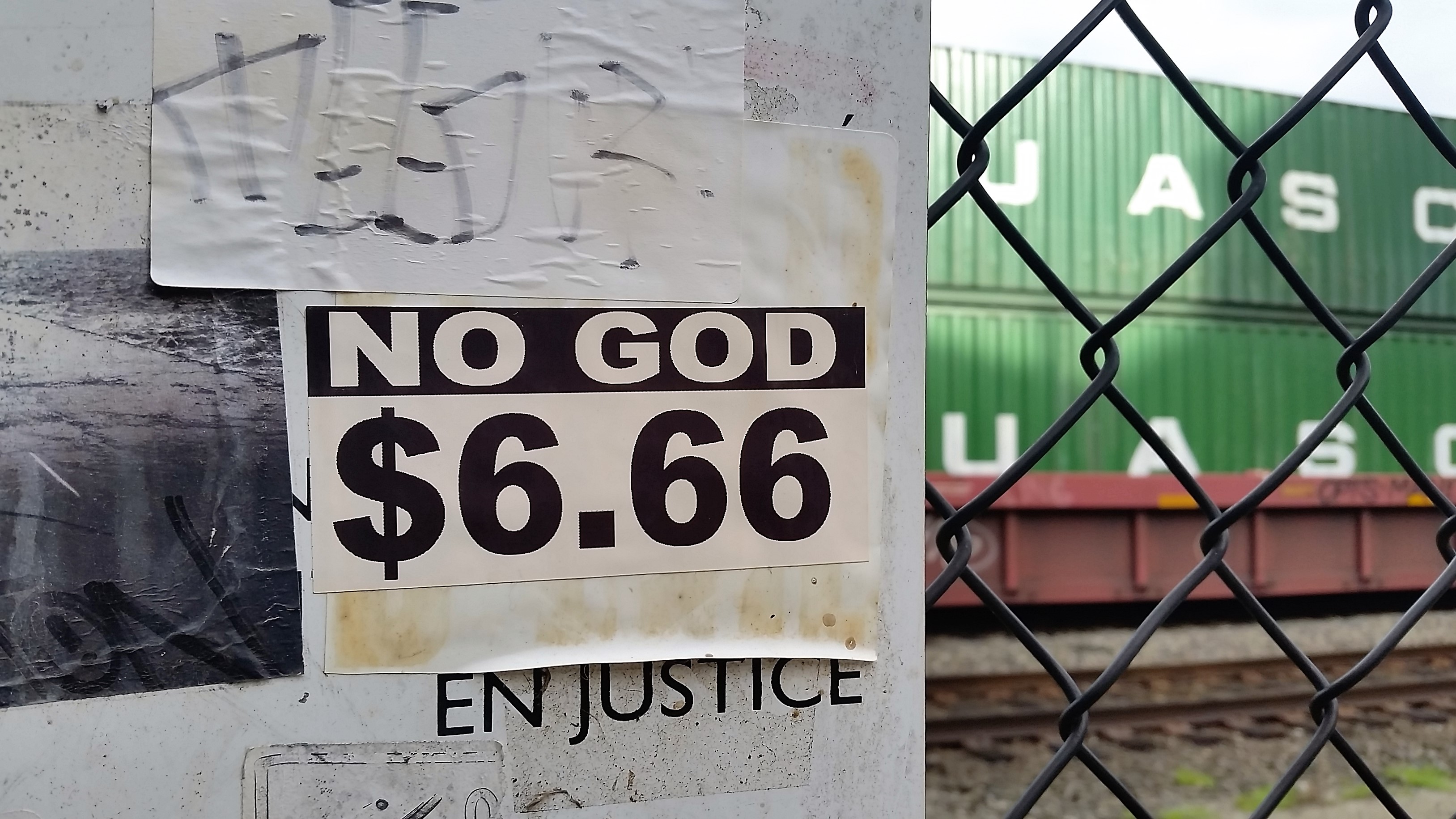
Gas station cashier
told me my change
was $6.66. 

I said,
“I hope that’s a sign
of good things
to come,” 

& he replied
with a hearty,
“Hail Satan.”


On the 5th Anniversary of Taking My Daughter to Warped Tour 2013

“Sell out … with me, oh yeah” – Reel Big Fish, “Sell Out”

I was informed at the gate that I wouldn’t need a ticket to enter, because I was accompanying my 14-year-old daughter, & several of her underage friends, so I tried to sell my extra ticket at the door & was almost immediately arrested for scalping, but thankfully, I was not apprehended, which allowed me the opportunity to witness a Stefan Struve doppelganger get knocked out cold in a parking lot moshpit fistfight, while Reel Big Fish covered A-Ha’s “Take On Me.”


the big rig ladder

[found/erasure poem]


some people weren’t cut out
to be cooped up

maybe you’re one of them 

you want to climb
the big rig ladder
know what it is like
to swing up into a big rig cab 

show it who’s boss
make those 855 cubic inches
of raw diesel power
behave 

tame them 

drive trains
transmissions
braking systems 

move on to the real thing 

three tough weeks
on the driving range
& on the road 

backing
docking
coupling
reverse serpentines 

then taking the big rigs out
on the interstate 

you got what it takes
to take on the big rigs?

if you want to climb
the big rig ladder
start with the pros

Source: Ryder Technical Institute mail-in advertisement, 1975


Josh Olsen is a librarian in Flint, Michigan and the co-creator of Gimmick Press.

3 Poems by Brian Rihlmann

1715332001_a1d157ad13_o.jpg
MOSTLY TRUE
Those two…you ever seen
the movie, “Waiting?” Or maybe
more like the real life Beavis and
Butthead…always together,
clowning around, hiding out back
passing a joint before and
after the dinner rush.

Well, one day T shows up by himself,
goes straight to the kitchen, and starts
doing his prep, all quiet and withdrawn.
So I ask someone, ‘Where’s M?”
“T shot him!” “What?”

But it was true—they’d gotten
hammered after work and were playing
around with a nine, and….well,
accidents happen.  But before long
M was back, showing us the hole where
the bullet had passed through the love
handle fat and missed every vital organ.

He held up his shirt proudly, as T
reached over and flicked at the
scar tissue with his finger, then
ran laughing out the back door,
throwing a trash can in his path.
M chased him, and we all laughed.


LIKE SOUP
It was 2009. Mid-recession.  I was
still blessed to have I job I hated.  My
neighbor was enduring the gauntlet of
I’ll-take-whatever-I-can get.  We stood
on our balconies, ten feet away from
each other, drinking tallboys.

“Man…I dunno if I can do this much longer.”
“What?” I asked, “The telemarketing?”
“Nah…I had to leave that.  They wanted me
to bully old ladies into buying their crappy
timeshares.  But this new gig…I’m picking
up bodies for a funeral service.  Last week
they found an old man, dead in his
bathtub for like a month.”

“Jesus!” I said. “What was that like?”
His face wrinkled as he lit up, took a drag,
and exhaling smoke, said—“Like soup.”


LIVING URNS
we sit around telling war stories
and watching a grainy VHS tape
of a show we played 20 years ago
while the twenty something kids
grin, and roll their eyes when we’re
not looking, and the grandkids
play air guitar and bang their little
heads in imitation of the guys onstage.
guys with less grey. guys who could
play half the night, and party til dawn.
guys who had life firmly by the balls. guys
who could get away with anything, who
stole the reaper’s scythe and ran away,
laughing, and was that us? a resemblance,
yes…but as the night lengthens, as we
stand in the driveway still talking after we’d
said goodnight two hours before…
(It’s almost midnight, and we’re tired!)
as I’m reminded of taking over a small
town, how we terrorized the locals,
how we arrived like barbarians at that
spot on the river yelling and pouring
beer over each other’s heads, how we
scaled the razor cliffs and jumped
50 feet into the icy green water below…
(just how drunk and high was I?)
as I’m reminded of this and other
crazy times I barely remember…
I’m not quite sure, though they
assure me it’s true. I love these guys…
they’re like the living urns for the
ashes of my immolated, completely
taken-for-granted youth.

Brian Rihlmann was born in New Jersey and currently resides in Reno, Nevada. He writes free verse poetry, and has been published in The Blue Nib, The American Journal of Poetry, Cajun Mutt Press, The Rye Whiskey Review, and others. His first poetry collection, “Ordinary Trauma,” (2019) was published by Alien Buddha Press.

“Bleach And Cats That Are Black” by Ryan Purcell

4464526587_a0f85a2428_o.jpg

I woke up with your black cat curled up dead on my feet.
The black cloud was over me and I pretended she was asleep
and nudged her away and went back to depression sleep.
When I woke up she was right where I left her so I took her to the trash freaking out and the furry weight and her empty food bowl made for a fucked up midnight morning.
I drank tall boys until the pharmacy at CVS opened
and bought syringes for my diabetic mother but the clerk and I both know that judgy bitch is healthy as an ox and needs no insulin.
She could use the sweets if anything.
If I shoot enough electricity
I can sanitize this 600 sq ft apartment with bleach
that’ll reek out the building and make
that witch that lingers in the hall ask me
“What the fuck is good with that bleach?”
And I’ll say
“Fuck off Juanita, I got no time for your shit.”
But I’ve got nothing but time.
And echoes.
It moves slow and black through me and I clean the outside because I can’t clean the inside and don’t even ask me what’s in the fridge.
I haven’t gotten to that yet.
Just don’t open it.
You’ll miss the smell of bleach.
Not all my compartments are hollow but we keep them separate.
I put water in the cats bowl then remember and leave it anyway cause fuck, I might have
nightmared it,
and I could’ve sworn I heard a meow two seconds ago.
The oven.
I should really clean that oven.


Ryan Purcell is a poet and writer from the New York Metropolitan area. He writes about heavy topics like depression and addiction with the light hand of someone that has walked through them and come out the other side. A decade of bartending and eavesdropping has given him a special interest in communication, language and their inherent breakdowns/limitations.

“Eyes Ahead” by Kim Kishbaugh

14652859380_67f85948f6_o.jpg
Past pitted buildings the boy tramps sidewalks by day
sandals padding hot pavement
loneliness icing his soul
he has learned to walk alert but calm
claim his space
look at no one
look away from no one
The dog that paces beside him
has no name
but has learned to wait for scraps
in exchange for the snarls she directs
at anyone not the boy
At night they bed together
mostly in silence


Kim Kishbaugh is a former journalist whose poetry has been published or is forthcoming at Escape into Life, goodbaad, Headline Poetry & Press, and Tiny Seed Literary Journal.
She wanders through the world looking for magic and sometimes finds it. You can find her on Twitter and Instagram: @kkish.

3 Poems by Stuart Buck

16234446574_30661f9e83_o.jpg


little ants

i am sorry that i used to collect you in matchboxes
in my pocket, far away from the rest of your family

i was young and had yet to discover how cold life can be
without the soft crawling of other bodies


little poem of hope

on my way to kill myself i met
a very friendly cat, so i turned around
we are all decomposing slowly
so that is of some comfort
we are all semen/blood/dying stars
so that is of some comfort


when i was young my mother told me i could choose the colour of the sky

so i chose invisible because i wanted to say hello to god but when the infinite is transparent you do not see god or the end of all things, you see yourself staring back and you are full, so very full of everything


STUART BUCK (HE/HIM)  is a visual artist and award-winning poet living in North Wales. His art has been featured in several journals, as well as gracing the covers of several books. His third poetry collection, Portrait of a Man on Fire, is forthcoming from Rhythm & Bones Press in November 2020. When he is not writing or reading poetry he likes to cook, juggle, and listen to music. He suffers terribly from tsundoku—the art of buying copious amounts of books that he will never read. 
Twitter: @stuartmbuck

2 Poems by Josh Sherman

how to tell stories to children.jpeg

HOW TO TELL STORIES TO CHILDREN

How to Tell Stories to Children
was originally published in 1905
Sara Cone Bryant wrote it

She was an author of children’s books

Sometimes I think my life is being written
by an author
of children’s books
like Sara Cone Bryant

Things are oversimplified
dogs play a disproportionate role in the plot
there is whimsy that just seems sad
to normative adults 

Anyway, you were reading
How to Tell Stories to Children
on April 19, 2017, around 9:45 p.m.
while riding the streetcar

Your pants were pea-green and wide-legged
Your hair brown-like blonde
You were probably an art-school student
Your major, probably conceptual

You’d just sat beside me
because there was an empty seat
But maybe also because I was reading
But maybe not because I was reading

The streetcar driver was a comedian—he asked
“What kind of room has no windows or doors?”
And right away you replied:
a mushroom

It wasn’t rehearsed at all
Your brain just worked like that
Nobody else had answered or even tried
Then you went back to How to Tell Stories to Children

I continued reading Landscape With Traveler
A novella by Barry Gifford published in 1980
I wanted to get to know your brain

I wanted to be a streetcar operator
But you got off at Dovercourt

And I took the streetcar to Lansdowne


BODEGA

I feel like sad corner-store fruit
I’m a little bit expired
I’m a little bit bruised
I wasn’t always like this
but it’s how I am now
You’ll find me beside the Lays chips

and the gummies
You’ll find me under unflattering light
You’ll find me at unexpected hours


Josh Sherman is a Toronto-based journalist with fiction previously published online in Hobart and in print in the Great Lakes Review.


Art by Julienne Bay

“Transmutation of Waste” by Leah Mueller

30466369651_9e13f73349_o.jpg

Recycling your IRS
pay or die letters
is an essential part
of being a good American. 

They were made from trees,
ground into pulp, flattened.
Emblazoned with words

like “forfeiture.” Sent
through the hands
of dutiful couriers
from the US government–

postal carriers in
year-round shorts,
sturdy men and women

who avoid your eyes
while they command
you to electro-sign
their sinister plastic devices.

Never keep these notices,
you don’t want your
friends to see them.

Don’t burn them,
it causes global warming.

Don’t throw them away,
they’ll end up in landfills.

Reuse the letters by
putting them in your
blue recycle bin

beside those spent bottles
of wine you couldn’t afford
but drank anyway.

The letter will leave
your hands and travel
to a facility for its revival.

Its smooth, mended surface
beckons false promise,
reincarnation as toilet paper
or perhaps a love letter.

Instead, it will be transformed
into yet another postal edition
of terrible news, since

nothing good ever comes
in the mail anymore.


Leah Mueller is an indie writer and spoken word performer from Tacoma, Washington. She has published books with numerous small presses. Her most recent volumes, “Misguided Behavior, Tales of Poor Life Choices” (Czykmate Press) and “Death and Heartbreak” (Weasel Press) were released in October, 2019. Leah’s work also appears in Blunderbuss, The Spectacle, Outlook Springs, Atticus Review, Your Impossible Voice, and other publications. She won honorable mention in the 2012 Wergle Flomp Humor Poetry contest. Her new chapbook, “Cocktails at Denny’s” was published by Alien Buddha Press in November, 2019.

3 Poems by Leah Mueller

25030385431_0035102cc9_o.jpg

Why You Won’t be Getting a Refund

Thanks for leaving
my rental house
trashed with your emotions.

You can’t have any of your
security deposit back. 

Those many ersatz moments
when you mentioned loving me
will all count as damages.

I’ve kept track of each one,
in case you want
an itemized report.

The carpet cleaning bill
from your meltdowns
was bad enough, 

but then you put your fist
through my window,
jumped into the yard
and took off running
before I could catch you
and hold you accountable.

Rest assured; I’ll make sure
I find you, even without
a forwarding address.

Meanwhile, I’ll take comfort
in knowing your reputation’s so poor
that even the landladies
in your hometown

would rather see you starve
then ever rent to you again.


Lullaby

Someday
you’ll understand

what it means,
and then you’ll forget:
like when the sun
comes out 

right before sundown:
brilliant half hour,
then darkness.

Sleep, and wait
for the next one.


Metastasis

One wish:
to go backwards

in time, and
stop the army

from invading
your skeleton

before it captured
your cells:

that wish
never granted,

your chance forever
blown into shrapnel,

scattered like
bits of detritus:

burnt sacrifice
to indifferent gods.


Leah Mueller is an indie writer and spoken word performer from Tacoma, Washington. She has published books with numerous small presses. Her most recent volumes, “Misguided Behavior, Tales of Poor Life Choices” (Czykmate Press) and “Death and Heartbreak” (Weasel Press) were released in October, 2019. Leah’s work also appears in Blunderbuss, The Spectacle, Outlook Springs, Atticus Review, Your Impossible Voice, and other publications. She won honorable mention in the 2012 Wergle Flomp Humor Poetry contest. Her new chapbook, “Cocktails at Denny’s” will be published by Alien Buddha Press in November, 2019.

“A Methodical Approach to Sleeping Alone” by Hallie Nowak

37996850565_399dd1a2cc_o.png

Step 1: Light a candle. Break some incense.

Step 2: Admire the pile of dirty clothes at the foot of your bed. (Look, but don’t touch.)

Step 3: Turn off the lights to hide the pile of dirty clothes at the foot of your bed.

Step 4: Sit down on your bed that is too big for just you and barely close your eyes.

Step 5: Remember the fingertip of the first snowflake of winter on your eyelash.

Step 6: Remember the time that you locked yourself out of your apartment on Christmas Eve.

Step 7: Forget that you’re alone.

Step 7: Forget that you’re alone.

Step 7.5: Remember that you’re alone under the swollen moon and the pinpricks of stars and the cold, clear voice of winter. Everything leaks through the hairline crack in your window. A breeze bursts against your sallow midriff.

Step 8: Pluck the petals from your skin and carefully stack them on the corner of your bedside table. Admire the way they wilt, that dusty scent of your loneliness.

Step 9: Are you alone,

Step 10: Brood about the way you squeeze the toothpaste the wrong way.

Step 9: Or are you lonely?

Step 11: Get out of bed. Check your dim reflection obsessively. Note the discoloration under your eye. Note that the discoloration under your eye is the ashen scarf tangled in the bare fingers of branch in Moody Park. 

Step 12: Stroke the sad subtle indent his body left in your memory foam mattress.

Step 13: Make yourself cry.

Step 14: Weep until you feel a spirit leave your gasping mouth. 

Step 15: Flip the damn pillow over.

Step 16: Remember that the human capacity for love is infinite. Remember to lock the door to your house. Remember that your roommate makes breakfast for dinner. Remember to watch for shadows of men in the street. Remember that IHOP is open 24/7. Remember to brush your teeth. Remember the inky kindness in your cat’s eye. Remember the warm breve latte in your hand at Old Crown. Remember to feel everything. Remember to feel nothing. Remember that you are a Scorpio. Remember that everyone is alone: that no body is alone.

Step 18: The snow outside the window collects onto the glass pane next to your bed. The portable heater says 79 degrees. Your loneliness collects thin shards of ice. Your bed is warm. Your pillow is cold. How beautiful it is to be warm in a room collecting snowbanks. How beautiful it is to be not lonely; to be completely and irrefutably alone: 

in dreams; in sleep; within; without; alone.


Hallie Nowak is a poet and artist writing and residing in Fort Wayne, Indiana, where she is in pursuit of her undergraduate degree in English at Purdue University Fort Wayne. She is the author of Girlblooded, a poetry chapbook (Dandelion Review, 2018). Her work can also be read in Anti-Heroin Chic, Honey & Lime, Okay Donkey, and Noble/Gas Qrtrly where her poem, “A Dissected Body Speaks,” was awarded runner-up for the 2018 Birdwhistle Prize. 

Twitter: @heyguysimhallie
Instagram: @hallie_nowak