Isn’t what you thought was how can I fake my own death when I am probably already dead?
(I found a great canary and he was so great in the faked-up backdrop with me…)
Maybe a fake death is more painful. You have to keep waking up to plan for it
Eulogy for A Great Canary
He couldn’t replace himself in a language famous for
making up mistakes. So he kept all of his receipts on the nightstand
wondering oh how yellow they get, and wrinkled.
You can’t return anything to what it was
no matter how fake it was trying to make it count.
Birdshit
I’m thinking the sky is one coat on a hanger.
In a closet? Don’t know.
What about these sequins in our fists like it meant
we would probably have ten billion mirages for an exit?
Laurie Welch earned an MFA in Poetry from the University of Nebraska. Her poems have appeared in LA Review, Forklift, Ohio, and others. She lives and teaches in Omaha.Attachments area
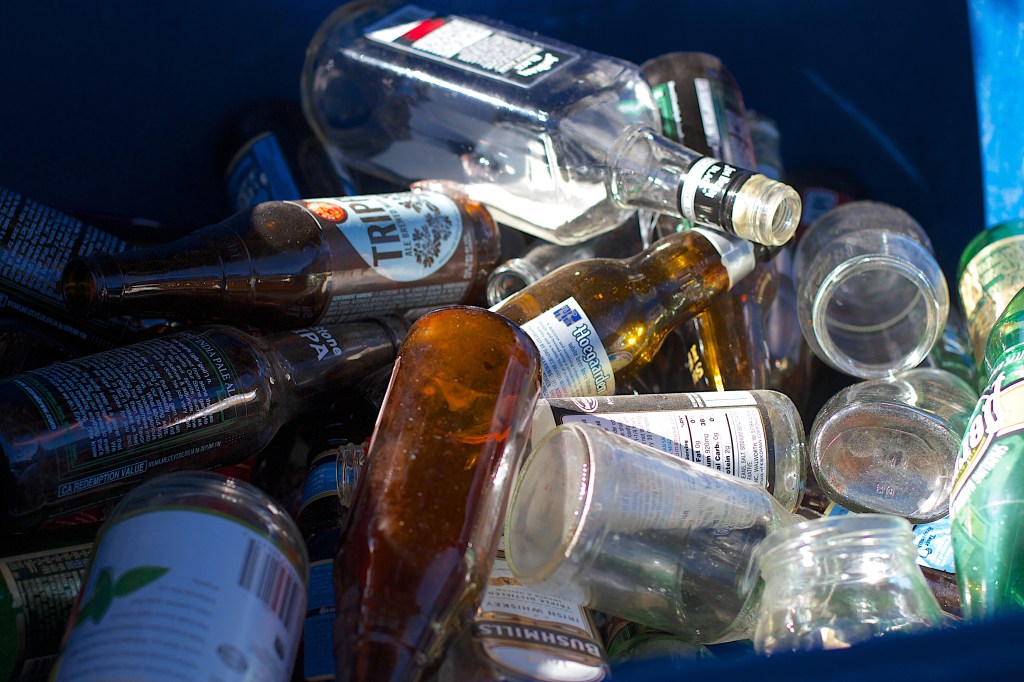
I honestly don’t know how my son wound up inside the redeemables deposit. I guess he climbed in while I wasn’t looking. He weighs about as much as a bag full of glass bottles, but I still would have noticed him synched up in that flimsy green plastic.
We ran out of the barcoded stickers that label the bags and scan to unlock the hatch, so I had no choice but to leave him inside the yeasty shipping crate. I crossed the parking lot, went into the grocery store, and printed out a new reel of tags from the kiosk.
When I got back, he’d torn through some of the flimsy plastic and had thrown recyclable material everywhere. He’d latched onto a Heineken can, tonguing whatever dribble was left in the rim, and his hands were sticky beyond belief, though that’s par for the course with my little condiment lover.
I scolded him a bit, just because we’re still working on boundaries, and then convinced him to tidy up as best he could. The virginal reel of white squares on its wax paper backing fluttered in my breast pocket just beneath my chin. It gave me the idea. While he was in there, he could make the most of it. Like fishes and loaves, our bounty miraculously multiplied.
“Just put these over the ones already on there. Cover ’em right up,” I instructed. His love for stickers came in handy. Usually a scarce good, I encouraged him to be liberal with them. Lining them up just right was good practice for his fine motor skills.
When I invited him to climb out, he protested. He was having too much fun, but I was getting paranoid so I retrieved him, maybe too hastily, because his tears attracted some looks, though nothing people weren’t used to ignoring.
A couple days later I went to check our balance. All those nickels really added up quick. It was tempting to withdraw it all, there were lots of places it could’ve wound up, but I found the self-restraint to leave it there to redeem against grocery bills. We ate good that week, worry free.
Then I got a call. My account had been flagged. They had my boy on camera. No mention of me, for some reason, but they’d tied the suspicious deposit to our usual Hannaford and figured it out from there. I considered denying it, but no plausible alternative explanation presented itself to me in time.
I agreed to repay them, or rather, I had no choice but to wave goodbye to what remained of the credit on my account. They revoked my program membership, and took down my son’s name to proactively ban him from their system. Fraud is such a harsh word, it sounds so deliberate and nefarious.
My bottle deposit days of convenience are over; we’re back to Redemption on Forest where the proprietor levies an unofficial tax, pilfering odd containers on the grounds that they’ll clog his machines. It’s low-tech, but the human element keeps it interesting. Probably more efficient than the corporate surveillance at the other place, but my son keeps finding ways to wind up places he shouldn’t be. We always make the most of things.
Crow Jonah Norlander lives in Maine with his wife, child, and two retired racing greyhounds.
I don’t like the sound of it. “Group interview.” But I need a job. It’s getting pathetic. I’m living off a credit card and the very little money I have saved. Money I made working back home in Arizona and money my father gave me right before I moved here, in the hopes I’d make something of myself. What I’m saying is, I’m broke. Useless. And still pretty soft. I looked online, using my neighbor’s internet, and found that a movie theater not far from me is hiring. I sent over a resume and the manager responded a few hours later, telling me to come in tomorrow for a group interview. And the first thing that goes through my head is NO. I’m not ready. Can’t handle groups, let alone group interviews. I don’t even know what they are. Am I to become part of a group, or are they? I type it in on my computer and read and read and read, preparing. If I know what to expect, then I have a chance. My favorite article that I find is called “How to Nail a Group Interview: Tips, Questions, and Work Simulation Exercises”. I study it. I let it become part of me. I read it again and again until I know every question by heart.
“How do you work in a team?” I grew up playing sports, so I am very comfortable with the concept. I live and breathe for the team. I love the team. I am the team and the team is I.
“If one of your team members asked you for help with their work, before you are done with your own, how would you react?” Fuck yeah. You need me to sweep the floor? I’ll sweep. I’ll pick that popcorn up with my bare hands. I’ll slurp that nacho cheese right up. You need help with the bathroom? On it. One of the urinals broken? Easy. I’m the new urinal. For the team, I will serve as a human urinal.
“What is your biggest weakness?” Well, sir, I’ve got to be honest here. I am too hard on myself. A perfectionist.
“Why do you want this job?” Ah! I’m glad you asked. One word: Film. I have been a student and lover of film my whole life. Just to be close to it — the magic, the prestige and pageantry — it would be an honor.
And I’m still playing it all in my head over and over as I walk to the interview the next day. I’m wearing my best t-shirt and my hair is combed back. I look like an asshole. Hopefully though, an asshole with a job. I can see the movie theater ahead of me and a mixture of hope and sickness fills my head like cold wet fingers pushing in through my ears. Employment. Responsibility. Money. I look down at myself, run my hands through my hair, inhaling that magical Californian air, and cross the street toward my destiny. Ahead of me, a young man in a tucked-in button-down shirt is walking in to the theater. He’s college age, my age, but he looks younger than me somehow, more alive. I watch him as he talks with an employee, smiling confidently, thanking the employee by putting his hands together and bowing slightly. Then I watch as he walks through a door next to the snack bar. He’s here for the group interview. He’s my competition. And I think, good. If it were easy, I wouldn’t want it. Someone once told me that men are like sharks, that when they stop moving and competing, they die. And I am (essentially) a man. A shark. A competitor. When I get closer to the theater door, I see my reflection. My nicest shirt isn’t so nice and my eyes are sunken in and red and there is a big juicy pimple in the center of my forehead—couldn’t be more symmetrical, pulsing and ready to explode on my fellow interviewees, so noticeable I feel like I’d have to address it. But that’s okay. I’ve done my research. I can do this. I walk in and head for the door the nicely dressed young man went through. As I pass the snack bar, I can hear two employees talking. They’re saying something about the actress in some new movie. “If I was that hot,” one of them says, “I’d be in movies too.” “Yeah, like, she’s not even a good actress!” “Fucking lucky bitch.” “Exactly. It’s all luck,” the other says. And I start to feel physically ill. The voices of the employees seem really sharp. The smell of stale popcorn is all around me. The floor is sticky and my shoes are making a crunching sound as they rip away from the soda-soaked tile. My mind starts to drift off. The confidence is fleeing along with it. And for some reason my whole body feels hot and starts moving on its own. I’m walking out the door and then I’m on my way home and then I am home and then I’m on the phone with Fresh asking if we can meet up. I find myself in an alleyway behind a smoke shop. Fresh appears and he takes the cigarettes out of my shirt pocket and lights one, then sticks a small bag in the cigarette carton and hands it back to me. I realize it’s my turn so I take out the money from my pocket and we slap hands and bump chests. He says, “later bruh bruh” and then I walk home with the image of the nicely dressed young man smirking at me, like he knows something that I don’t and never will.
T.J. Larkey lives in Arizona. He is doing much better now. Also his name really is T.J. He has been called that his whole life. It’s not abbreviated to hide something dorky like Timothy.
What Would Happen If The Speed of Light Simply Changed
I knew the speed of light had slowed down to a snail’s pace when I looked across the street. The people I saw on the other side were from weeks ago. I knew it when I looked down at what I was eating and saw breakfast, even though I was actually eating dinner. I knew it when I first laid eyes on my true love, even though our children were already born.
[Unfinished]
Every morning, I’d ask this barista how he was, and he’d always say the same thing — “I’m here.” Then one day, he wasn’t. That was years ago. But I still think about that guy, all the time.
What We Can Learn from The Death of Mr McKenna
They found my old high school history teacher, Mr McKenna, dead behind a bookcase in his home. Neighbours had complained about the smell.
I looked into his cause of death. Apparently if you drop something behind a bookcase or a wardrobe, you should never lean into the small gap between it and the wall to retrieve it. If you lose your balance, you might get stuck. If nobody finds you, you might die. Apparently, this is very much a thing.
Instead, move the bookcase or wardrobe first. It might be a bit of a pain, but then again, so is slowly dying alone.
I don’t remember many lessons from school. Only those from Mr McKenna’s. I remember him spending a whole afternoon convincing us ‘however’ and ‘therefore’ are two of the most powerful words in the English language, and we should always consider using them in any conclusion to any essay. I remember someone asking him what the point in learning history was. He told us, amongst many other things, history presents us with an opportunity to learn from our mistakes of the past.
It must have been awful for Mr McKenna. All alone, lodged against a wall as his last breaths left his body. The bookcase that killed him must have been stacked with so much amazing literature. Books about wars, scandals, revolutions, migrations, all kinds of hardship. In all those pages, I bet there was nothing warning about the potential perils of getting stuck behind a bookcase. Maybe if there was, he’d still be alive today. These words are going to be in a book. These very words, right here.
Maybe this book won’t stop any wars. However, maybe it will end up on someone else’s bookcase. Maybe when that person gets old and they live alone, they won’t die stuck behind it as a result. Therefore, these words about Mr McKenna’s death would have saved someone’s life.
I think Mr McKenna would have liked that.
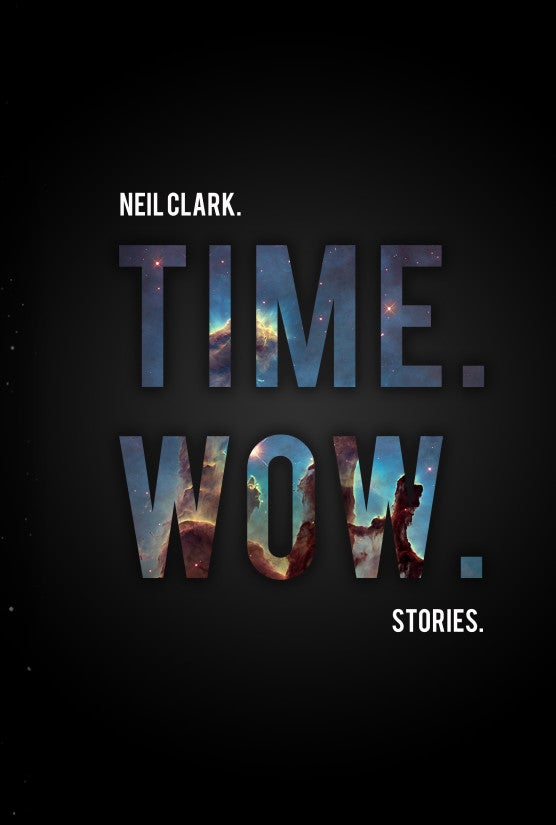
“Time. Wow.” is available for pre-order and will be released on October 15th, for more details please visit: https://backpatiopress.bigcartel.com
Neil Clark has been nominated for Best of the Net, Best Small Fictions anthologies, as well as longlisted for both the Wigleaf Top Fifty and Bath Flash Fiction award. His work was included in the Best British and Irish Flash Fiction of the Year 2019/20. His debut flash fiction collection is now available from Back Patio Press.
After getting paid, Goya drives to Walmart hoping to purchase a gun and spending an hour looking at guns and picking one out and filling out all the necessary paperwork and handing her background check to the clerk.
“So, it will take a week for the background check to process?” Goya asks the clerk.
The clerk turns the forms to read them, and he makes little reading sounds under his mustache, and his eyes go back and forth across the paper, and he breathes a deep breath in to his mouth and out through his nose.
“I can tell you right now that it probably won’t pass,” he says, turning the form around and pointing to a checked check box that reads, I have been diagnosed with a mental illness. “They cannot sell guns to people who have been diagnosed with certain mental illnesses.”
“Okay,” she says, taking the paper from him and walking through the parking lot to her car and driving down the highway and pulling into the parking lot of a different Walmart and filling out another background check without checking the box called, I have been diagnosed with a mental illness.
▲▲▼▲▲
As Goya tells David about how she wants to buy a gun, he imagines Goya accidentally shooting him through the wall between their rooms.
The sequence of hazy mental images starts where he can visualize both of their rooms at once. Goya is in a nightgown, and it has a geometric-shape print. The shapes are fluorescent yellow and fluorescent orange. She holds some hand cannon. He stands up to put his pants on or something banal. Her room fills with smoke. The images cut to where the point of view is behind the bullet. Everything is in slow motion. His daydream follows the bullet to his brain. His body falls away. It reveals blood splattered on the wall behind him.
David focuses on the red liquid, and the blood on the wall in his mind becomes the pasta sauce he is gazing at. The room tone takes on a dead-channel quality. The buzz sits on top of all other sounds in the room.
IIRRRR
David squints. He feels nauseous. He moves a wooden spoon in the pasta sauce. It pushes chunks of vegetables around in the red liquid. Goya watches him.
IRRRRRRRR
The dead-channel tone reaches its highest point of tension.
“Smells good,” Goya says.
“Thanks,” David says.
She laughs. He cannot figure out why she laughed.
“Have you ever shot a gun?” she asks.
He focuses on her briefly. He goes back to watching the pan, and the sauce boils, and he leans over, and he checks the size of the flame, and the flame has fingers, and the flame fingers pulse.
“Blanks for some films I worked on in college,” he says. “Why?”
“I don’t know, like… I’ve never shot a gun, but I’ve been wanting to for a long time.”
She brushes her hair out of her face. She pulls herself up to sit on the countertop.
“…”
“I led some generic-type guy on for months because he kept saying he would take me to shoot guns,” Goya says. “We broke up, because it was like… never going to happen.”
“…”
“We would just play chess all the time, and I never won,” Goya says. She is starting to digress.
“Months,” David says. “That seems committed. That seems quite committed. I think you can just go to a range and shoot pictures of people with rented guns.”
“I feel like I am really good at chess. I must not be because I never win,” she says in the digression.
“…”
“Yeah… well, a shooting range doesn’t seem very meaningful,” she says.
“I feel like I am good at chess because I beat someone with a chess tattoo,” he says following the digression.
She laughs. David laughs. They laugh for different reasons.
“…”
“Not sure if I look for emotional significance in a shooting experience.” David walks away from the stove. He gets the colander ready. He gets something else ready.
“That’s unbelievable to deal with,” she says.
“…”
“But you’re not looking for a shooting experience, David.” The sauce begins to bubble, and Goya turns the stove off for David. “This is important to me.”
“I would only get a gun to live out some following-in-William-S.-Burroughs’-footsteps bullshit.”
“That seems meaningful.”
“Yeah, I need to get a gun,” he says. He continues in a nasally, William S. Burroughs voice, “Time for our William Tell routine.” He mimes placing an apple on his head, and he bites his lip as though placing the idea of the apple with care, and Goya holds some invisible hand cannon, and she takes the idea of the apple in her sights, and she fakes recoiling with its implied kickback, and he moves his hand behind his head as though his brains were being splattered on the wall behind him, as though Goya just shot him in the face.
“…”
“Or whatever.”
“I’ve been thinking about purchasing a gun, but I just feel like… it is not a good idea. Seems like a joke that turns out not to be funny. Like joining a cult.”
●█●●█●
With a magazine over her face is Goya lying on the couch. There is supermodel wearing deconstructed jeans on the cover with a featured article about the You’re Worth It campaign. A little light leaks between the magazine and her face. It illuminates images, but they are too close to focus on. Fluorescent colors are on trend. Out-of-focus fluorescent colors fill her entire field of view. When she breathes out, the pages curl and crinkle. She holds the sound of crinkling paper in her thoughts, distinct like a sound effect for a film. Crinkling paper becomes her favorite sound. She can conjure this sound at any moment in her thoughts, and again she conjures the sound in her mind, and she breathes out, creating the sound with the magazine.
CREAK KUNK
As Hunter walks in, the first thing he sees is Goya on the couch sleeping, snoring quiet breaths, making tiny crinkling sounds. He leans his skateboard against the couch, of course it makes a scraping sound as it begins falling, his hand reaching out towards the skateboard, the skateboard staying just out of his reach.
THWACK
The skateboard smacks into the hardwood floor. He picks up the skateboard. Maybe, somehow, Goya slept through it. Goya lays still with the magazine over her face, so Hunter begins walking toward his room.
“Err,” Goya says through the magazine.
Hunter brushes his long, black hair out of his face revealing his sparse mustache, and he says, “Sorry for waking you.”
Goya does not respond, not moving, not speaking.
“…”
Hunter starts to walk away.
“Hunter,” Goya says. “What’s your favorite sound?”
He pauses and turns around, and he says, “Umm,” and brushes his hair out of his face again. “Something frying in a skillet.” He laughs.
She smiles beneath the magazine.
“…”
“…”
“What’s yours?”
“I think mine is crinkling paper.”
Goya comes up behind David. She stares a getting-someone’s-attention stare at him. David stops focusing on his phone. He scans the room. Every horizontal surface has beer cans on it.
“Hunter and I are walking to the bluffs,” Goya says.
She asks if he would like to come with. He agrees. He grabs his camera. They walk toward the bluffs. Their neighborhood is close to downtown, and most of the homes are standalone, and they have small, unkempt yards. The neighborhood is mostly impoverished households, and the occasional new home with a manicured yard stands out. A passerby nods at them. Hunter and David and Goya wave. Another passerby yells at them from across the street to ask for a cigarette.
“Sorry,” Hunter says.
“Fuck you,” the passerby says.
“…”
They walk between some houses to the bluffs. Hunter and David and Goya sit. Their breath vaporizes. They cannot distinguish between cigarette smoke and their breath. They look through the vaporized breath at the distant mountain. It is snow capped, and it vomits a jagged forest into polluted waters below.
“Can I bum a smoke?” Hunter asks.
David is the only one with any cigarettes left. He sets his camera down. He reaches into his pocket. He pulls a pack of cigarettes out. The pack is black, and it is beaten up, and all the cigarettes are bent. David opens the pack. He hands it to Hunter. Hunter pulls one out. He lights the cigarette. He hands the pack back. David places the pack beside his camera. He leaves the lid open as if to say, They’re fair game.
Vaguely in David’s direction, Goya touches her mouth with a soft touch and a distracted gaze. She reaches out, grabbing the camera and bringing it to her face and pointing it at David. His hands cover his face. He makes an anxious expression behind them.
Hunter’s eyes shift from David to Goya and back to David.
CLICK
The camera flashes. As Goya pulls the camera away from her face, David pulls his hands away from his face, and they reveal their faces almost in unison.
“Did you get it?” David asks.
“…”
“…”
“…”
Goya smiles as she sets the camera down, and they go back to looking at the view from the bluffs. “I think we’ve found it,” Goya says.
“…”
“…”
“Found what?” David asks, and he believes he already understands, but he asks in hopes of hearing her speak. He hopes she will speak romantically. He hopes she will speak romantically about this moment.
“I wish I hadn’t said that… seems silly now,” Goya says.
“…”
“I don’t know… like that intersection of comfort and novelty and connection with the people around you.”
“It seems nice,” David says, and he may have destroyed the sentiment by acknowledging it. Hunter and David and Goya sit quietly for a while.
Everything slows down, and they never realize how slow they live.
“Numbskull” is available for pre-order and will be released on October 15th, for more details please visit: https://backpatiopress.bigcartel.com
No Glykon is a writer, designer, and musician based out of Providence, RI. They are stretched upon the plain and covering some nine acres of ground. Two vultures on either side of them are digging their beaks into their liver, and No Glykon keeps on trying to beat them off with their hands, but cannot.
In the backyard of Mickey’s house I snorted 2 lines of cocaine cut with 20mg of Adderall through a duct-taped straw.
I could have gummed it. Dipped my finger in the baggie and rubbed in my mouth. My nostrils were crusty trellises of rocky mucus, but my septum hadn’t collapsed yet. I was leaning on a warped wooden fence watching Mickey bend his neck over the encyclopedia to take the last two hits.
Mickey and I met when he was a barback at Champion’s. While he worked and I drank we talked about chess and which books we liked. He had a tattoo of a snake inside his right ear, and would invite me to hang out at his place after the bar closed. He didn’t have a car, and while I was looking for a place to stay, he let me sleep on his couch if I drove him to work.
I watched the clouds split in twos, threes, and fours. I wiped my nose. It was cold outside. I forgot my lumberjack coat at home. Mickey and I sat in his plastic green patio chairs drinking and smoking unfiltered Lucky Strikes. We listened carefully to the birds violently fuck each other in the trees above us and grinned.
Sounds like they’re doing it doggie style, Mickey said.
What kind of birds you think they are?
Probably robins. Or it could be owls.
How are you feeling?
I’m feeling fine. I could be higher though.
Me too.
What’s the hardest thing you’ve ever done?
I’ve smoked meth a few times.
He looked shocked.
His shock was shocking.
I assumed he’d done everything.
He asked if I could tell him the story and I told him it wasn’t worth talking about because it wasn’t that interesting.
He said, I don’t know why, but I respect meth.
I respect good meth.
He asked if I knew anyone holding.
I told him I knew someone.
While birds fucked their tiny brains out we walked inside and played dice for hours. He won and I won and he won and I won until I said, Let’s go get some meth.
My car leaked oil and was prone to overheating. Backing out his driveway I caught a glimpse of the small puddle left on the pavement, and the dotted trail that would follow us. Mickey sat in the passenger seat looking out the window not saying anything. Around his feet were crushed-up fast food bags, old french fries, ketchup packets, books, a red lighter, two water bottles, two smoked joints, and loose change that added up to around $1.50. He was uncomfortable.
I pulled into a gas station to fill up the tank, and Mickey went in to piss. I texted Torie we were on the way, and she replied to meet her in the back. I took the pump out of the tank, and Mickey came out carrying a bag of sunflower seeds.
We got in the car and he asked where he could spit his seeds.
I told him to use the dixie cup in the holder.
He was throwing in at least ten seeds at a time, and spitting them out in the little paper cup. Down the road, when he was halfway through the bag, we passed a couple on the shoulder. They were arguing next to their broken down truck.
I asked Mickey, Isn’t that your neighbors?
He crouched in his seat so they wouldn’t see him.
Yeah, they’re friends with my parents.
She’s hot, I said.
I know.
Smoke was coming out their hood. Further away I looked in the mirror and saw a small flame where the couple had been. Mickey kept looking back at it, and I asked if he brought enough cash.
We drove to the bar Torie was working at and waited in the neighborhood near the back entrance. Torie walked towards us. She looked around the car. Behind her. She took out her hair net and got in the back seat. Mickey’s knuckle hair stood in dark rows while his hands shook in his lap. His face was pushing oils through his open pores.
Supp fags? Torie said as she leaned in between us. She smelled like hamburger grease.
Torie, this is my friend Mickey.
Hey Mickey. Any friend of Charlie’s is a friend of mine. She put her hand out for Mickey to shake.
Mickey hawked his seeds into the dixie cup, and put it in the center console to shake hands. Charlie said you sell meth? Where’d you get it from? Is it strong? He shifted in his seat, the trash at his feet sifted and rustled.
Slow down I just got off work. Torie pulled the pipe and a tinfoil ball out of her leather dope kit.
I said, Calm down Mickey. We’re going to smoke meth. It’s cool.
I put on my ambient playlist for Mickey.
Yeah. Meth is cool, Torie said.
Listen to these calm ocean sounds.
Turn that up, Torie said, Was that a fucking dolphin?
I’d fuck to this. This is some good shit.
Torie handed me the pipe and I held the flame underneath the bowl. Once the inside became opaque I inhaled and handed it to Mickey. He pressed the pipe to his lips, closed his eyes, and inhaled everything he had. The moment where the drugs are inseparable from the user. Twins at the pipe. His eyes closed. The meth entered his system. The pipe was holding him. He was entering its system. He handed the pipe back to Torie.
She smoked like a professional. Nothing sensational, but no less charming. She smoked like an athlete who never stumbles a play. Torie swayed her shoulders to the waves crashing, keeping time. I have a deep respect for people who do things with precision.
Torie laid back in the leather upholstery. Hit this real quick.
The nylon fell from the ceiling into the blue and green dixie cup filled with Mickey’s spit and sunflower seeds.
I hit it really quick. The waves kept crashing.
People walked out the bar with my lips still on the pipe. They walked towards the car, but couldn’t walk past. More people were around the car. Walking in place. Bumping into the car and into each other. At least 3 rows of people around the car walking in place like cadets. Beautiful, repulsive, vague, and blank. No one looked inside. We were invisible to them. I flashed my lights and they were gone.
Mickey, it was a real fucking pleasure. Torie said goodbye, hit him on the shoulder, and left.
Mickey was slumped so low in his seat his knees were in the trash. He looked at me, scrunched up with ketchup all over his jeans. I was too fucked up to drive, but not worried. We sat there awhile, riding with the dolphins. When it got darker, and I felt good to go, I turned the car on to take us home.
The music kept looping, pumping, but everything was still. Mickey sat up before we got to the burning truck we had passed before. He told me to slow down.
He said, I want to see what happened.
I parked next to what was left. Even with the windows up I could still smell the burnt tires and charred frame.
I’m getting out, Mickey said.
I stayed inside, watching Mickey walk towards the truck. He looked around, inspecting the remains. He put his fingers through every crack and crevice. While I watched him put his hands around the destroyed thing, I let the high and the ocean sounds take me to another place. I wondered if he could hear the music from my car, or if he was imagining what the fire sounded like before it went out.
He opened the door and got in the front seat. When he got out and walked back, he was holding onto something.
He got in and he showed me: it was a blank cd with nothing written on it. I wanted something to remember, he said.
He put it in the player, and nothing came out of the speakers.
We drove home in silence.
We walked through the open door of his house. We sat on the couch facing his TV. The Simpsons played. Mickey stared at the screen.
My eyes shifted, then I fixated on a crack in a ceiling I hadn’t noticed before. A brown roach crawled out its side.
I got up to step outside, and Mickey looked at me and said I’m glad to be alive. I nodded, and I sat on his front porch alone.
Far away, behind the houses across the street, the bright red tower crane lights bled in the soft blue twilight.
All dirt and no sand here in Nebraska. The Sandhills are a lie. The cranes are retired drones looking for Florida.
The beach here is freshly tilled. Any moment a farmer could come through with a sack of seed and plant next year’s mutant, nudge it good night with his boot. The lake (we’ll call it a lake) is a cloud of dirt and sky and urinary relief.
To best enjoy the dirtiest beach in America, I suggest at least 70 beers and a pinky sip of tequila every time a train barrels by. The train, of course, is just twenty paces from camp and thunders by several times an hour. We had to split ourselves into tequila teams so we wouldn’t quit. We’re not quitters. We are scum. We are cute.
Lincoln on a Map
Google Maps locates Lincoln at the doorstep of O’Rourkes, a beloved downtown bar and second home to two generations. Me and my Dad.
O’Rourkes got my Dad pregnant. He’s had Rosemary’s Baby brewing inside him for 25 years. As old as me. He’s finally growing some breasts to feed the babe.
It’s eating him from the inside, that much I know. Just yesterday he called to say it claimed one of his kidneys.
O’Rourkes got my Dad and now its getting me. I’m alone with a $7 pitcher and a notebook. My friends are on the way.
—
Connor Goodwin is a writer and critic from Lincoln, Nebraska. Other writing has appeared in The Atlantic, the Washington Post, MEL, Hobart and elsewhere.
After looking at the Hart Crane memorial sculpture,
I vomited into the Cuyahoga River
because I had too much cannoli at Sainato’s.
Even with a broken foot, I climbed Brandywine trails
to look down upon boulders the size of Megalodon skulls,
which are landscaping rust belt conservation areas.
One of my worst fears
is being too faint of heart,
in regards to myself.
A raccoon scuttered into pink shrubbery. It can feel the rain without getting wet.
I need the same ancient intuition, like Emersonian ink being a lifestyle of velvet darkness.





 Back Patio Press