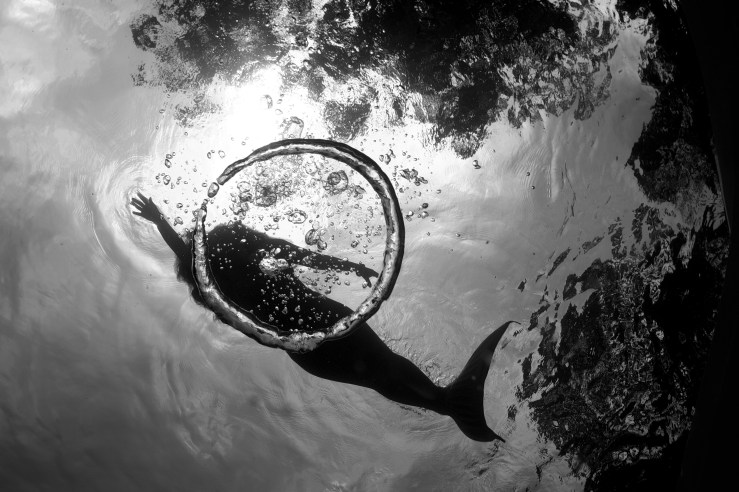
“Mermaid by the New Moon” by Rick White

17074517078_b087ec1841_o.jpg


The operation went well. No reason why it shouldn’t have, it was all routine stuff. But the sight of you in your hospital bed still freaks me out.

The morphine has hit you pretty hard and when you come round you say some weird stuff about a nurse with no teeth – I haven’t seen her anywhere.

In the bed, wearing your hospital gown, you look tiny. Except for your long blonde hair which is wild like always, spread right across the pillow and cascading down over your shoulders.

For some reason I think you look like a mermaid who’s been brought to shore but cannot possibly survive.

‘Take her back, she needs to go back to the sea!’ I want to shout at the non-existent, toothless nurse.

I’m used to you communicating without words. So I know that the little point you’re doing means you want a sip of your ice-water. I hold the straw to your lips while you take a drink, then you whisper, ‘thank you’ before slipping back down into the warm, gooey morphine.

It’s almost time for me to leave. Visiting hours are over and it’s dark outside, you need to sleep.

I start to think about my Granny – Granny Eileen. She had a million different superstitions that she always swore by and I always think of them whenever I’m praying for someone to be safe.

‘If you’re ever bitten by a dog – you need to put the dog’s hair on the bite or it won’t heal.’ That’s the one that always comes to mind because it took me years to realise that is actually where the expression, ‘Hair of the dog that bit you.’ comes from. Or maybe it isn’t, maybe that one really is just a metaphor for drinking alcohol and Granny made the mistake of taking it literally.

Why, having been bitten by a dog, would anyone then want to chase the dog and attempt to shave it?

Nevertheless my Uncle swears blind that this actually did happen. As a child he was bitten by the neighbour’s dog and sure enough, Granny Eileen went round, shaved some of the dog’s hair and sellotaped it on to my Uncle’s wound.

If that was true I’m sure he would’ve ended up with tetanus or something but I can picture my Granny in the hospital assuring the doctors that this was absolutely the right course of action to take.

A nurse comes in to your room and dims the light, that is my cue to leave.

‘I’ll be back tomorrow to pick you up.’ I say. But I’m not sure if you hear me, you’re fast asleep, mermaid hair overflowing. Condensation trickles down the glass of ice-water on your bedside table. I hope that you can reach it if you need it.

When I step outside the hospital the cold air takes my breath away.

Suddenly I’m on a motorway bridge, the one we had to cross if we ever wanted to go to the shops when we were kids. Granny Eileen took us one night, a night just like this one and she stopped dead in her tracks as though something had startled her. Then she took out her purse.

‘If it’s a new moon, you must always turn your money over.’

She took some silver coins from her purse and handed them to me, told me to put them in my pocket and then turn them over. I think that one’s supposed to make your money grow, although it never did.

I think of it now though, standing in the freezing cold hospital night, beneath the starlight and the pale glow of the new moon. I thumb a couple of twenty pence pieces in the pocket of my jeans, turn them over once or twice.

As my breath plumes like ghosts in the air, I hope I’ve made just a little bit of luck.

And if my mermaid needs to find her way back to the sea tonight, I hope it’ll carry her safely there.


“Connecting Passengers” by Neil Clark

9455146473_a0fe66acf5_o.jpg


I’m sitting in an airport departure lounge, opposite a person in red.

The person in red gets up and heads to their gate, accidentally leaving their phone on their seat.

Whoever is on the next seat notices and picks the phone up. They run after the person in red, leaving their own bag on their seat.

A thief appears. Picks the bag up. Runs away with it.

Someone sees this and starts chasing the bag thief, leaving their own belongings on their seat.

Another thief comes along. They pick the left belongings up. They start running.

An onlooker gives chase, leaving their stuff on the seat, which gets swiped by another thief, who gets chased by someone else who leaves their things, which get lifted. The lifter gets chased. The chaser, robbed. The robber, chased…

I turn to look out the window and see planes taking off and landing every few minutes, departing for and arriving from destinations all around the world.

I think about the planet spinning while it orbits the sun.

I accept my fate. The person in red will come full circle and they will give chase to me, on this trip or the next.


Neil Clark is a writer from Edinburgh. For money, he works in an airport, where he witnesses stranger things than the above on a daily basis. Find him and his tweet-sized micro fictions on Twitter @NeilRClark, and visit neilclarkwrites.wordpress.com for a full list of publications.

“Taxidermy the Rich” by Alan Good

15572899238_c5fc7fe303_o.jpg

This rich fucker hit on top of us. I’ll give him some credit because we was a good two hundred thirty yards from the tee and he hit a ball down the middle of the fairway that bounced about twenty feet short of where we was standing and would have rolled another thirty, forty yards if I hadn’t knocked it down. Jess said we should let him play through, it wasn’t worth starting anything. “Play through my ass,” I said, and she goes, “That don’t even make sense. Just let him play through.”

All I’d wanted was a quick nine but this guy had to turn up. Fucker had on these white shorts that seemed to be swallowing a salmon polo shirt. Looked like an albino python trying to choke down a yuppie. After the country club got ripped up by that F-4 the collared-shirt crowd took over the pleb course with the express intent of reminding us that golf is their game. These country club boys didn’t like the way we played. Didn’t like the way we looked, our trucker hats and cutoff shirts. They wanted to install a dress code. Always in a goddamn hurry. What’s the point of living in Oklahoma if you can’t take a minute to finish your beer before lining up your putt? They was always on our asses, making snotty comments when they played through. They all had brand-name clubs and woods with heads as big as their egos.

I’d been fixing to let his ass play through but his breach of etiquette shot my good intentions straight to shit. Another day, I might’ve just stared him down and played on after I made my point, but I was wound tight. I’d only come out to get my muscles moving, get some of that negative energy out, clear my head of all the stress that was being heaped on me by rich fuckers just like him. Jess wanted to let it go, but it was her he was hitting on top of; some guys still didn’t like to see women on the course, thought they couldn’t play, and in spite of all their superficial gentlemanly ways they’d ride their ass and make demeaning jokes and treat them like second-class citizens, even Jess, who could drive a ball farther than me.

He weren’t him but he looked just like that developer, the motherfucker that wanted to turn my farm into a gated community. Private security. Manicured yards. Cloned homes. A heated private “community” pool. A clubhouse. All these fucking libertarians think taxation is slavery and true liberty is only found in HOA fees. I wanted to hurt him. I wanted to sprint the two-and-a-thirds football fields that lay between us. I would hold my club up like a warrior leading his army into battle and bring it down on his skull and twist the staff around his neck. But I had no army. No one could make a fucking living farming anymore and I was the last holdout. I wanted to rip his heart out through his mouth. I wanted to drag him over to Formaldehyde Frank’s place. Frank did taxidermy in his garage and I’d let him stuff the rich fucker and then I’d take him home and mount him at the end of the driveway, a scarecrow for when the developer comes back around.

I started toward him, raised my club and half-lunged, but I stopped myself. If I killed that rich fucker then the other rich fuckers would win. I’d get the death penalty and they’d get my farm.

I tossed my pitching wedge in the grass and pulled out my 5-wood.

Jess goes “Hey, what the fuck?”

I picked up the rich fucker’s ball. A Top Flight that no one had ever had to dig out of a water hazard. I whacked it back at him. I’m pretty wild off the tee but I’m normally pretty straight with the 5-wood. This one I hooked further to the left than Che Guevara. I put a little too much into it. I don’t know if he was scared, or if he just had enough sense not to push me, but he just flipped me off and trotted into the next fairway to hunt his ball and Jess and I played on. Jess beat my ass. Fucker had me rattled and I finished seven-over.


Alan Good is a writer and an editor at Malarkey Books. 

“The Ghost in The Closet” by Declan Cross

19348065641_d734c8c9fc_o.jpg


It’s only midnight, so I probably won’t get to sleep for another few hours. I never do, especially on week nights, there’s just too many thoughts to be had. Thoughts about whether or not I will be fired tomorrow. Thoughts about whether one of the people on Tinder will message me so I can use that meaningless conversation to feel less anti-social. Thoughts about what that intermittent thumping coming from the other side of my room. Most of the thoughts keeping me up are about the first two. If something is going to burst out from the shadows and kill me, that would not be the worst thing in the world. Death doesn’t scare me but filing for unemployment and admitting to myself that I am lonely does.

So, I just stare at the ceiling and think my little thoughts and wait for sleep or the creature in my closet to take me. I don’t have a preference as to which comes first, so long as it comes quickly. But, after a while, the incessant knocking is getting on my nerves. It’s been going on for a half an hour, just a knock every couple of minutes. Exasperated by this being’s unwillingness to come and introduce itself, I get up out of bed and pad across the room in my underwear to flick on the light. Nothing noteworthy jumps out at me as my eyes adjust and I scan the room, but one more thump comes from the far wall.

I walk to the closet and fling it open without a second thought. Before me stands two racks of clothes and a pale being floating a foot off the ground. It looks mostly human, except with translucent skin and legs that turn into wisps of ethereal light instead of feet. It also looks a lot like me. Which is upsetting for two reasons. One is that I do not really like how I look, especially in the light of this spectral being. The second reason is because I now realize this phantom is not here to kill me. I would never trust anything that looks like me to take my life. It stares into my eyes, knowingly. I walk back to the bed and lay down. I look up to the closet, where the specter floats, still staring into my eyes. I rest my head on the pillow and fall asleep swiftly.

I wake up to the sound of my second alarm. I never remember waking up to turn off my first alarm, but it always happens. I get up and stumble to the bathroom, eyes blinking away the red spots in the early morning brightness. Halfway through washing my hands I rush out of the bathroom without even turning off the taps. I come to a stop in the middle of my room, staring into the eyes of the ghost, now sitting on the edge of my bed. Its eyes stare right back.

After three minutes frozen to the floor, I slowly start reaching for my phone, intending to take a picture to prove that my brain has not simply started augmenting reality. The ghost reaches out its own arm, stopping mine just short of the phone on the other pillow, the one without a dent from my head. It cocks its head and smiles kindly, before getting up and leaving the room. I turn and follow it to the kitchen, leaving my phone where it is on the bed.

The phantom gestures towards the fridge and then to the pantry. I prepare two bowls of cereal and two glasses of juice, before hurriedly scarfing down my shares. I had not realized how hungry I was until the ghost insinuated it. The ghost does not touch its food but stares maternally as I fill my empty stomach. It then motions for me to follow back to the bedroom, where I presume it is time to get ready for work. I walk over the closet where the ghost used to preside and reach for a dress shirt and tie. Once again, the spectral hand reaches out and stops me. The faint glow that is the head tilts to the side as the eyes stare. I instead grab my comfiest cardigan, the t-shirt with the cartoon Martian on it, and a pair of ripped jeans that would get me fired on their own. After I’m dressed, the ghost starts heading for the door to the apartment. I grab my cigarettes and my journal with the crab on it and follow, head swimming with curiosity as to where we will go.

I follow the spectre to the forest, not far from where I live. Pedestrians ignore the both of us, walking through my new friend and looking as though they wished they could walk through me. The ghost leads me down a trail to a bench, along the way I notice it glancing at the little signs under all the trees, telling us their genus and species. I had never noticed there were little signs there and follow the ghosts’ gaze to read them all.

Abies Balsamea

Carya Ovata

Acer Saccharum Var. Nigrum

Tree branches wave in the wind as we pass, moving further along the trail. We pass dogs and I smile as they walk by. The dogs look up at the ghost and give it a friendly blink while their owners just keep moving, wondering why their dogs look at the sky in that way. We finally come to a bench, seated comfortably in the shade of two overarching Amelanchier Laevis’. The ghost gestures to the journal and I open it up.

I sit there writing for most of the day, while the ghost glances around calmly at the surrounding forest. It is alive with sound. I work in the alterations of tree names as names of my characters; Abi, Cary, Sacha, and Amelia. As the sun begins to get low along with the temperature, the ghost smiles and stands. We walk along the path back towards my home. The ghost again gestures to my fridge and pantry when we get there. I fill my belly once more and fall asleep not an hour later.

When I wake up the next morning, the first alarm has already been turned off, but the second is yet to ring out. I push back the covers on my bed, take off the t-shirt with the Martian on it, throw it in the hamper, and go to open the closet. On the floor sits my journal with the crab on it, a half-smoked packet of cigarettes, and a leaf from Acer Saccharum Var. Nigrum.


“Tomorrow” by Zac Smith

5435749760_80aa9d1636_o.jpg

I stole a car. The keys were in the ignition, the flashers were on, the radio was all ads for car dealerships. It was unlocked and gassed up and ready for a new life. Perfect. Why not. I hopped in and got going. Slid into the stream of commuters heading out to the suburbs, then slid back out onto 28, then onto 109 alongside Lake Winnipesaukee. I drove with the windows down, my hair wild in the breeze. Turned onto 113, 112, up the mountain and back down the other side. I’d pull up to a junction for some new number and try my luck. Didn’t matter where. All places I had never been before, all beautiful and lush. New sights for the new me: criminal, escape artist, crazy person. The car and I eventually wandered over into Maine because all the Live Free or Die signs started to freak me out. Soon I would not be free, soon I would be in a holding cell, in a courtroom, in a jail. Or just plain old dead. But before that, I could do anything. I could decide to go up on 150, hop onto 6, go on up through Moosehead, up into the middle of nowhere, no one, nothing. So that’s what I did. Gravel roads, dirt roads, dead grass. I killed the engine, cut the headlights. Listened to the dull moan of bugs in the trees and grass. Dug through the center console, the glove box, the trunk, under the seat. Don’t know what I expected, but I found a handgun, safety off. Jesus Christ. Shot it into the air, five rounds. Come and get me, come and get me, here I am. But the shots probably sounded like a hunting rifle, probably sounded just like nothing to nobody. The bullets punctured the sky and it started to bleed out little pinpricks of light. No moon. I tried to think about tomorrow, and the next day after that, and the next and the next and the next, but I couldn’t think of anything. The stars keep winking. The bugs keep chirping. I keep waiting. But nothing’s coming for me.


Zac Smith is big and damp and a friend to all dogs. They lick his face, his neck, warm dog breath and wild eyes. His stories have appeared in Hobart, Maudlin House, Philosophical Idiot, Soft Cartel, etc. A bunch of places. Oh no, there they go again. The dogs, loose tongues, bouncing jowls. Oh no. Oh god. He’s fallen. Dogpile. And yet, and yet. He tweets: @ZacTheLinguist

“Faster Food” by Michael Grant Smith

2392774119_ab95fbb76a_o.jpg


“Order up!

A teenaged server slid Will’s lunch across the stainless steel counter. On the tray was a bowl of Asian noodles in broth, a dish of something slate-gray and lumpy, two cinders in the shape of empanadas, and a quart of buttermilk.

“Your total is $37.99.”

Jittery with hunger, Will reached for his wallet but pulled back.

“I didn’t order this,” he said. “No one asked me what I wanted.”

The server’s black olive eyes shined. He nudged the tray closer to Will. In the oatmealish gray sludge a blister formed, swelled, and popped.

“This is fast food. GET SOME NOW, that’s our motto!” The teenager jabbed a thumb at the menu board on the wall behind him. Except for the motto, the menu was blank.

Will’s face burned as he checked his watch. He had half an hour for lunch and only ten minutes remained. The restaurant’s steam and bustle and noise made him anxious, yet more ravenous.

“No one asked me what I wanted,” Will repeated, “so why should I pay for this?”

He sought support from the customers behind him. An expensively outfitted woman glared as if he were a dog rapist. Arms crossed, a leather-jacketed older man weaved from side-to-side and bowed his head; in the middle of his bald spot, a pair of tattooed eyes fixed on Will. Everyone else glowed with hatred.

“Let’s go, asshole!” hissed a girl aged ten or twelve.

Will tried to take a deep breath and his lungs wouldn’t budge. He stared at the ash-toned not-oatmeal.

“What is this, anyway?” said Will. His stomach moaned.

The server grinned like a decayed corpse.

“It’s $37.99. Next order up!

Will paid him and picked up the tray. A whiff of the broth suggested sunbeam-kissed stagnant rainwater inside a butcher’s dumpster.

The well-dressed woman snatched a fifty out of her handbag. She claimed her order and didn’t look at it or wait for change. Will stepped aside when she stormed past him; he glimpsed a slab of moldy fruitcake, an unpeeled yellow onion, and a box of drywall screws. The leather jacket man, still bent and weaving, edged up to the counter. His scalp-eyes ogled Will. Outside, sirens whined.

Will shuffled away from the queue and scanned the dining area for a place to sit. Hunched over their trays, customers occupied every seat. There were no spoons for the noodle soup.


Michael Grant Smith wears sleeveless T-shirts, weather permitting. His writing has appeared in elimae, The Airgonaut, formercactus, Soft Cartel, The Cabinet of Heed, Ellipsis Zine, Spelk, and other publications. Michael resides in Ohio. He has traveled to Hong Kong, Shanghai, and Cincinnati. To learn too much about Michael, please visit www.michaelgrantsmith.com and @MGSatMGScom.  

“Janky Bourbon” by J. Edward Kruft

36853731036_f2b5691c03_o.jpg

He was hearing Tracy Chapman’s Fast Car for the first time, on his car radio, driving down Wishkah Street. By the end of the first chorus, he had to pull over because he didn’t know how he could possibly listen and drive at the same time, given that he’d had his license only a month, and given that the song fuckingbegs you to pull over and listen. He was stopped in front of the church that used to be a theater – something he’d passed a hundred-million times – but by the time the singer got to telling about her old man’s problems – living with the bottle and such – he’d forgotten where he was: that he was sitting in his ’76 Nova, downtown, and it was raining. Hard. That’s when Max looked up, a little bleary-eyed, and saw him standing under the church/theater marquee.

He cracked his window and called: “Hey.” (Something about the song made this seem okay.) The man waved a little. “Need a lift?” The man nodded and came around to the passenger door and let himself in. “Hey,” Max repeated.

“Hey,” said the man.

“I’m Max,” said Max.

“Janky Bourbon,” said the man and Max reflexively laughed.

“Dude, are you describing yourself? Or are you trying to tell me that’s actually your name?”

“Maybe. Maybe not.”

Max nodded. “Okay. I getcha. So…where to?”

“Anywhere,” said Janky.

Max glanced back at the church/theater marquee. “You go to that church?” he asked.

“Oh, nah, man. Me and Christ, we’ve gone our separate ways. We don’t see eye to eye. You know? Nothing personal, but religion and me, we’re not on speaking terms.”

“I getcha. But, you know, you actually look a little like Jesus.”

“Yeah. You know, the pictures they show us.”

“Yeah.”

“The hair.”

“Yeah,” Max conceded. “So,” he asked again. “Where to?”

“Where you going?”

“Me? I’m supposed to be in school right now, so anywhere else is good with me.”

Janky smiled, nodded, and pulled a pack of cigarettes from his breast pocket. He offered one to Max and after they’d both lit their smokes, he said: “Anywhere else is good for me, too.”

Max drove them to the park above the Catholic hospital and pulled the Nova into a space below the tennis courts. The rain was even harder than before, and the windshield was awash so as to render the red brick of the old hospital an amorphous distortion. Janky said, a slight grin on his beard, “You know, Ted Bundy was from these parts.”

Max nodded. “Yeah. He was my uncle.” This disarmed them both and they laughed and laughed, though somewhat nervously.

“So,” said Janky when they finally settled down, “I’d totally blow you.”

“Cool,” said Max.

After, as they were enjoying their cigarettes, Max asked Janky if he was hungry.

“No cash,” said Janky.

“I got a few bucks.”

They went to Denny’s and Max got the clam chowder. Janky said he was fine with coffee, if he could also have Max’s oyster crackers.

“Sure. Sure,” said Max.

After a considerable silence, Janky asked: “Are you a pool player?”

“I am not,” said Max. “Why?”

“I don’t know, you just look like a pool player.”

“I look like a shark?”

Janky seemed to take the question literally, and seriously. “More porpoise-y. I guess because of the nose.”

Max spooned his soup. The clams were rubbery, and he thought to say to Janky that it’s probably a mistake to order seafood at a Denny’s, but he feared that would make him seem flaky, since he’d picked the restaurant, and willingly ordered the chowder. Instead, he surprised himself by blurting: “I have to tell you something.”

“Yeah?”

“This is, like, the first date I’ve ever really been on. Well, that’s kinda a lie. Because I went to the movies with Brenda Franke. But, you know, she askedme, and I didn’t really want to go but I figured it was a way to tell my mom to get off my back: Okay? See? I’m on a fucking date already. Happy?

“Anyway, am I stupid to call this a date?” asked Max.

Janky smiled. “Hey man, call it macaroni if you want.”

“So. Okay. Then, what’s your real name?”

He smiled. “William.”

“So, William. Have you heard this song called Fast Car? It’s super awesome, about this woman who’s with this deadbeat guy, only she keeps telling herself he’s not a deadbeat and that they’re going to make it because he’s, like, got this fast car and if they get in and go real fast, it will, like, I don’t know, take them where they need to go. You know? You ever thought about that, William? That sometimes we just hold on tight and hope that we’re taken where we need to go? You know, even if we’re totally jonesing up the wrong tree?”

William popped an oyster cracker in his mouth and smiled.


J. Edward Kruft received his MFA in fiction writing from Brooklyn College. He is a Best Short Fictions nominee, and his stories have appeared in several journals, including Soft Cartel and Typehouse Literary Magazine. He loves fried zucchini blossoms and wishes they were available year-round. He lives with his husband, Mike, and their adopted Siberian Husky, Sasha, in Queens, NY and Sullivan County, NY. His recent fiction can be found on his Web site: www.jedwardkruft.com.

twitter: @jedwardkruft

“The Important Meetings That Take Place in Conference Room C” by BF Jones

5526839767_1730082040_o.jpg

The marketing meeting will take place in Conference Room C. Darren will be hosting, which he likes very much and he can barely contain the little wriggle of his excitement. He’s looking forward to unravelling his strategy to the rest of the team and has been polishing his 68-slide PowerPoint presentation for the past 4 months. He’s looking forward to using the word “hone”, a sharp word for a young, sharp mind. He’s looking forward to a solid hour of talking at his colleagues, explaining to all how important it is for the numbers to go up and people to look at their website. This is quite revolutionary, really. He would have preferred a 2-hour meeting to really get into a more granular pitch but Tom has booked the conference room at 10.

Jennie doesn’t like Tuesdays. A nothingy day she thinks. You don’t get the enjoyment of getting the first day of the week out of the way and it’s not hump day yet. And there’s always, back-to-back, long, tedious meetings. And Jerry from the sales team works from home on Tuesday which means she has to fork out for her own donuts. Yes, Tuesday is the armpit of the week. Another 5.22 hours. She’s tired. Her eyes ache from clock-watching, her rear aches from sitting and her hand from finger pointing. Why do people keep on blaming her? It’s not her fault things don’t get done on time. They have unrealistic expectations, really. She has to defend herself and get others to share the blame. That’s what they do in the Apprentice, isn’t it? She’s going to try to shave a few minutes off. A couple of long tea breaks, a slow walk to the donut place maybe. 

Tania doesn’t give a shit about the fucking meetings. God she hates this job. And her colleagues. She’s renamed them in her head, as if it would help. Bossy, Lazy and Dummy. If she didn’t have to sustain a pretty sizeable cocaine addiction, she wouldn’t bother. But she can’t afford not to work. And she has to pay child support as well. That whole baby business really sucked. Why would they be so hard on her when Courtney Love got away with it? Such an unfair system. Such a lovely baby too, from what she remembers of him. Round cheeks, podgy little hands grabbing her finger with surprising strength. And now she has to pay for the child she hasn’t seen in 7 years, the bills, the tinned mushroom soup, the coke and her online poker account. By the 3rd of the month, it’s all gone and she has to sit here, put up with them all, their meetings, their donuts, their big words and the horrible air con in Conference Room C.

Tom can’t concentrate during Darren’s presentation as he’s worried about his own meeting. As the team charity representative, he is in charge of organising events that will bring goodness to the world all the while raising the profile of the company. This year he has organised a “race for famine”. Thought you don’t race for famine, you race against it, Darren had pointed out, unfortunately after the newsletter had been sent but thankfully before the t-shirts had been printed. Tom got a pretty good deal on the t-shirts. Probably stitched by underpaid, under-aged children but it’s hard to motivate oneself to spend more than a few quid when you know they’ll end up in a landfill a couple of weeks after the event. Yes, a great deal. He’s also ordered 600 plastic bottles to be distributed at the event and got a great deal too. People mentioned they would have preferred paper cups and he’d agreed but the deal on the bottles was better. Yes, it’s plastic but it’s not like they do this everyday right? A drop in the ocean really. He might not mention those though. Tania might bite his head off. She’s pretty green for a junkie. Yes. Concentrate on the do-gooding. We’re a community, we’re uniting for one cause. For the hungry children of Somalia. Was it Somalia? Ethiopia? The place with the skinny children with the big heads. Might be worth being general. Just say Africa. Just say Africa, don’t mention the plastic, or the blunder in the newsletter. Make a big fuss about how much exposure this will give the company. Don’t mention no-one has signed up for the race yet. There’s still a couple of weeks. Maybe promise a goodie bag to all that enter? Or treats? People love goodie bags and treats. Jennie would be there in no time if there were freebies.

Or drop the fee? Have a late bird entry fee? Less money for Africa but does he have a choice? Those kids will probably die anyway. But if he fails to secure places, his sponsor, funkyfunerals.com will drop him. Oh gosh. They’re going to rip him to shreds in there. His throat gets very dry. He needs water. He pops out discretely.

The Conference Room C has been made musty by the previous meeting. Darren, Jennie and Tania wait in the awkward silence of those who don’t like one another and have given up altogether being cordial. Darren is rehydrating. Jennie is eating an egg-mayonnaise sandwich, its smell spreading additional discomfort. Tania is tapping her foot with increased aggravation wondering where the idiot has gone and why he isn’t able to keep to timelines, that dumbass.

The text message comes in and they all lift their phones, discovering the brief message in unison: “Not feeling well, went home, meeting cancelled. Tom”


B F Jones is French and lives in the UK with her husband, 3 children and cat. She works as a web consultant. She has stories published in The Cabinet of Heed, Idle Ink, Bending Genres, Soft Cartel, Storgy, The Fiction Pool and Spelk.

“The Weather Maker” by Craig Rodgers

14231941109_6ff5df6016_o.jpg

He stands in grass alongside the highway, ignorant of the whip of wind thrown by the passage of car after car, the hum and roar of a thousand faceless strangers coming and going, entombed in ceaseless steal.

His pants are pulled high the way old timers wear them.  His shirt is wrinkled but tucked in.  He stares up at a sky of uncut blue, devoid of texture or limit.

A man rises from a bench at his back.  A bus stop linked to the highway by a turnoff.  The man’s approach is slow, careful.  The man is old, he walks with a cane.  The old man stops at the highway’s edge and he too looks up at the limitless blue.  The old man speaks.

“It’s like to rain.”

The weather maker takes a gold watch from a pocket.  He looks at the time and he looks back at the sky.  He does not look at the old man and he does not respond.

He walks west until two city blocks have trod underfoot.  An off white block of a building stands set back from the street.  Oversized letters bolted to building face denote the company owning a variety of businesses housed on each floor.  Along a sidewalk running past the building’s front a few dozen fresh faces hold signs bearing slogans maligning the weather forecast, cursing the local weatherman for the state of the world.

            Make Love, Not Drought

            Forecast this!

            Whoever said ‘Rain, Rain, Go Away’ needs to take that back!

Mock dissidence, sarcastic picketing.  The weather maker stands apart from the marching flock and he watches, he listens as they shout their tongue-in-cheek chants to the world, to passersby, to all.  Old protest standards repurposed with a new punchline.  Cars honk, people stop to watch.  Each in time moves on and among them the weather maker does the same.

The front door is glass set between columns, the building face’s only yielding to ostentation.  Fingerprints above and below a sign reading PUSH mark the touch of a thousand prior trespassers.  The room into which the weather maker steps is divided at its center by a semicircular counter staffed by two receptionists behind which the room trails off into two separate hallways giving visitors the illusion of choice.

The weather maker picks a receptionist using criteria known only to him and as he steps to the counter he locks eyes with this stranger offering to him a smile polite and genial.

“I’m here to see Art Sebastian.”

She nods and she goes on smiling and on a console tucked onto the counter’s inner shelf she types something as she asks if he’s a relation, if he has an appointment.  The weather maker turns his face away but his eyes move back to find hers.  He tells her no, though to which question his response is addressed he does not say.  He tells her the man’s forecast is wrong.  He says it again.

“I want to let him know his forecast is wrong.”

She lets out a quick laugh but he remains placid.  She looks at the other receptionist and she looks back.  She asks his name and he gives it to her. She asks him to wait a moment please and he does so.  She types and she hums to herself.  Her eyes on a computer monitor.  She only looks up when a man with a large neck and a security badge appears from one of the hallways.  The sentinel takes the weather maker by the arm and he speaks with an authoritative air.

“Okay, come on.”

The weather maker stiffens and he twists away but the sentinel holds on.  It is here he begins to shout.  He says the forecast is ruining lives.  He says the man’s ignorance is poison.  He goes on ranting, spittle flying.  He says all the things voiced by the marchers outside but his sermon is earnest and brimming with fervor.  Lobby folk stop.  They freeze, they stare.  A woman puts a hand to her face.  Someone drops a phone.  The weather maker shouts still.  He blames them each one.  He blames their enabling.  He writhes in the grip of the sentinel and he goes on shouting, stopping only when a hand slaps him across the face.

They hold him in a conference room.  He sits unspeaking and when two uniformed policemen arrive he is unspeaking still.  The policemen exchange pleasantries with the security sentinel and they gather the facts of the weather maker’s outburst and with this done they return to idle talk.  The weather maker does not look up and he does not speak and soon he is being led from the building.

He sits uncuffed in the back of the patrol car.  His gaze faces front, watching the city’s unrelenting onrush. Halfway through the trip, in a gentle voice, almost a whisper, he begins to speak.  He talks of the wise, the soothsayers of old.  He talks of village elders, those keepers of knowledge known for their vision and foresight, revered.  He invokes the Farmer’s Almanac.  The policeman in the passenger seat nods now and then.  The driver looks at the weather maker in the mirror.  As they pull to a stop at their destination a single raindrop smacks against the windshield.

The weather maker sits on a bench beside a man in a suit chained to the seat’s scarred arm.  Years of etchings, meaningless leavings, memories.  The man in the suit stares at these.  The weather maker looks ahead at nothing.

People talk.  Officers, others.  They discuss him but do not speak to him.  They talk of his rant, sometimes interested, sometimes joking.  They talk of calling an evaluator, a doctor.  The talk moves on, the gossip shifts course.  He is not booked and no one is called and in time the weather maker is turned loose.

Traffic buzzes and barks with the start and stop of passing lives.  He stands back, face upturned as he waits for the bus.  A deep gray has bloomed above.  He goes on this way until the squeal and sigh marking the trundling bus’ arrival.

People watch the approach and recession of block after block or they hold bright devices in hand, scrolling and swiping and leaning close like lovers.  The weather maker looks ahead.  He listens to sounds beneath the surface, the quiet hum of the world.  Hands on knees, back stiff.  Jaw clenched at what he hears there.  When the bus comes to his stop he is already standing, he is already moving.

Darkened spots along the sidewalk fade where the touch of furtive droplets are being soaked into the hot pavement or eaten by the wind, the sun, the day.  The weather maker walks on until he comes to stand again among the faux protest and its chanting sarcastics.  He listens with hope.  In time he joins in.  They laugh, they chant louder still.  He talks, he shouts.  He recites the crimes of the forecaster and they dance along to the tune of his preaching.  Above and below the world begins to grow with darkness.  He tells them he’s faced the man before and he will again.  With their help he will again.  They march, they dance.  He stands in their center, roaring his fire into the blackening sky.  They march and stomp and they scream along with him, holding picket signs like clubs as the rain begins to fall.


Craig Rodgers has an extensive collection of literary rejections folded into the shape of cranes and spends most of his time writing in North Texas. His newest release is “The Ghost of Mile 43” is available on kindle/print.

you can also find him on twitter: @abasketofcraig


“Generations: Charades/Coitus” by Tyler Dempsey


8009751125_774bd8c748_o.jpg

Quotes litter the walls. One reading: Cumming is just as important as leaving.


“You’re an artist?” Tim asks Mia.


“My son,” reaches for her tote. He ogles.


Here!”


“They’re amazing!”


“He’s eighteen.”


Before leaving, she buys her first painting.


At the weekly meeting, Saintly calls Tim’s painting, Modern Centurealism, whatever the hell that is. Paul shows, “The Wave.” Product of weeks in Paria Canyon. Sunburned rock. Emerald gold. Saintly reads a three-lined poem, “Untitled.” Jeff delivers his goods.


She stops him at the door. Canvases dangle. “Glad you came.”


His 18-year-old heart twirls.


Back home, drunk. Crazy about me! (When we marry, she’ll keep her last name as a hyphen.) He snores in the Tommy Bahama chair.


Steaming breakfast. He studies the painting. Mia hums, “Sympathy for the Devil.”  


“What?”


“Nothing.”


Eyes narrow, “What’s going on?” He looks at his not-from-box breakfast, to the wall, back.


“I felt like something different. Okay?”


“Okay.” Again he glances at the painting.


“I’m collecting. First of many.”


“Shit smeared across canvas.”


“Not surface-level, like your stuff. Doesn’t mean I don’t like it. Or it isn’t good.” She licks her lips.


He storms off.


She settles. Quiet table. Quiet house. Tim would eat this dress.


“This meeting’s wild,” claims Tim. “Artists from everywhere. Catering, booze.”


Jeff irons several garments. Any attention from his nose.


Her dress a shrink-wrapped costume, Mia grabs two hunks of chocolate, a fistfull of pistachios—a crumble, or three, of blue cheese—holding wine away she wades into the crowd.


Tim quiets the audience. Provides an introduction. Explaining artists begin with a speech or without a word. Jeff commits to talking. “My first real work,” the mic feedbacks. “An Artist’s Voice.”


Tim quips, “Ideas without direction.” Comparing it to last week’s piece.


They collide near the bathroom.


“I’m sorry for being critical. Criticism’s gold, though.” He draws closer, “I wasn’t, hard on him?”


“That’s art.”


You’re art.” He tucks strands behind an ear. They kiss. Fingers travel. He covers her mouth. Mia loosens his belt.


“My room?”  


“Uh-huh.”


Here you are.” The balcony. “Your piece is amazing, you painted it.”


He offers the bottle. “I guess.”


“You don’t get it.”


The cigarette-alcohol taste resembles metal. “Thanks. You want to—talk?”


“I guess.”


Tim heaves. Bedsheets strangle. “Can’t believe we did that,” she has a Bonnie-and-Clyde look.


“If you deserve it. Good things keep singing.”


Cheek on his bicep, “You’re good. You’re art’s good.” He cringes. Her finger draws sweat-circles around his bellybutton.


“Tonight’s collectors own many of my works,” he lights a cigarette, a mushroom-cloud explores the ceiling.


“I’d love a Tim Young gallery. You’ll be amazing one day.”


He doesn’t understand. “I will.”


She’s doing yoga. “Want to sit by me?” he pats the blanket.


“That’s alright.”


“Saintly. I like you.” He said it.


“Aww. I like you too.” Jeff springs for a kiss. (He’s been drinking.)


Shirt’s off. He fights his anvil of clothing. Makes for her belt, stopping to see what he’s doing. She’s annoyed. He’s horrified to think why. A mental-play unfolds: back in the crowded room. Naked, “The first flaccid thing ever done.” In a bigger spotlightTim, “Decent idea. No execution!”


The silence warps glass. She flutters her eyes. “I’m Saintly. Who are you?”


“Jeff.”


“What’s this?” Head snaps sideways.  


“Lame.”


“Why are you here?”


“Heard there were artists. Brought paintings. Smoke and ideas. I give up.”


“I can’t stand it.” Her fingers walk his forearm. “Even the name’s dumb. Art.”


“What do you do?”


“Wait tables.”


“You can’t . . .”


And raise kids.”


“Single mom?”


“You know it.”


“Pregnant?”


They laugh.


“Thanks.”


“For what?”


“Seriously.”  


“You’re welcome. Not sure what I did.”  


“I feel like I know you.”


“They teach guys that?”


“I’ll get along, little by little.”


If you get a table.”


“Lots of guys?”


“Not tons. Any I want . . .”


“Any you like?”


“Oh, yeah.”


“Women?”


“Sure.”  


“What about this?”  


“We just met.”


Tyler Dempsey won The Tulsa Voice/ Nimrod International Journal 2nd Annual Flash Fiction Contest and has been a finalist in Glimmer Train and New Millennium Writings competitions. This is one of many pieces in, “Time as a Sort of Enemy,” Tyler’s flash collection he’s shopping around. His work appears or is forthcoming in (amongst others) Soft Cartel Magazine, X-R-A-Y Literary Magazine, Wilderness House Literary Review, and Gone Lawn. Find him on Twitter @tylercdempsey or: http://tylerdempseywriting.com