Save for the few movie nights in my room or hers next door, or that awkward fight we had about how I wasn’t any fun because I didn’t go anywhere with her or Sarah — which made me cry for feeling inadequate as a friend, even though they lived life in a much faster lane, while I was preoccupied with depression and the kind of anxiety that makes you want to rip your skin off, even just walking across campus during broad daylight, and as a result of our different lifestyles, no one chose me as a roommate for the following year — Mindy didn’t know me all that well or the childhood experiences I had that forced me to become a shell of myself, never opening up in an unabashed, raw way, or share what I really felt or what I was really going through, or keep a journal because, deep down, I knew that my well-being depended on no one finding it, to know that shoving one of her leftover condoms (thank G.O.D. unopened) from her Spring break trip with Bill (the poor schmuck she strung along for months on end), into the plastic case holding my bed-in-a-bag, facing it upwards so my mother could see it when she helped me move out of my freshman-year dorm room for the summer, was not humorous. Mindy’s malicious “Oh, don’t forget your condoms!” as she stood in her doorway, while I made my way past her to the elevator, disgusted my mother and mortified me. Red-faced, I ripped it from the bag and threw it back at Mindy’s feet, insisting that the condom wasn’t mine, knowing the idea would be lost on Mindy that her move was a low-blow. And as convincing as I tried to sound that Mindy was playing a dirty trick on me, it mattered not. My mother’s scorn, coupled with my immeasurable embarrassment and guilt, hung over me during our short ride home, thick as clinging, overgrown ivy that never seems to die no matter how much you keep cutting and ripping.
Christine M. Estel lives and writes in the Philadelphia area. She tweets from @EstellingAStory.
On the sacred recommendation of the head chef in my kitchen, my best friend John and I traversed the breadth of Kansas state to the hum of Pink Floyd over the radio. Being immigrants, we were unfamiliar folk to the corn-sodden great midwestern expanse. For the satisfaction of our coastal curiosities, there seemed no method more appropriate to rectify this modern problem than the all-American road-trip, though in part too carefully curated with the technological luxuries of the 21st century. We bought a paper atlas, but even the desolate Black Hills are wired.
When we left the better half of Kansas City, my phone guided us to the long west. His was plugged umbilically into the aux. There was a sort of alchemic equivalency to this that seemed only fair and natural, like Newtonian physics, or well-established inheritance law. We needed direction, so we needed a soundtrack. My chef recommended the 1973 album, so we were obliged to abide.
I’m sure you’ve heard of it already, but don’t stop me. Let me have this moment. There’s the old rumor of non-causality that if you begin The Dark Side of the Moon at the same moment as the beloved Judy Garland film classic of 1939, a synergistic effect will present itself. Tornadoes tamed by screaming and brain damage resolved with basslines. Witnessing this act of alignment is something I have never done, fully intend to do someday, and lie about constantly that I already have. It’s a hyperactively celebrated rite of passage for era-hopping tab-eaters, the point of no return down the long-melting reality screen. What a load, right? Alan Parsons would agree with me. People microdose now anyhow and over-analyze these things. It’s not lost on me that we’re in Kansas. You can imagine it, if you squint.
That’s how it goes, yeah? You’ve listened to it once, at least. It always starts with a double-take. Speak to Me came in so quiet that we had to check the cable, pulling it out a couple times and blowing in the hole like bad porn or an old Sega cart. Don’t bullshit, we all do it. The only person on this Earth who never does is my chef, and I can assure you that’s only because he spends eight hours of each six days of work hitting dislike on the shop Pandora if it queues anything out of the Peter Gabriel—Neil Diamond musical range. This man is my spiritual father. Mine did alright, but I like this one’s taste in music better. He agrees that The Chain should have been the first song on Rumors. My father does not. No contest.
Rising with the track, the low morning clouds began to leak. A storm had followed us hot from the church-crack Sturgis lightning to the sweltering and sudden outpour of Chicago that soaked our socks and pruned our toes with warm, wet moisture as we hiked down Michigan Avenue. The first screams of the album welcomed in the rain and shook it like a sieve above us.
John rose from his slouch in the half-reclined shotgun seat and stiffened upright with messy angular contractions, the opening notes of a recognizable bit. Everything is a bit. His hands scrambled for purchase, slapping the center console, the right-hand handle, the child-safety lock, the glove compartment. His eyes widened, his lips tightened, he whipped his head from left to right, methodical and out of synch with the frantic ministrations of his palms against plastic. We have known each other enough, and I have yet to determine if this is social exaggeration or if this is as genuine as his anything. The adolescent textures of Roger Waters had his full attention.
The volume of falling water increased as the last chords of Breathe faded out and the driving beat of On the Run faded in. At the two-minute swell of distortion, my mouth began to creep along the edges of my face, rising up at the corners but never breaking its concealment of my teeth. The gentle drizzle had aggregated into a perpendicular firehose. The excitement in our carpeted Corolla was palpable in expletives. The death-portent of the Synthi AKS made us feel dangerous.
Around the third minute, we exited the thundercloud with the deep force bass of an airplane impact, suddenly crashing through the wall of rain and into the open sky. We were running now along the Kansas highway with the pattering fallout footfalls of the bomb behind us. With no hope of recovery from our synchronistic amazement, the cacophonous arrival of Time sealed us into a suggestible hallucinogenic state. It could only have been psychosomatic, but does that really matter? Just listen.
Sound never really dies. It exists in the aether, all around us, and under specific circumstances, it finds itself tapped and summoned. The same could be said of decades of collective hallucination, or that thing about if you crack your spine, all the acid you’ve ever taken will bubble right back up again. Nick Mason was guiding us down like Virgil through the rings, surrounded by the laughing ghosts of long-dead psychonauts and burners, all the way through to the frozen circle, where David Gilmour’s wrinkled fist punched upwards from the depths and loomed until it burst before us like a mortar.
Of a giddy shock, John pealed. I could see the little black pockmarks of his face expanding and reddening like an acidic vision. Certainly it was only the heat and our skin opened up like beggars’ hands to the atmospheric moisture, but the fantasy was fun to indulge. We spend more time dreaming about drugs than actually doing them.
Serenaded by overlapping reverb, the highway skipped us up and down, like the steady pulses of a waveform generator, bobbing us along the amps through to the sixth minute, where each respective lambda lengthened and trough shallowed until we were deposited again on level road. The grey canvas of the sky melted behind us, and Clare Torry began to scream, welcoming the reborn sun and splitting the west before us. I could catch in John’s eyes the frightened awe of God presented in the form of endless corn. She kept us tense for perceptive hours, brandishing a vocal knife and not quite sheathing it until we touched down at the bottom of the greatest gig there ever was: four seconds of silence.
Startled by the slamming registers of Money, snipping my nerves at their split ends enough for the hair to grow again, I was bumped back into the confines of my skull. I hadn’t noticed it until I pressed a finger into each eyelid that we were slick, sweating like pigs. We had finally hit the clarity threshold of the trip non-trip. If I had learned anything of the many kitchens I have fried in, there’s always a moment like this. We’d get back shortly to the shitshow, after our milk-crate smoke break. John dabbed his tee up to his blistering forehead and carded back loose hair. He was smiling with his teeth, grimacing, bopping his chin to the wicked baseline. This was the booth at the nightclub at the bottom of Judecca. John laughs. Fucking Gilmore, what a prick.
I should say here that John isn’t the shitbag that I am. He’s a good guy. Honest. His parents built their lives to take him home from school. I was emancipated for tax purposes. There’s a particular kind of insufferable that comes of prolonged close contact, and his I could love as fondness. Likewise, he chose me on the expectation that I’d offer a measure of wisdom to his developing deadhead sensibilities. I am not nearly the chaos wizard he presumes me to be, but he doesn’t need to know that.
What he did need to know is what I’d said the day before, responding to his orgasm in the dining room of Joe’s Barbeque about two hundred and thirty-six miles behind the state line. I wish I enjoyed anything in life as much as he enjoyed everything. Good food, better music. Chair cushions, air conditioning. The honest happy relish of no exaggeration. Is it the depression or is it too many lysergic daydreams and ketamine bathrooms? Am I doomed to a Charonic fate, psychopomping all my friendships through amping crests that I will never know again myself? Fuck these contemplations of a lifetime addict: ultimately futile, all the same result. I shouldn’t care so much. We’re ordering our last shots at five minutes fifteen. We’ve got to prepare ourselves for this shit, because we’re getting back into the heat any minute now. Henry McCullough tells us he was drunk at the time.
Our thoughts dissolved in the drone of the Hammond organ and were sucked by the circulating car fans. My skull vibrated in F minor by the time the saxophone appears ahead of us on the highway, notes rising out of the distant spots of steaming asphalt, like tiny pools of water, ever out of reach. We had fallen again into a perfect silence. I was nauseous and without fear. This was a late-stage familiarity so truthful to me that I almost forgot that this was only music and that was only Kansas. In God’s country, I marveled at the power of belief.
John surrendered himself to faith. Never in his life had I seen him lose that fine and anxious edge of an arm so ramrod straight against his side that the armpit ceases to exist. He relaxed in that moment, shoulders flush and curved against the cushion of the seat, slipping down until he was playing footsie with the gum wrappers and beef jerky in the abyss. I was pleased to be ferrying this Styx, but something nagged me as I watched him melt. We coasted all the way through Any Colour You Like, soothed by solos. It was long past the peak and we’d be alright.
I didn’t put it together then, but hindsight is a bitter mistress, making an education of me always, and I know now what it was. I hope John never does drugs. I fear I’ll lose him if I put him into the business, one way or another. I’d sooner bear the burden of guilty paternal control than the exponential guilt of squandering a young man’s potential. I was just out of it enough that I kept hearing Crazy Diamond on the track and expecting a rise, but it never came. That’s the wrong album, and there was only the brilliant mirage ahead. The nearest ocean was six thousand miles away and I couldn’t say I wasn’t nervous with the thought.
John didn’t notice me grip the wheel as we rolled into minute one second sixteen, Brain Damage exploding in our ears like the bewilderment at the end of the 8 hour ride. He looked like he should be gripping the wheel instead. Chill out, man, we’re almost at the bottom. We can go to bed soon, I promise. This, I can impart without remorse. We’re the only lunatics for miles around.
We were a little more prepared for minute two second thirty. John took the drum line in, gently slapping the console to the toms, and we dove in for a last little high as we entered Eclipse, rubbing our gums with what remained on the plate. He’d gained a little experience. By the end, you always feel professional.
The last word of the name is the last word of the album. It’s poetic, and we felt smart in our silly, momentary analysis of the thing. There’s just so much more to it, probably. The Hammond coasted to a smooth finish, an extended note, and, just like that, it was done. It was over. We were silent through the last heartbeats of the album, listening to our own, looking at the corn, the sea of the fucking thing. It looked so lovely, after the rain. The American dream of what heaven must be, the sprawling sun in the wide open, golden west.
That was pretty good, wasn’t it?
We put on Rumors. There were still thousands of miles to no place like home.
Adrian Belmes is a reasonably depressed Jewish-Ukrainian poet and book artist residing currently in San Diego. He is editor in chief of Badlung Press. You can find him at adrianbelmes.com or @adrian_belmes.
I made it through. That’s the point of this story. Anything is possible. Perseverance and endurance are requirements. So is meeting a kind person. A helpful organization. Let me stop here and hit the rewind button.
January 2012
I’m fucking cold. Not it’s sort of chilly out. Not brrr or damn I need an extra layer. No, I’m talking bone cold. Your veins aren’t navigating the blood correctly. Your mind is a fucking ice block. Details: I’m in a parking garage. This is my current home. It’s connected to the courthouse. The temperature is in the teens. It’s early January in Ohio which means I’m freezing. I’m in the glass-encased stairwell, where it might be a couple of degrees higher than outside at best. I’m trying to sleep on concrete. I have no blanket, just a black peacoat which I received from a local church. Sleep is hard when you can’t get warm. And when you feel worthless. And alone. And scared. And suicidal because that’s always an option. It has to be when you have nothing, you are nothing. I fantasize about jumping off the top of the garage. Splat. Goodbye. My story over. Fade to black. But I didn’t actually jump or I wouldn’t be writing this. Let’s go a bit further back.
2009 – 2011
I’m a degenerate gambler. I love to bet the horses. And by love I mean the unconditional kind. Love gambling more than my children or why else would I spend every nickel to my name on a bet? Christmas gifts? Fuck that noise. Birthdays? A card with no cash. Everything else? I’m just a ghost at the track. A depressed ghost. A sick in the head ghost. A selfish piece of shit ghost. I am everything besides a good dad. I chase the dime instead of spending time with my tiny girl or older son. I care about nothing but exactas and trifectas and superfectas and longshots who are longshots for a reason. It’s a compulsion. I can’t stop nor do I truly want to. I sell my food stamp card to gamble. I con my mom out of money to gamble. I steal metal from factory dumpsters and sell it to a scrap yard for money to gamble. Like I said, chasing the dime, except the dime is an elusive rabbit and I’m an inefficient hunter. I’m awful at gambling because I honestly think I’m more intelligent than speed figures and breeding and past performances. I’ll chase that dime, that high until I land in a parking garage.
January 2012
I’m halfway asleep when I hear a car approaching. Headlights flash over my frozen body. Cops. Dammit. I get up and walk to the car. Two officers, but only one speaks. He’s young. He asked me what I was doing here and whatnot. I mumbled my usual bullshit answer and he eventually said something about we didn’t see you here. His way of saying go back to sleep, you’re not in trouble. I was relieved.
Roughly two hours later and another car approaching. I’m bathed in headlights again. Dammit. I get up and walk to the car. A familiar face, the young cop has returned in his personal vehicle. He has stuff for me. McDonald’s. A quarter pounder and fries. A gift certificate. Gloves and toboggan. A puzzle book and pen. I wanted to cry. I wanted to hug him. He told me about a place where I could get help, Transitional Living. He knew the woman who ran it, gave me her card and told me to call her tomorrow. He also said he was going to call her. This place helped the homeless and mentally ill. He knew I was in trouble and he went out of his way to intervene. An absolute saint. He pulled away and I tried to go back to sleep but couldn’t. I kept thinking about the kind and caring police officer. A good man. A good human. The opposite of me. I also thought about Transitional Living. Hope on a business card. I would eventually get in touch with them and start the long process of getting better. Years of therapy. A case manager who worked her ass off to transform me. Medication for depression. A new chapter began. A new me was born. I became a real dad again.
I made it through to the other side because of a young cop. Because of Transitional Living. Because I was resilient and wanted to change. I embraced it. This story ends with me in my own home, warm and cozy, writing about the past. And hope. Because hope is real. Clutch it like it’s a newborn and never let go. Hope saved me many moons ago. It can save you, too. You must believe in something you can’t see or touch but is always there.
—
Chris Milam lives in Middletown, Ohio. His stories have appeared in Jellyfish Review, X-R-A-Y, Lost Balloon, JMWW, Molotov Cocktail, and elsewhere, You can find him on Twitter @Blukris.Attachments area
My partner recently told me that she can tell I was mostly raised by my grandparents. She called me the oldest young person she knows. Or was it the youngest old person? Either way, her point was made. And I can’t deny it, as much as I’d like to try. I do appreciate a quiet night at home, devoid of surprise run-in or unscheduled interruption. Even when I make plans, well in advance, no matter how much I’m looking forward to it, whether it’s a concert, a baseball game, a poetry reading, or a live pro wrestling event, when the day of the show comes, I’d rather stay at home, and even after I’ve convinced myself to go, no matter how much I enjoy it in the moment, I’m happiest when it’s over. Katie told me that I lack spontaneity, and my response was that I experienced enough spontaneity in my childhood to last me the rest of my life. Katie rightfully groaned and rolled her eyes, her response whenever she felt I was playing the victim, and I said, “I lived in 20 different houses before I was sixteen!” My mom and my stepdad were spontaneous, spontaneous with their jobs and their bills and their fidelity and rent, and as a result of their spontaneity, we would spontaneously move to two or three different apartments in one year. During the first grade, I attended three different elementary schools (one of them twice that year), a fact that still makes my mother cry when I bring it up. All three schools were within the same school district, in Holmen, Wisconsin, a village with fewer than 10,000 people, but for a first grader in the mid-1980s, they might as well have been on different continents. For one of the schools, I was only enrolled a couple weeks, while I temporarily lived with my maternal grandparents (hardly the first or last time). I barely remember anything about it, except for pissing my pants one day because I was too shy to raise my hand and ask for permission to be excused for the boy’s room, but it turns out that my brief presence evolved into a bit of an urban legend for my classmates. One evening, in my early 20s, I was approached by a group of drunk college students (granted, I was also then a drunk college student) and asked if my name was “Josh Sather.” And, well, the answer was yes. “Sather” was my legal last name before I was adopted by my stepdad, when I was in the second grade, but for these strangers to know me by that name, it meant they would’ve had to know me before then. So, yeah, I am Josh Sather, I confessed, and my answer was met with an explosion of laughter and profanity. “Holy shit, where the fuck did you go?” one of them asked. “What the fuck happened to you?” another slurred. “I told you he existed!” said another. As it turns out, this gathering of intoxicated individuals had all gone to school together, from kindergarten through their senior year of high school, and my two weeks in their classroom, in first grade, was like a blip in their collective memory, like a shared delusion. The weird, quiet, ambiguously ethnic apparition who showed up, unannounced, in the middle of the school year, and then vanished without a trace, just a couple weeks later. Did that even happen? they’d joke amongst themselves, Was he even real? And finally, it was confirmed, like the existence of Bigfoot. Josh Sather lived. “And that,” I proclaimed, “was the result of spontaneity.” Katie just looked at me and yawned, and then so did I.
At the Drive-In
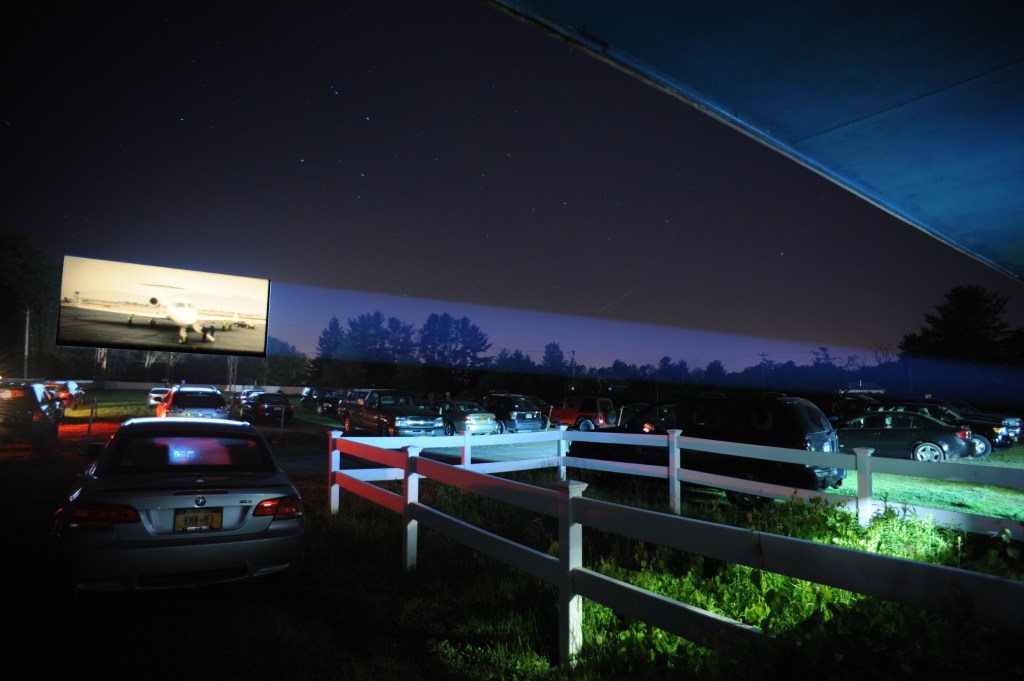
I told my mom that Katie and I were at the drive-in, and she had plenty of romantic advice to give. “Buy her some popcorn, put your arm around her shoulder, hold her hand, and kiss her on the cheek,” she told me, as though this was our first date, and Katie and I hadn’t been together for over 18 years, and raised two kids and a dog. I read my mom’s text to Katie, and she sarcastically gave me the finger.
“Do you remember when you took me to American Werewolf in London?” I asked my mom, and she immediately began to apologize. When I was about 2 ½ years old, my mom took me to the drive-in theatre, with her then boyfriend/friend who was a boy, to see John Landis’ American Werewolf in London. I was obviously too scared to watch the whole movie, and almost immediately began to cry at the sight of Rick Baker’s groundbreaking, Academy Award winning horror effects, but it was one of the most formative memories of my childhood, and likely why I’m such a horror fanatic to this day. “Your grandparents weren’t always so perfect,” my mom said, attempting to change the subject. “They took me to the drive-in to see The Graduate when I was 7 years-old,” she said. She said watching the love scenes in the car with her parents was one of the most embarrassing experiences of her life, and she still hates Dustin Hoffman for that very reason. “That’s great,” I said, “you should ask grandma about that,” and once again the texts began to pour in. “You can never do that!” she said. “Grandma would be so mad. She would deny it. Don’t ask her about it. Promise me you won’t ask!” she begged via voice-to-text, and I promised her I wouldn’t ask.
“What a shame,” I said to Katie, “to be almost 60 years-old and still not feel comfortable talking to your only living parent like an adult … Remember when Jackson puked at the drive-in?” I suddenly recalled. Our son was barely one year old, and we had taken him and his then 6-year-old sister to the drive-in theatre, to watch Charlie and the Chocolate Factory. Katie had just finished feeding Jackson a bottle, he had just recently stopped nursing, and when she sat him up on her lap, to be burped, his entire stomach full of breast milk emptied onto the dashboard. Perhaps needless to say, we didn’t stick around to watch Johnny Depp’s performance as Willy Wonka, with Katie and Jackson soaked in hot, curdled breast milk, and his sister, Gabriella, throwing a crying fit over having to leave the movie early.
Well, on the night of July 3rd, Katie and I didn’t have any kids with us at the drive-in. It was just her and me, our first movie together, alone, in god knows how long. It didn’t even really matter what movie was playing, it was just good to be out of the house. “In the car, but out the house,” Katie posted on Facebook. All around us, even while the movie played, thunderous fireworks lit up the horizon. “Next time we’ll bring booze,” we promised each other, and sighed in relief when the credits rolled and it came time to crank the air conditioner.
Josh Olsen is a librarian in Flint, Michigan and the co-creator of Gimmick Press.
All I wanted was a note. It didn’t seem a lot to ask. It didn’t have to be perfect. It could be written in scribbles, like some nearly illegible clue. It could sail in on a fatal breeze folded into a paper airplane.It could be tucked into a locker, a backpack, a desk, this note that never came.
I remember almost everything before and after that first day of kindergarten. It was mid-year, after Christmas, because that’s when you start kids in school who are destined to have traumatic lives.
I remember my stupid outfit, and most of the names and faces of my classmates. After all, we would be stuck with each other for the next ten years. One of the twins took me under her wing. Karen and Kristen. Everyone got them confused because of the names and their identical outfits, but I didn’t understand it. They were paternal twins and had very distinctive qualities. It was Karen who showed me around. She was the friendly one.
In the midst of the introductions, we faced off on the battleground of the kindergarten room with two boys, a redhead with a fat face and a boy with black hair and blue eyes who was the most beautiful human thing I had ever seen.
“Don’t you hurt her,” Karen warned the boys.
“Don’t you hurt him,” the redhead said to me.
The redhead was on my bus route. That first week he kicked me in the shin hard with his mountain boy boots. But he was the one who, before the year ended, ran across the room and planted a kiss on my cheek and ran away. The last I remember of Brad was ninth grade. By then I had forgiven the kick. He got sent home from school for wearing a shirt that said “Candy is good, but sex don’t rot teeth”, so who knows what kind of life he had at home.
Anyway, it was in the first few weeks after I started kindergarten when a lady from the office came to pull me out of class. I thought I was in trouble. I followed her into the principal’s office. The principal was female. These two women looked at me like they didn’t quite know what to do with me, like I might sprout wings and fly up in a corner. I waited.
It was just the Valentine’s Day party. Everyone was excited. I thought I was getting away with something but, no. The school had been notified that I was not allowed to participate due to religious reasons.
“Well, that’s ok. You can sit here,” the principal said. She put me at the corner vault with a little desk reserved for troublesome children. The office secretary brought me a napkin with a party cookie on it and a paper cup of punch. She looked at me with pity as she set it down.
“Here you go.”
I picked up the cookie, which fell apart. So I sat there and ate my crumbs with red sprinkles. Thus began my long journey to becoming a social pariah.
I used to check for a note from a secret admirer. I became obsessed with the idea of having a secret admirer. Other girls got notes in their desks, but my desk stayed neat and empty. I got a “Neat Desk Award” every month of fifth grade. Valentine’s Day in particular would have been a good time to get a note. Every year we made those heart shaped paper folders that were stapled together and hung them on the back of our chairs. No one came to pull me out of the party, but ever after I felt like an infiltrator, waiting for the authorities to appear at the door. I had one girl friend, Brigette. We were both untouchables when it came to other girls. Maybe because we were both tomboys or because we were quiet and artistic. We compared our valentines folders.
“Look at this one,” Brigette said with disgust. She slid her valentine over. It said “From a sicrit admire”.
I never had a secret admirer that I am aware of until I was 18. There were no notes. I got other kinds of notes, late night letters of remorse, apologies fueled by alcohol and cocaine. Most of the secret admirers I didn’t even know about until 10 or 15 years later when I heard it through the grapevine from the one guy friend I had left.
“You know so-and-so, right? Yah, he works in my office. He said he was gonna ask you out once, but he was too intimidated.”
By then it was nothing. I subconsciously blamed the secret admirers for being spineless. And, as for me, they could just catalogue me away with the rest of their wasted opportunities. It was up to me to be the person to give my world what it needed. To take the risks, where angels fear to tread, beyond the realm of cowards and unwritten letters. Now all I’ve got left are some petty words. That’s my song and dance. The dance is a private thing. So here’s a song. Not to myself or even necessarily as a gift to the world.
FROM A SICRIT ADMIRE:
“Don’t get me wrong
If I’m looking kind of dazzled
I see neon lights
Whenever you walk by
Don’t get me wrong
If you say, “hello”, and I take a ride
Upon a sea where the mystic moon
Is playing havoc with the tide
Don’t get me wrong
Don’t get me wrong
If I’m acting so distracted
I’m thinking about the fireworks
That go off when you smile
Don’t get me wrong
If I split like light refracted
I’m only off to wander
Across a moonlit mile”
~The Pretenders
—
Abigail Swire writes fiction and non-fiction. She served time as a journalist, mad scientist, and assembly line worker, among other things. Abigail has published articles and short stories for various media.She is currently working on her first novel, The Factory.
In the waiting room of the Department of Education where I held my number in the line to get my fingerprints taken, a TV lawyer instructed us to call 1-800-HURT. The governor who looks like my Chihuahua mix said the attempt to spread fear is the world we live in. So the world we live in is only an attempt.
The Culkins
I want to find a long lost Culkin brother. I believe most people I know are secretly on the hunt for a lost Culkin. We like their skinny pale bodies because they remind us of drugs we are too afraid to take and the desperation it would take to get us to take them which we have not yet experienced but sort of long to and this sensation about the Culkins we get only from movies and paparazzi photos and word of mouth and marketing. The Culkins are marketed by their own lives exactly to me and my friends. I moved to New York without knowing I moved to New York expecting to find a Culkin in some disgusting bar nobody else knew about and who would love only me, only me and party drugs, but now I know this as I search for him, even when I read I search for him. When I read books in my apartment and when I sleep. A blonde Culkin, a light brown haired Culkin, a Culkin who likes art. The Culkins are so baroque. A baroque Culkin endears himself to me when he exists.
The Best Days of My Life
Those were the best days of my life. I listen to the soundbyte from that Bon Jovi song in my imagination every time I think of any memory from my past. I don’t know when I started doing it. Those were the best days of my life. I was at Jameson’s birthday party at Kiki’s the restaurant for cool hot young people by East Broadway and I peed in the toilet and my pee was hot pink because I had been eating only borscht for three days because I made two gallons of borscht by accident and my now ex-husband wouldn’t eat any of it because it was admittedly not that good. The toilet wouldn’t flush and there was a long line of hot young people waiting to pee so I got down on the floor and repaired the toilet and went back to the table full of Jameson and five beautiful female strangers and told them I had repaired the toilet because of my fuschia pee and those were the best days of my life.
—
Courtney Bush is a poet, filmmaker, and preschool teacher from Biloxi, Mississippi. Her writing has most recently appeared in blush_lit, Critical Quarterly, Night Music Journal, and Ghost City Review. Her divorce chapbook ISN’T THIS NICE? was published by blush_lit in October 2019. Her films Kim Bush’s Abduction and Marilyn Monroe’s School for French Girls can be found on NoBudge.com. She is the co-host of Letters to a Young Minion, a poets’ podcast about the Minions, alongside poet Jeesoo Lee.
I hate to start this way. I hate to start a review of someone else’s writing by talking about my writing, as if I’m writing in any kind of way that can be taken seriously, but lately anytime I’ve gone to write something I’ll reach a point where a thought strikes me. I’ll be writing and suddenly I’ll stop and think: “What’s the point?” And usually, or always, my point is to make some kind of point, which ends up boring me so much I don’t continue. And if not exactly a point, the most innocent thing I might be doing with my writing is trying to be clever, or smart, which fills me with a boredom even more overpowering. What does it matter? What could I possibly have to tell anyone about? Seriously, we could be underestimating the permafrost thaw by as much as 50%. The United States Army’s internal research suggests societies could start collapsing within 10 years. How much could anything I have to say matter?
This feeling has leaked into other people’s writing as well, mostly—obviously—fiction. It’s as if all I see in other people’s writing is their striving to make a point or to be clever. I quit reading more fiction books in 2019 than I finished. It’s like, oh, you put a Chinese Muslim immigrant and an Iraq War vet together in New York City? Guess I don’t have to read the whole thing, because what else are you going to say besides the world has made a mess and therefore human connection is complicated? I use this example because I’m sure it’s not about the book being bad necessarily, but I can no longer convince myself to suspend acknowledging where the writing seems to be going. I don’t have the patience anymore. I understand the antagonism between the US and China. I know what we ask soldiers to do to Muslims. I know how fucked up immigration is in this country. It’s not that you can’t write about those things in fiction anymore, I don’t think, but setting up stories against realities like that is not only not interesting to me right now, it feels corny. It’s like, I know where the world is going, and it’s to shit, so I don’t know how you could say anything else with premises like that. To try to extract anything else, let alone something like hope or happiness, out of those enormous premises feels like an outright lie. Or it’d take nonfiction. The bad is becoming so big it’s outpacing our ability to even comprehend it, let alone escape from it. The American war economy is a hyperobject. The relationship between the last two superpowers at the end of the world is a hyperobject. Climate change is a hyperobject. You’re not getting anything out of it. You’re not subverting it with daily life because daily life is swallowed up in it. You can throw in all the tricks you want, but that won’t obscure the fact that almost everything at that scale is horrifyingly vacuous right now. Most things at that scale are where the world’s real nihilism exists. Allusion, realism, fabulism, dirtbaggery, whatever one might use to try to get anything more out of reality like that is crushed under the actual weight of it. And the same goes for poetry. Metaphors, similes, bizarre forms to mirror confusion and chaos, to signify a way to understand the text, to signify a way one is supposed to feel reading the text, for me it all gets crushed under whatever reality is being hinted at. If I see a poem going all over the place I don’t even bother. Your poem is in two columns and can be read in three ways? Is that not just a gimmick? In fact, devices like these feel so shallow compared to what they’re going after that they have not only been landing flat, I can’t stop seeing in them the attempts to be clever or make a point that I can’t seem to stop doing myself.
But then something like this comes along:
“Tater tots, untouched, in the trash / B-roll of hell / Stock photos of people losing the will to live / Every few hours a man with one eye walks by my desk / He sees the real me, eating lunch alone”
There are 741 lines of this, 741 unstructured, standalone, non-narrative lines.
“A music without sound / Michael Jordan crossing over Larry Bird / Allen Iverson crossing over Michael Jordan / Light from the computer screen while the city turns to dust / Hours pass… / Lie after lie delays the truth”
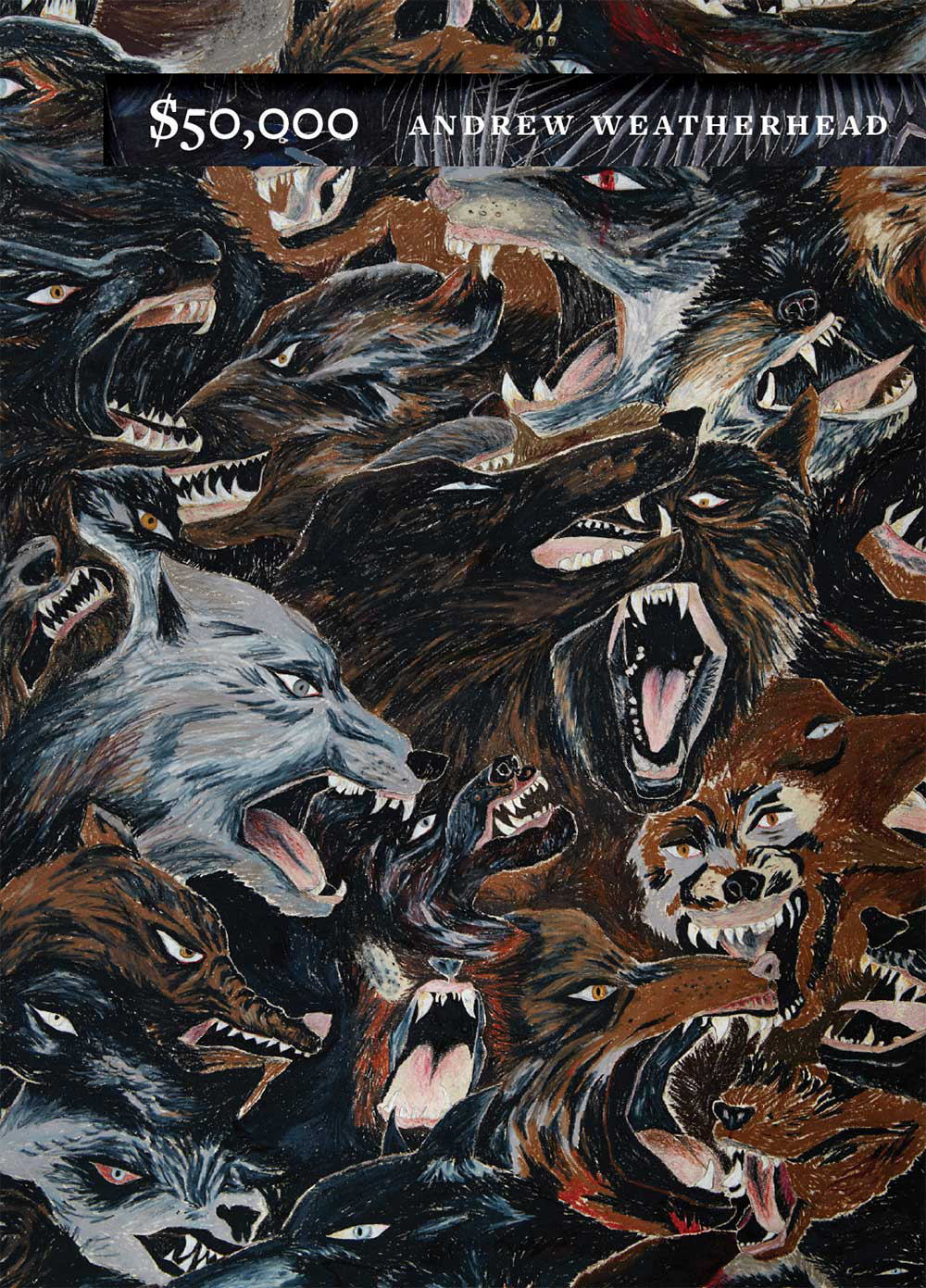
It’s immediately readable, and the readability, how fast you’re drawn in, is refreshing. There are no tricks. There are no gimmicks. There’s more blank space than text, which may be the way it’s supposed to be done. And it’s not that it’s just a bunch of nonsense. It’s not that it’s not going anywhere. I’m not saying that you need to be incoherent to say something interesting, because there is an absolutely recognizable feeling as one get deeper into it. There is an arc, however sporadic. It’s dark and sometimes funny. There’s no story. There’s no real build or climax. It starts to dawn on you that it’s like your life. It’s like my life. It’s probably like Andrew’s life. The peaks and valleys (especially the peaks) have been grinded down into a more or less straight line that just goes on and on. $50,000 is the most honest book I read last year. It was the best book I read last year. It felt like it was saying something important. It felt like it grappled with the question, “what’s the point?” and wasn’t crushed. But how could such a simple book do that?
“Facts can’t change us; beliefs are too resilient / Agreeing to disagree may be all there is / Even though scientist guess we’re all just guessing / Because if knowledge, then ignorance and fear / So I mistake spilled coffee for a shadow”
It’s right there. Facts don’t matter. You’re not persuading anyone. “No answers only interpretations” he writes later, aping Nietzsche. What’s the difference between answering and interpreting? I think the difference is in $50,000 Andrew isn’t going to give you spilled coffee as a shadow, or a shadow of spilled coffee. He’s just going to give you him mistaking spilled coffee for a shadow. Why would you take spilled coffee as a shadow, anyway? They’re hardly the same color, and not even the same thing. One’s a drink and the other is an absence of light. What would you get out of that right now? Would that tell you anything about the world? I don’t believe it. In $50,000 all you get is Andrew mistaking spilled coffee for a shadow, and is that alone not something you can appreciate? Is that not good enough? While I don’t think many people would disagree that right now all we have is each other, and that we need to be there for each other, I think hardly anyone is willing to take the implications of that seriously. Implicit in that sentiment is the understanding that we are totally alone with each other, that there isn’t any sort of transcendence to look forward to or any tradition to fall back on. It implies a lack of any deeper connection to each other and to the world. Our relationships with each other and the world are not metaphorical or transactional. What that means is you don’t get spilled coffee as a shadow. The best you can do is try to appreciate that someone has it at all. It’s not mine and it’s not yours. What we all uniquely have or experience isn’t a metaphor, it isn’t something to be bartered and traded, nor should it be. If it sucks it sucks. If it’s hard then it’s just hard. I think this is where the misunderstanding of identity politics, or intersectionality, or representation occurs, when they’re seen as based on metaphorical relationships instead of literal experiences. If we can’t get to a point of appreciating the inherent experience each of us have in a way that might not affect us at all—or if we can’t present our experiences without attaching signifiers of ‘intelligence’ or a ‘better’ understanding—I don’t think we don’t stand a chance. As humans we’re all as disparate as the lines that make up $50,000. Why shouldn’t everything be this simple? There’s no real connection. We’ve got to make do with whatever kind of ‘one’ these lines, or we, form. Even if they don’t form a coherent narrative. Even if it doesn’t make sense.
Baudrillard called this world Integral Reality. Absolute reality, all there is is all you see. There’s nothing left behind all the faces and signs, there’s no greater, or more concentrated, or truer meaning. “Colville died last night,” Andrew writes in one of his lines. Colville is dead, and you can put together as many facts and anecdotes about his life as you want but you won’t make a metaphor out of it. All you’re left with is feeling bad for his parents. And if you can’t find a metaphor in something like a friend’s death, what chance is there of finding one anywhere else? It’s best to just quit trying. Just give us what you want to give us. Strip it all down. $50,000 does it literally. Line after line after line. Metaphors and similes minimal if they’re there at all. Of course I don’t know if this style has the kind of momentum and/or pliability to become a form, something that can be done again and again, but I also don’t think literary devices are inherently signifiers of fake things. They just feel, in face of all that’s going on right now, useless at best and lies at worst.
I hope people read $50,000 and try to strip their perspectives of all pretensions like this. Although it might be ironic that this places all the emphasis on individual voice and experience at the same time I’m saying I don’t care or want to hear your metaphor, it is more an act of trust, a trust in oneself and a trust in the other to be radically honest. I hope all writing, not just poetry, goes this way for a little bit, even though I obviously have no idea what that would look like. I guess it’s something you can intuit. And clearly I didn’t read all the books last year. I’m sure other people are writing in a similar way, but I struck out more often than not. The only other thing I read last year that wasn’t nonfiction that felt as real as $50,000 was Nick Drnaso’s incredible Sabrina, which is illustrated and written in Drnaso’s similarly bare form. It’s this bareness that feels interesting right now, this Benzodiazepined, how-much-longer-are-we-at-this kind of bareness. I’m talking about not pretending your writing has made things less fucked up. I’m talking about not lying. I’m talking about how Andrew opens $50,000 saying, “No matter how depressing this book may get, just think about how much positive thinking it must have taken me to finish it.” I’m talking about Joy Williams saying, “One of the great secrets of life is learning to live without being happy.” Or maybe I’m talking about Joy Williams saying this: “Imagination is nothing. Explanation is nothing. One can only experience and somehow describe–with, in Camus’s phrase, lucid indifference.” The big picture is morbid. Maybe Andrew has figured out that right now anything more, like happiness or hope, can only be gotten at fleetingly, in the minuscule, mundane cracks in between the pummeling the world gives.
The memories come to you in ECTseizures—even the overlooked and dusty ones. A psychic told your parents before you were born that you were going to be a “hero child”. You can say this—you are no such thing; that psychic had a dyslexic premonition.
DecemberA small psych unit, your twelfth stay within four years—this time for methamphetamine psychosis. The voices in your head become muted by the benzos and anti-psychotics your distracted doctor prescribes. You traverse the hospital halls reminiscing about getting high.
2017
At another hotel. Is it night or day? You see escorting as an endless vortex of self-erasure. But the thick cash, right? When you work on your own and are addicted to drugs, all the crisp money you make goes to the drug dealer. The money is deadwood at the end of the day.
January Hovering around 88 pounds.—body by meth. You and Kevin do drugs in the tent he’s living in. He’s an intellectual, despite being a transient derelict. You always share your drugs with Kevin because you feel guilty when you keep everything to yourself.
2015
People have morally bankrupt behaviors when this compulsion disguises itself as your brain telling you to go into your mom’s magenta bedroom and steal her jewelry.
“You’re not stealing thatmuch from her,” you say to yourself.
“She doesn’t even wear these things anymore,” you rationalize while guilt still burns through you.
2014
The girl’s (my) heart clings from balancing graduate school, drugs, her fiancé, other men, parents, and sickness. She gets sick when the drugs are not around, but becomes the sickest when she has them.
The girl reads about Philip Seymour Hoffman’s death on her phone after she does her shot of heroin and cocaine. She wishes her speed-ball was as strong as the one her favorite actor injected at the time of his demise.
2013
At the age of 23, the girl learns that sanity is not permanent. The girl believes Baltimore is assisting in her downfall. The drug game is killing her. She is killing herself because dying is a consequence that comes with the territory. She is addicted to not only drugs, but the lifestyle—the copping, the scum-fucks who seem more unfeigned than any of her former private school friends, the dilapidated houses where she spends all day in an opiate-induced haze—a dimness that takes her to a layer of Earth where pain from the past and present do not exist.
As the girl looks at the track marks stitched down her arm, her vision gets muddled; her limb does not look like one anymore. Heroin says He loves her. She loves Him too, but in a different way than how she loves Kevin, her drug boyfriend, her bodyguard, her confidante—the lover who kisses and licks the blood streaming down either of her arms. The girl fakes a smile and welcomes death as her outcome.
—
Clara Roberts is a graduate of the MA in Writing Program at Johns Hopkins University. Her nonfiction work and poetry have been published in Adelaide Literary Magazine, From Whispers to Roars, Gravel Magazine, Heartwood Literary Magazine, and trampset journal. She lives in Baltimore where she finds material every day to write about in her journal.
Pale blue eyes, Colored by the horror of war in the South Pacific, Once filled with promise in the redemption of a returning Marine, Alive, warm in the embrace of young love, Those eyes, stern and fair, glowed with pride for his family and grew calm with the wisdom of a well-lived life.
But in the twilight before his mind disappeared, those eyes begged me to stay; Lenses clouded, they pleaded to understand the loss of will and control. Eyes that searched mine for peace, finality, Until the last flicker of reason was but a pale blue whisper, Haunting me.
♦
“I love you, Daddy.”
“I love you, too.”
“We love each other.”
“Yes, we do.”
—
D. Price Williamson is a veteran, dad, lawyer, occasional writer, and wannabe outdoorsman and athlete. He lives in Pennsylvania with his wife, youngest daughter, and a silly dog named Isabel.
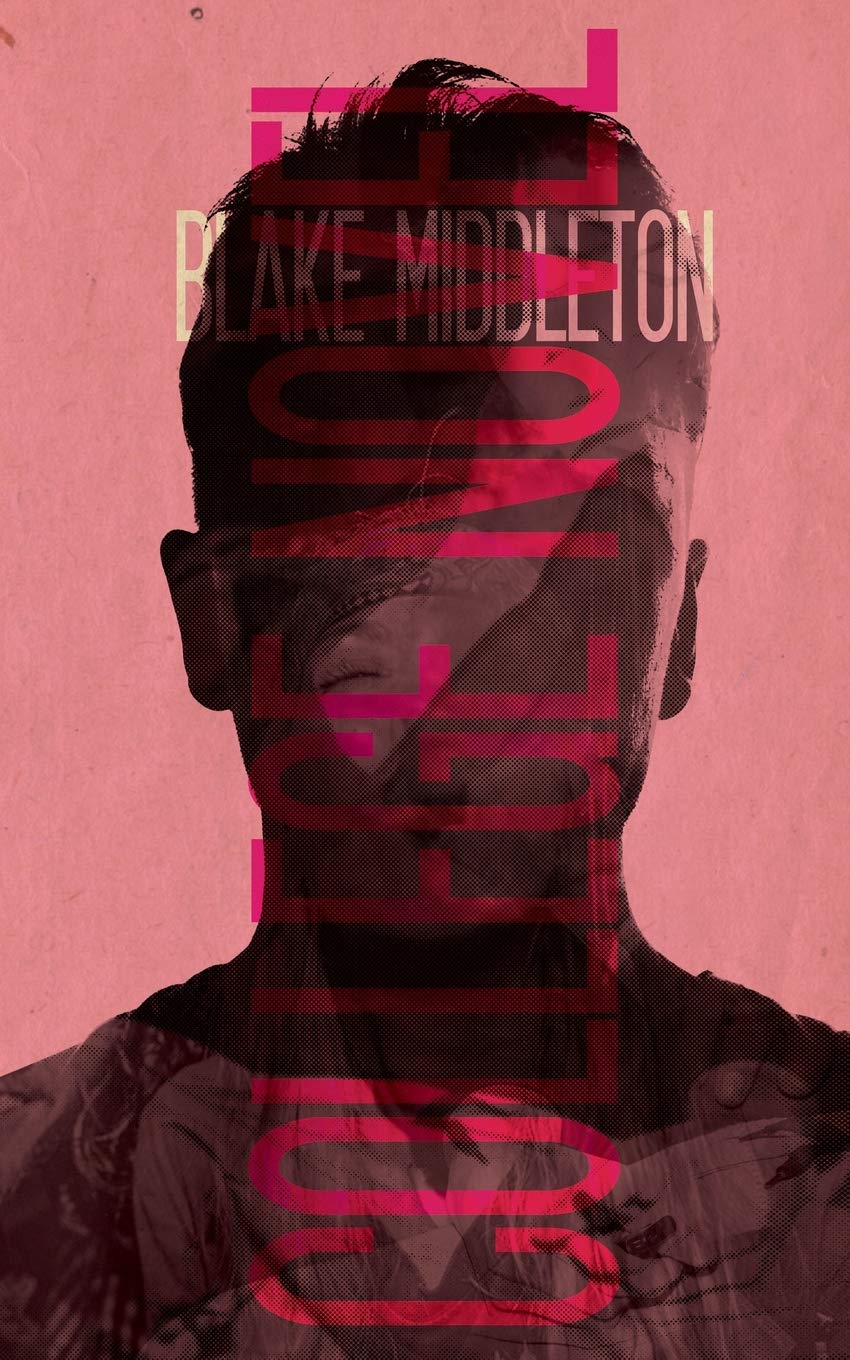
An early scene in this book tests the reader. Jordan and Robert are sitting on a bench discussing what a Cobb salad is when someone walks by yelling about “horrible marketing.” Jordan asks Robert if he can imagine “getting upset over horrible marketing.” Robert says he feels like “Jesus on the cross.” It’s a very funny exchange, indicative of the way real sentiment in this generation can only be expressed boiled down through a joke. If you do not know who is walking by, if you can’t picture the dude on his cellphone yelling about horrible marketing, you’re going to have a hard time understanding what is going on in this book. Things are so divided right now, as the cliché goes, that there are people who don’t understand—who couldn’t even comprehend—that the horrible marketing guy is the disaster looming over the end of this book and these characters. There are people who would be unable to understand that this book isn’t about a descent into chaos, or about how crazy and nihilistic young people are nowadays, this book is about the time right before you descend into chaos, right before you become a nihilist and start to care about something like marketing. All of which is to say: this is a book about right before you enter the real world.
College Novel is also a book about bullshitting. Built episodically, almost like a sitcom, it moves along primarily through dialog, with most scenes revolving around little more than a collection of characters doing drugs or drinking, packed with inside jokes and irony. The characters, often in various states of laying around on the floor, talk about wanting to die at Six Flags, whether they need more beer, joining ISIS, and the Scrubs actor Zach Braff. If the dialog had not been so funny and masterfully translated to text, this book probably wouldn’t have worked at all. I don’t know how you create such random dialog so specifically. I can only think that Blake must have recordings of him and his friends talking, because despite knowing and understanding this language of nonsense these characters use, I couldn’t even begin to recall it or know where to start when writing it. It is the most impressive aspect of this book, and also its moral mirror.
Beyond the dialog and these scenes the plot is spare, sort of leading up to Jordan graduating college and centering primarily on which character he should date. But, like a sitcom, a larger picture comes out of such nothingness. What comes out of this book is an excellent depiction of what almost being an adult is like for a lot of young people right now. And that’s because a lot of young people right now are also just bullshitting.
But, again, this book isn’t about nihilism. There’s still a meaning within so much bullshit. People are concerned about all the bullshitting young people do nowadays, especially young white people, and there are certainly places where the bullshitting is an edgy vacuum of meaning that always seems to let in shit like the meninist or incel or white supremacist ideologies. But there isn’t a vacuum in the middle of this book, because these characters are still searching for something. Like the dialog, there is something sincere hidden behind the randomness.
In a scene toward the end of College Novel, Jordan and Abby take acid while housesitting a cousin’s mansion. Despite it not being a bad trip, the two don’t like it. They don’t like it because of how disconnected from reality it makes them feel. “People that take acid frequently probably hate reality. It’s just like, so unlike reality,” Jordan explains. Later he says, “I think that’s why acid makes people freak out. They like, forget that they took drugs, and mistake whatever is happening for reality.” What is important is that they are not trying to escape, as this behavior is often accused of.
In a scene right before Jordan and Abby take acid, they take mushrooms, and something completely different happens. The two relax and feel happy. “It feels nice not to have anything that I feel like I need to figure out right now,” Jordan explains. “I feel happy,” Abby says, adding, “I think I just realize that so many things that, uh, we’re taught to care about, are just like, bullshit.” This moment highlights what Jordan is really searching for throughout College Novel, and what a lot of young people are searching for: a way to be happy within the world, despite where the world is going and trying to take you. And if the recognition that things we’re “taught to care about, are just like, bullshit,” sounds like a trivial and childish realization, well, just look around. Our world is overrun with people who care about things like marketing. Our colleges are purposefully overrun with people who care about marketing. The big question for these characters isn’t whether they’ve got their priorities straight, because they already hate money and are just looking for ways to be happy and good people, but whether those priorities can be sustained after college when one enters the real world, which is a very honest and important question for a lot of people. And while this book doesn’t answer that (it’d be a very different book if it did), it does insist on something meaningful beneath all our bullshit, and helpful to see.







 Back Patio Press