end of the line by Tex Gresham

i rode a train that left the station at seven in the morning. there was a little greek man at the station waiting for the same train. he smoked cigarettes in front of a no smoking sign and played mr. worldwide at full blast out of a bluetooth speaker. the station agent told him to stop smoking and turn down the music. the little greek man said don’t ruin my day.

the train arrived and i repeated that to myself: don’t ruin my day.

i had bought a ticket the day before: departing from glendale with san luis obispo as the final destination. end of the line. a friend of mine who works as a bouncer at jumbo’s clown room gave me four grams of shrooms and said, “it’ll do you some good.” 

he also thought having me meet him at his job would do me some good, but it only deepened the low-grade sadness i’d felt ever since my fiance left me. together six years and here i was, three weeks into a loneliness i’d never felt in my life. and the beautiful women dancing on stage at jumbo’s only intensified that loneliness.

so here i was, on a near-empty train heading north, the only other passenger in my car the little greek man who had blown through pitbull and was now jamming alone to wang chung.

i ate the four grams as we pulled away from grover beach, chewed them up with a complimentary apricot croissant and washed it all down with complimentary coffee that tasted like peanut skin.

they kicked in right as we pulled into the station. an anxious leg bouncing. a sensation that someone was pulling on my chest, a brief bodily reminder that the psilocybin is almost to your brain. it typically passes as the visuals start to wash over your reality. the sudden need to get off the train, to be out in the open. the train stopped with a jerk and i jumped out onto the pavement.

but as i walked from the train towards town, the anxiety lingered, deepened, became hands gripping my shoulder. pushing me down. i told myself it’ll pass. told myself i can handle this. said to the four grams in my body don’t ruin my day.

as soon as i entered the quaint, shop-lined streets of downtown san luis obispo, a sledgehammer made of grief and remorse and regret slammed into my skull, shattered through bone and squished my brain into a traumatic pulp. tears bunched up around my eyes and leaked out onto my cheeks. my face twisted as i tried to hold it all in, drawing the attention of all the couples around me.

because that’s all there was in this town: couples. happy. loved. walking shop to shop to buy things they’d look at together in twenty years and think remember when we bought this? couples eating meals together in french-like cafes. it was as if the whole dna of this town was made of two people in love. 

trees above warped like wacky inflatable men in front of car dealerships. the ground crawled like ants escaping a disturbed hill.

i turned a corner to get away from it all and ran into a bridal party fawning over a wedding gown a soon-to-be bride modeled with blissful joy. i turned and ran up a hill, towards the sounds of a trumpet playing mexican melodies. and was led right into a wedding in progress, the newlyweds standing at the top of a staircase while their guests worshipped this new commitment to love.

i couldn’t escape.

so i found a park bench and sat and let everything fall out of me. grief remorse regret. an emotional mantra that intensified each time it repeated in my mind. grief remorse regret. why could i bring myself to a place like this but not someone who actually loved me? grief remorse regret.

the sledgehammer pounded me down over and over for the next three hours. and then it kind of just slid away like cold jelly off a piece of toast. all that crying left my face bloated and my eyes raw. all i wanted to do was sleep, but i still had a five hour train ride ahead of me.

“you look like a man who’s been beat to hell.”

i looked up. a black guy stood over me. flat brim hat with a feather in it. shirtless with a burgundy leather vest. tight slacks and wingtip shoes so sharp they could cut someone. his face wiggled like a bad photoshop filter.

i said “just dealing with something.”

he said he could dig it. he introduced himself as joe and started building me up with things like you look like a bad motherfucker and takes a real man to feel shit. i don’t know what brought him over, but i was glad he was there.

and then he pulled out his phone and called someone he called one of his girls. and then proceeded to convince her to get on a bus so she could come suck my dick. 

she gave a stern i ain’t doing it and he yelled back bitch, don’t ruin my day. 

i walked away while he argued with her.

it was a slow slouched trudge back to the station and i made it back on the train right before they closed the door. i found a seat and fell into it as the car lurched and left the station.

i closed my eyes, ready to sleep the whole way back to glendale, when i heard him.

the little greek man was back on the train with me, both of us alone and riding back to our lives. his bluetooth speaking softly shouted “good year for the roses” by elvis costello. i leaned back and let the train take me home, the sun setting in the pacific to my right. and all i could think was:
i guess i needed that.


Tex Gresham is a screenwriter and author of Heck Texas, Sunflower, and Easy Rider II: Sleazy Driver(s). His new book, Violent Candy, is releasing this fall from House of Vlad Press. You can find his other stuff at squeakypig.com.
Thank You For Your Patience by Teddy Griffith

I’m sorry for the wait on your salad,

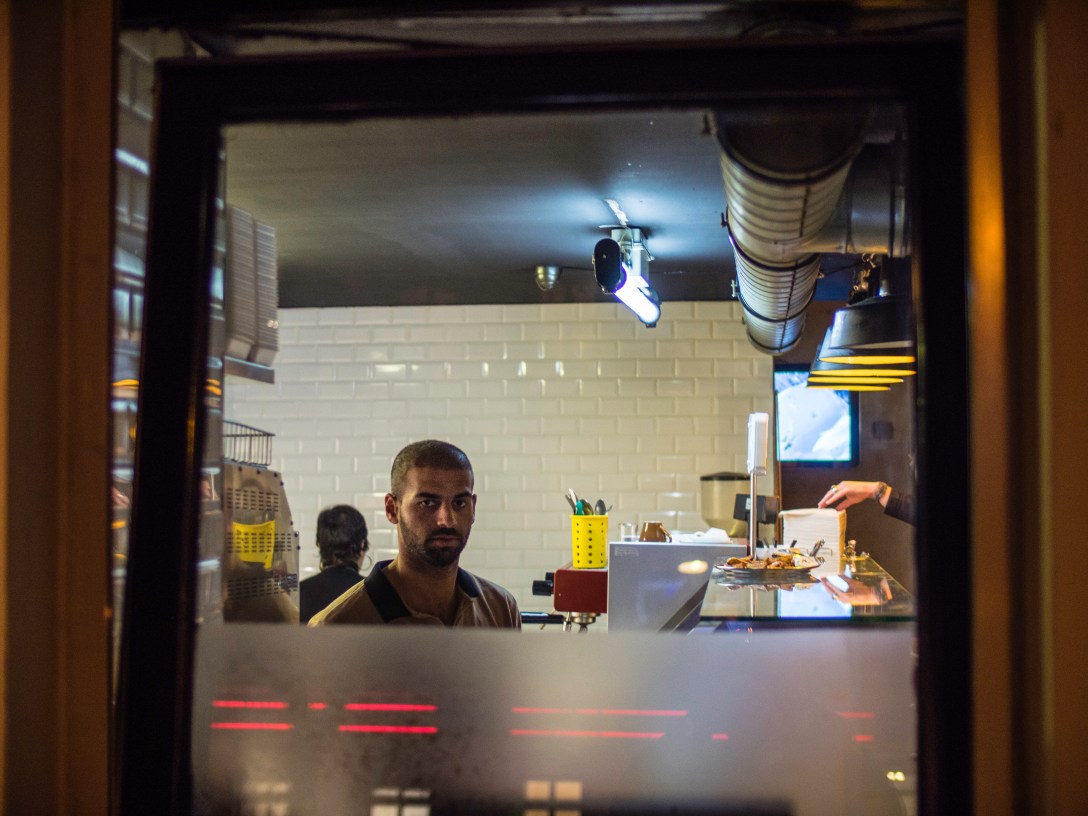
things are really crazy in the kitchen right now—

Sandi, one of my coworkers, turned into a horse. 

She was filling a monkey bowl with salsa, 

and to this point,

everything about her had been extremely normal. 

One time she walked out during her shift,

because there was just too much shit going on,

and one time she told me, in passing, 

that her mom wouldn’t be happy if she knew she worked Sundays,

and another time I saw her stab her finger with the lemon wedger.

Real blood. 

Sandi turned into a horse, and now we don’t know what to do

and neither does the horse, so please be patient with us. 

It was so sudden, there was no gradual turning of her arms to hooves—

She was filling salsa and then she was a horse, 

simple as that. 

There was a look of confusion in the horse’s eyes at first, 

as though it was realizing it was a horse. 

Then it started doing horse things, and that’s why you heard all the clashing

and the screaming and crying. 

And my manager is doing everything he can to lead the horse out of the kitchen,

but he really wasn’t qualified for this—

none of us are.

And somewhere, I imagine, Sandi’s mom is watching TV with a bible by her nightstand,

Dr. Phil maybe. 

She’s got a glass of water and she’s already halfway asleep. 

I suppose she won’t be very happy 

when she finds out Sandi turned into a horse.


Teddy Griffith is a restaurant worker who lives in the mountains of North Carolina. His writing has been in Words & Sports, Cowboy Jamboree, and some other places.

I LIKE AMERICAN POETRY by Reid Kurkerewicz

(I am standard size, I contain multiple tubes.)
I am a victim of my parents
and a conduit of ancient rituals
sifted from a bloody creek.
I lack more

Inner Resources than you
I have always wanted to say I this much.
And yay! though I surf through the alleys
of identity theft
I will follow no pagan
for the nation of dogs is within them.

Notice what I won’t edit.
I act how in God’s eye I am.

I loudly proclaim
the utter success of my vibes
to seem employable again
and means-tested and on-time.

My heart. I’m sorry.
You know you can hear it.
It hurts like this when I recall

why we don’t censor poets
who cannot rhyme.
I rhyme.
I lie.
A lady collapsed today
and still I lie.
I, too, dislike it.
But I need no prompt.
I like all humans adore
a femme top who adores a Fascist.
I write to young poets,
you must change your life
insurance policy and billable services.


Reid Kurkerewicz is a writer from the shores of Lake Michigan. He lives in Brooklyn and hosts a monthly poetry reading at Unnameable Books. He has a tattoo of a cube. 

Two Excerpts From A crate that once contained oranges by John Johns

Making piña coladas for your close friends

Halfway through cutting into the pineapple the resistance became too much. Yeah. The knife was stuck. And when I tried to pull back the whole fruit came up with the knife. I waved this knife-pineapple before my eyes in wonder. 

Then I slammed it down to the surface and the blade cut deeper – there was a wet ripping sound. I slammed it down a second time, and the two halves of the pineapple lolled apart unequally and golden. There was the smell. The wetness of the knife. The reveal of good stuff well-earned. And the dissatisfaction of a good struggle concluded.

I offer Baby Hughie an Easy Peeler tangerine

He stares at it with intrigue, then astonishment, then dismay. He chews the knuckle of his index finger and shakes his head. He picks it up with both hands and feels its cold skin against his tiny upper lip. He looks at me. Yep. There it is. Cold and orange, straight from the fridge. 

Noticing that I’m peeling mine, he begins to peel his. It’s not easy though, and his breathing becomes very heavy. Globules of juice form where his little fingernails have penetrated the pith. He sniffs. He opens and closes his mouth as if rehearsing the act of eating. He’s building a pile of dimpled orange skin scraps while I, as an expert in easy peelers, have removed the skin in an unbroken spiral. 

I split the naked fruit in two, easily, and he cannot believe it. It’s so easy. Life is so easy. I peel one segment away and shake it around like a little trophy. Now Hughie is tapping his forehead quite hard, and blinking. He’s scared. I place the segment of orange onto my tongue. Hughie is vibrating with fear. I rescind the segment into my mouth. Then I close my mouth. Then I chew.


John writes from England, and he just finished this novel. Extracts have appeared in Lighthouse and Perverse. In 2019 zimZalla published a book of his. He also runs a journal called Tar Press, publishing new fiction onto Twitter. Their archive features, among others, Amit Chaudhuri and Julianne Pachico.

His personal Twitter may be currently suspended. Usually it’s @henry_johns. Tar Press is @tar_press

Never!!!! by Elizabeth Yellin

drunk at the open house

trying to convince someone’s mom to hold me down and “ride it gruesome”

battle rapping a dog (and winning)

vibing out like a total natural

getting crushed to death while eating a salad

flipping the bird at some birds

getting coffee while having to shit way bad

holding in the shit

going out for another coffee

instead of shitting 

and chugging the coffee through the pain

going out for drinks later

and still holding in the shit

never letting go

never letting go of the shit

trying to explain what you mean by “riding it gruesome”

nailing it just totally mysteriously convincing

and getting everything you ever wanted

taking the shit

giving up coffee

kissing a wild bird

holding the dumpster above your head and smearing the lettuce against the pavement

never vibing (never!!)

letting the dog win the rematch

getting choked out in the amazon position and dying briefly

and buying the house with cash

and never writing another poem again

absolutely never, ever again

finally

(;


Elizabeth Yellin is Forever Magazine top voted poet 2023.

Like A Smoke Detector by Shy Watson

Carmel woke up as she always did—trembling and in search of water. She never remembered pouring the glass or placing it on the nightstand, but the habit had automated itself years ago, as with breathing at birth or any other cast that had kept her alive. She was grateful to have not soaked the sheets. It had been days, four of them, since she had awoken to a scent not unlike protein powder, having clumped with milk on a counter freshly wiped with bleach.

Her unemployment checks enabled what had already lain nascent inside her, from genetic predisposition and what she had witnessed. As a child, she pretended the sounds from the living room were that of a movie, the volume of the television unreliable as everything else. But eventually she unwillingly outsmarted the trick. Everything could only function for so long. And while she tried more advanced forms of denial (it was the neighbors, it was psychosis, she was dreaming), none of them ever stuck. Now she had the Klonopin, the Ambien, and the Bota Box wine.

Her job at the call center had lasted just long enough to qualify for the unemployment, and she hadn’t been bad at it. She was especially adept at scaring elderly women into buying things they didn’t need. She harbored a sweetness that seemed to outlive her, grow beyond her, and touch others with its vapored tips. But she had started drama. Everywhere she went, as her mother put it, she brought drama. It was why she was kicked off the volleyball team, her mother liked to remind her, why every boyfriend had dumped her, why her father never called, and, most importantly, why she couldn’t keep a job to “save her life.” What she wanted to say, but didn’t, was that she wouldn’t do anything to save her life.

Carmel’s cat, which she had found next to a shattered television only one month earlier, jumped onto her yellowed, faux-down comforter and screamed for food. The meowing was urgent and deranged, like a smoke detector, and Carmel sprung out of bed to shut it off. Of course, there was no food, only empty, concave cardboard boxes of off-brand Meow Mix. The fugue state responsible for Carmel’s glass of water had not yet become accustomed to caring for a cat. She slid on rain damaged Minnetonkas and thought beeeeeeend, and snap! as she plucked her EBT card from the mottled living room carpet. The jerking motion caused her frontal lobe to throb. She turned the bottom lock and slammed the door behind her as she left the apartment for the stinging autumn air.

In the summer, she had given the deli guy a blowjob, of which she only remembered the end, as his cum had tasted so acrid, it jolted her out of a blackout and forced her to register the fluorescent lit litter bag against her ear, on a dusty shelf by which she knelt. Abdul lifted his pants back to his hips and pointed toward the beer case as he said, “This time it’s on me.”

The EBT card had been accepted like legal tender ever since: for cat food, tampons, Parliaments, Twizzlers, and, more often than anything else, beer. There was no doubt the rest of the staff knew, considering the men—probably cousins—always snickered while ringing her up. Maybe they hope it will happen to them, she thought. And she was so unsure of herself that she couldn’t be certain whether or not it would.


Shy Watson’s fiction appears in Fence, Southwest Review, Joyland, and elsewhere. She wrote “Jeff! Bess!” for SAD HAPPENS edited by Brandon Stosuy (Simon & Schuster 2023). She earned her MFA from University of Montana.

Three Coal Poems by Ben Niespodziany

The Logger’s Daughter 

The logger longed for a daughter and when his daughter arrived he was crushed by a truck, stuck between tree and spleen. The daughter remembers nothing of her logger father but her hands do not dance around a saw.

When the War Formed

When the war formed in our corner of the room we moved to another corner of the room. We’re safe here, we said to each other, eyeing the corner with the war. When the war found us in our new corner we stepped out of the window and took to the roof. We could hear the war below us, fighting and writhing, such muffled exhaust. We’re safe here, we said to each other, our dying phones ringing with pleas.

Coal 

It was a long line to the coal mine so we left early and arrived late. The animals inside of the mine were praying or they were dead. We will try again and again.


Benjamin Niespodziany is a Pushcart Prize nominee and Best Microfiction nominee. He has been featured in the Wigleaf Top 50 and has had work appear in Hobart, Maudlin House, X-R-A-Y, Screaming into a Horse’s Mouth, and various others. He works nights in a library in Chicago.