2 Fables by Donald Ryan

8352634213_e8781a14eb_k.jpg

Baby Boy is a big fan of the hard-boiled eggs. Me, I’m eating a chef salad—the kind where the pile of piled toppings topple the function of the salad. Might as well.  It’s an All-You-Can-Eat buffet, and I’m sitting behind a fucking salad. I put on too many onions and am getting a headache. Baby Boy is on his second hard-boiled egg. Or is it his third? I lost count watching my husband ruminate steak. He says the streak of fat is man cud chewed in memory of the cow. We opted to lose weight, together, as a team. He chose the meat and sweets diet. Me, you guessed it. Skipping our first weigh-in was him giving up in the guise of a collective decision. Baby Boy swallows his third—or fourth—hard-boiled egg. I demand he eat veggies but don’t notice if he does.  My husband haw-haw-haws over half masticated meat. I started drinking too early—in life, this morning. This is my secret. I share it with coffee or Baby Boy’s orange juice. Vodka’s love is universal. Baby Boy swallows down a hiccup of hard-boiled eggs and scurries towards the bathroom. He doesn’t make it, spewing next to an elderly couple. Who knows how many dates these people have been on, alone in each other’s company. So thin. So frail. So disgusted by Baby Boy’s vile hard-boiled bile. My husband and I will never make it to their age of loving lonesomeness. Shit—they’ll be lucky if I can make it over to muster an apology. Baby Boy can’t swallow his sobs. He screams while being screamed at. My husband is furious. But he has no need to be. I’m the one with the salad. 

Always Look On The Bright Side of Life


The neighbor’s dog kept barking. Barking. Barking. And barking, all while being shushed by the browned leaves. Other than that, the day was silent. The sun was out, being toyed with by the clouds. Silver outlining the sky. It was the type of day that people who were destined to meet, met and people that weren’t, don’t. The world felt right. And the air. The sky. And the Heavens. All felt right. All but the neighbor’s dog was synced for great existences, no matter how mundane. Dano was sitting, flipping channels. He couldn’t sleep. And nothing was on. But even the nothing on television was being interrupted by the neighbor’s dog. Barking. Barking. And barking. He checked his watch, already knowing it was far too early to start getting ready for work. A blonde in a snug, pink dress faked a smile into the camera, complimenting the chef who looked like someone’s (kidnapped) grandmother (whose poor, dear soul was being forced to bake on television) before being flipped to a thin, sweaty young gentleman in an unfitted suit acting far too excited about a local high school’s football team Dano didn’t even know existed. Insomniacs who work the night shifts had to deal with the same crap television as the insomniatic dayshifters. The breeze picked up, harshly hushing the neighbor’s dog, but couldn’t maintain its gumption. A perfect degree of heat radiated off the ground, complimenting the day’s briskness and the essence of uncapturable perfection. An aweness unseen. Dano turned off the television.  His reflection on the dark screen stared at him slouched in the chair. Not liking what he saw, he turned the television back on, which disappointed him further. Mute became a happy medium. Now the thrift store fasionista bouncing through the commercial barked. Barked. And barked. The melody was becoming rhythmically wild. Almost furious. Dano pressed the spot where his eyebrows connect and ran his middle finger up his grainy forehead to his hairline. He yawned. His cell phone sat charging next to him. He’d call out of work. This the third time this month. No bother. Days like today were made for staying in, watching television.       

Every Dog Has Its Day


Donald Ryan writes. Hobart, Back Patio, Silent Auctions, Hello America, elsewhere.
“Letters Become Bricks” by Parker Young

827528543_02f9658080_o.jpg

You never know when one thing might become another. Like the letters I wrote — they all became bricks before I could mail them. Little grey concrete bricks. I didn’t have any use for the bricks, so they formed a pile in the corner of my living room which grew and grew with each subsequent failure of a letter. A thin layer of powdered concrete covered the floor over there, in the corner around the increasingly substantial pile. Because I couldn’t get my letters into the mail quick enough.

I tried to dissect one of the bricks. I thought maybe my letter would be inside — maybe the letters weren’t turning into bricks so much as growing concrete brick shells. I carried this brick outside, onto the sidewalk, placed it carefully in the exact center of the sidewalk, width-wise. Then I went back in to fetch the sledgehammer I borrowed from my neighbor Kenny. It took about fifteen minutes to satisfactorily demolish the brick. No letter inside, of course. But I couldn’t dismiss the possibility that the substance of the letter filled the brick in powder form, mixed into the concrete somehow.

Fortunately, a friend of mine worked as an aid in a nearby university laboratory. I brought her the crumbled remains of the brick at an appointed time. In a petri dish, she mixed some of the concrete powder with drops of a purple fluid before placing the dish beneath a microscope. She operated quickly, efficiently, and silently, a priestess of the observable world in her flowing white lab coat. After a few minutes hunched over the microscope, muttering prayers, she looked at me.

Looks like these bricks are thirty years old, she said.

Well, that was impossible. I was thirty years old. The now-demolished brick had appeared on my kitchen table two weeks ago, in place of a letter I hadn’t finished writing.

The next week, I tried a different approach. I actually mailed one of the bricks, hoping it might become a letter again in route to its recipient. I boxed it up and paid an exorbitantly high postage fee due to the weight.

Three days later, my brother called me up.

Why did you send me a brick? he said.

Ah, damn, I said.

I have a family, you know, he said.

Right.

You can’t just send me bricks.

I’m sorry, I said.

I’m mailing it back to you, he said.

The pile of bricks grew larger and larger until I decided to stop writing letters . Then I thought I might as well build something, since I had so many bricks. Besides, I had lots of free time now that I wasn’t writing letters. I carried them one by one into the back yard. Technically, I shared the yard with the three other occupants of our building, but nobody ever went out there but me, it seemed. In nice weather, I liked to lie down in the grass and hear the powerlines hum overhead. Sometimes a helicopter flew by, or a bird.

The only thing I could think to build was a small outdoor fireplace with chimney. I borrowed my neighbor Kenny’s wheelbarrow, mixed up an old bag of concrete, and got to work pasting bricks together in the proper shape — an arched mouth and gently sloped belly leading up to a hexagonal chimney column. Unfortunately, I was one brick short — I needed the sixth brick to finish the uppermost row of the chimney. No problem, I thought. I’ll go inside and try to write a letter.

Except this time, the letter didn’t become a brick. Of course, I thought. Just when I need a brick, I get a letter instead. So I sealed the letter in an envelope and mailed it, hoping it might become a brick on the way. Then my brother would call me up, complain, and mail the brick back to me, and I’d have a brick.

Hello? I said when the phone rang three days later.

What is wrong with you, said my brother.

I’m sorry, I said. I noticed he was actually crying. Or maybe he had allergies — I couldn’t remember if he always got allergies or not.

Why would you send me this? he said. This awful letter.

Parker Young lives in Chicago. His work has appeared or is forthcoming in Hobart, Bluestem, and Oyez Review.

“Tales of Ordinary Madness Redux” by Bram Riddlebarger

44947571962_e83e6dfb4c_o.jpg

I bought a used copy of Bukowski’s Tales of Ordinary Madness at a bookstore in Lawrence, Kansas. I had read most of Bukowski’s work in my twenties, but that was a time when I only read books from public libraries. I didn’t have the money to purchase books. I never had. If I wanted to read Ham on Rye, I would wait a year or two to find a copy in a public library in Portland, Oregon, or Albuquerque, New Mexico, or Columbus, Ohio. Wherever I moved next during my Great Search for America: Or, A Job that Paid Enough to Cover the Rent in My Crummy Apartment Far from the Hills of Southeastern Ohio. I was at the mercy of public libraries and the books that returned, God bless their souls. The small, public libraries in the region where I grew up didn’t carry much Charles Bukowski, or many of the other writers that I enjoyed. Sure, I might taste a few of their books, but they were apples leading me to a broader table. A need. A want. Growth: the original sin.

This all happened before the internet, when sins went the way of the world.

Cast out of the garden, I wandered the earth, working landscaping jobs and washing dishes and picking up trash to pay for the rent and my beans.

Eventually, I lived in enough places to read Bukowski’s entire oeuvre.

In my forties, I realized that I didn’t own a single one of his books. I hadn’t read any of his stuff for years. He was a ghost of my work boots. But there it was: Ham on Rye. And look! Tales of Ordinary Madness. I bought each copy for four dollars and change and carried them back home to Ohio, back to the tainted garden, back to the house that I was looking to sell.

All this traveling required oil.

Lubrication of the machine.

Bukowski would understand.

I had changed my own vehicle’s oil since I was sixteen. I still have the wide, low metal drip pan, filmed by time and dented by gravel that my father had used since he had taught me the work. The same one that my father discarded before he too left home, casting himself free from his familial bond. But one day I took my car in for repairs in my mid-thirties. I had the shop change the oil along with everything else that was needed to plan my next escape.

And that was it.

I could never unscrew the oil plug from the drain pan again.

My socket set is a gift that a voyager to the outer systems could only hope to possess when their spaceship was eaten by a physical manifestation of their innermost selves, but it was no match for power tools.

Stripping out an oil pan plug isn’t high on my reading recommendation list.

I began to go to Walmart for oil changes, like the defeated adult that I had become.

When I do, I always bring along a book with me. I sit in the small waiting room and read and dream about lower prices, surrounded by blue. No one has ever spoken to me in all the years of waiting in this room, or one just like it. Reading a book in the American public nowadays is like practicing the speed limit. Most folks just look at their phones or go shopping for their lives in America. But, O, today that changed.

I was only three pages into Bukowski’s “A .45 to Pay the Rent” and his peculiar capitalization, when I heard:

“O. I’m about to fall asleep.”

The man on the blue bench beside me shifted uncomfortably. He was a bit younger than me, a talker. He was in line ahead of me for an oil change.

He wanted to begin talking. His phone had no voice and had emptied itself of its secrets.

We both had a forty-five to one hour wait for the Walmart employees to honk once before backing our cars into the sun with fresh oil inside them.

“What is that your reading?” asked the man, like an automotive governor. He was perceptive and quite possibly an addict, but very friendly in a distant way. He was like the next ridgeline across the valley of our blue bench seats when the air currents were moving low.

I showed him the cover of the book, but he had already read the title.

“Is that like, I don’t know, this guy’s thoughts or ideas or essays on like how crazy things are in [insert jumbled, made-up psychiatric phenomena].”

“No,” I said. “It’s just short stories.”

Over the course of the next forty-five minutes, my new oil-change companion traveled the interstate of the psychic dream world. He had been deployed for three tours by the United States Marine Corps. He kept the money that they sent him each month for his many troubles in a safe at home. The banks wanted their forty thousand dollars that he had already taken from them. The banks didn’t care about PTSD or living in a rented, haunted house in Coolville, Ohio, where demons that could not be assuaged with sage played in the windows of your mind. The banks didn’t care that your father at a late age began frequenting the lonely state park restrooms and parking lots to act out his subjugated, sexual tendencies that concerned you in the years before he died with a cigarette in his hand, or that you saw him now in your demon dreams with a woman’s breasts and a knife jabbing into your head. They didn’t care about your visions of dead travelers in National Parks from an unknown enemy like the ones you knew so well, but couldn’t see, or rarely saw, when you were deployed so not very long ago. Hundreds of thousands of deaths unaccounted for and unexplained. Missing 411. Or that you didn’t trust your girlfriend with that money stashed away in your safe and that you, with a straight, unashamed face and without a thought or a flinch, were willing to tell me that you would put her in her place because you were a man, because, as much as our society may be changing, the social and economic poverty of our area is just as our fathers and their fathers before us, and that is how you were raised, and the small changes that have come have only begun to bleed into the edges of our moral poverty, while our economic morass has remained so much the same. Or the beauty of the Hocking Hills in Ohio in autumn, the myriad colors of the trees and the caves and the land, just thirty minutes away up the newly routed bypass gouging its way through our national forest, the only dream that was real and achievable, but would forever be unknown. Or the surge of the Hocking River, our river, our lifeline, our artery in spring swelling it banks to drown the damned or the foolish or the suicidal in the bleak outlook of our place and our time. Or that grand old lunatic asylum high on the hill over town, beckoning like a light against the dark that has long ago fallen. The specter of electro-shock and your friends that you remember, still there in the ward.


Bram Riddlebarger is the author of GOLDEN ROD (Cabal Books), EARPLUGS (Livingston Press), and POEM 3 A.M. (Nihilism Revised). His forthcoming story collection MESSAGES FROM THE AMERICAN TRASHCAN will be published July 4, 2020 with Cabal Books. He lives in Southeastern Ohio.
Social:
Twitter: @B_Riddlebarger

“A BRIEF HISTORY OF FAILED SELF CARE” by miss macross

24441998825_a3993592c0_o.jpg

Chug some room temperature water because my health is something that I need to consider more. Walk down to the pharmacy on Grant to buy overpriced CBD gummies. They’re still cheaper than the gummies from that boutique named Noun & Adjective, the one with a very Tumblr minimalist aesthetic and a soccer mom owner who is too high to do her taxes but also can’t really afford her accountant, so her business will go under in two years and her storefront will be replaced in that building by one of those garish but somehow less try-hard CBD KRATOM SHOPS that have everything on their signs in ALL CAPS, that sell ENERGY SHOTS and offer a deal on A FREE MONSTER IF YOU BUY X WORTH OF KRATOM and honestly, I’m all about that.

This fucking city, though. My water came from a gallon jug69 nice cents at the convenience storebecause there’s lead in the pipes compounded by frequent bacterial contamination. A criminal suit against the municipal water authority is pending, and my tap water is currently speckled lint ghostscertainly unsafe but I will wash my dead hair with it anyway, because I have no choice. Just like I have no choice but to go to the overpriced pharmacy on Grant for CBD, because my car is dead and there is no public transit in my neighborhood on the weekends. No idea if these gummies will do anything for me, as my stress is caused by my environment, rapidly deteriorating and not covered by my insurance.

miss macross is a Pittsburgh-based multi-genre writer who enjoys watching mecha and taking naps. Her first chapbook, MISS MACROSS VS. BATMAN, was published by Dark Particle/CWP Collective Press in 2018. Find her on Twitter @missmacross.  

“Armchair” by Parker Young

3519722825_e02f0ccc10_o.jpg


I had some friends I didn’t like. I didn’t like saying their names. For example, Arnold Bunk. How often in one lifetime can you say a name like that?

The problem with friends you don’t like is that gradually, over time, you forget why you don’t like them because they’re your friends, and anyway you’ve got nobody else to rely on when your smoke alarm goes off in the middle of the night for no reason you can see.

I’m getting ahead of myself. As the story goes, my smoke alarm went off in the middle of the night. But I couldn’t find it. I didn’t know where all the deductive equipment could be found. Anyway, the noise punched a hole in my head where a hole shouldn’t be, and I didn’t think I could go on living. Not with the hole in my head. Two holes actually. Ears! This is the story of how I got ears.

Instead of ending it right away, I went over to Arnold Bunk’s house, because I hated his name so much it was the only one I could remember in a time of crisis.

They’re called ears, he told me.

Fuck, I said. I think I was wailing.

This one’s just about Arnold Bunk, by the way.

He had a house with a basement.

Come on down, he said, leading me slowly down the stairwell, into the basement. The basement was where he kept his prize possession, a machine which reads your head. In the end, you get a word. This is the word, the machine would say, that most closely corresponds to your head. Or, if you believed in the power of the machine to the same high degree as Arnold, you could say that the machine’s word was your head. And your head was the word. Or was it that the machine was your head? Now I can’t recall. Arnold carefully strapped me in. He pressed the button. The machine had only one button because it did only one thing: read your head. Unless it also became your head, that would be two things, unfortunately. The button told the machine to do it, whatever it was, the reading, and my word was ARMCHAIR.

That isn’t correct, I said.

Arnold just looked at me.

Don’t do that, I said.

What? he said.

Don’t look at me like that. Like my head’s an armchair.

I’m not, he said, but next he put me in front of his TV. 

What could be worse than an armchair with ears? I heard everything that happened.


Parker Young lives in Chicago. His work has appeared or is forthcoming in Hobart, Bluestem, and Oyez Review.


“resume builder” by SR Gorski

3449616058_533eb6fa4f_o.jpg


A2

I lay naked in the tub with my back flat and feet up on the wall underneath the shower head, while using my feet to turn the knobs. The water has not yet reached my ears—wait, there it is, the vacuum-packing sound and low rumble of water seeping into my ear-canal. I bear it. Then the island of dryface gets slowly enveloped. As the tide makes its way into my nostrils I try to resist the choking sensation of water passing through my nasal passage and down my throat. Everything but periscoping pursed lips submerged, and I know I must look ridiculous. I stop right as the toohot water begins tipping over my lips directly into my mouth. And in a low-grade, self-asphyxiated epiphany it comes to me. Right at this moment I get THE idea: the ultimate résumé builder…

B2

 “In the tub? No dearth of womb symbolism for you Tommy,” Dolly, my agent, says. She hadn’t looked at my face since I walked in her office. Cheap polyfiber carpet rapids mire her floor in homage to Dolly’s penchant for furniture rearrangement. Her intern, Josh, had bought mover’s gloves months ago after catching on to his boss’s obsessive tendencies. “Think about it Dolly.” It’s fool-proof, I’ll land a job within the month. Modern minimalism meets performance art meets stigmata. An indomitable work of genius,” I say triumphantly. She is fully on board. Dolly calls in Josh and he begins dragging an aluminum filing cabinet between our conversation as she pantomimes pointless directions. 

A2

Another bath-time revelation. I lay in the tub as it drains. The cheap rusted varnish on the spigot and handles, for some reason, is a combination of turquoise and tooth-paste-white. Sitting there, play-paralyzed and unthinking, I notice that the shadow of the faucet neck makes the shape of an arm and finger pointing down towards the drain. There is still a small amount of water funneling through the perforated metal, getting wider in circumference as it runs out. I choose to avoid the more obvious symbolism of seeing a shadow point down towards a dark abyss; instead, I concentrate on the vortexing water. Momentum and a downdraft create swirling medium surrounding a vacuum. Debris with the most mass gets taken to the outermost limits and is ejected. It is a most telling omen for tomorrow’s endeavor—as if physics had extended its laws to my mind— a curious and overlooked micro-phenomenon but, for this moment, for some reason just out of my grasp, it inspires.

B2

 “Okay, I’m ready, I think,” I yell. But Dolly can’t hear me from below. There’s an 8” x 10” paper rectangle five stories down on the asphalt and she is standing next to it holding the camera I lent her. She is wearing some nurse scrubs she also borrowed from a roommate in case this gets messy. I focus on my target while standing above the building’s logosign: Jersey City United Packing HQ. I’ve practiced the jump in my head and I know I can make it. My résumé, an insignificant target, until I land—then it becomes something entirely different. This will show everyone that I am to be taken seriously, and that all of those acting classes weren’t just hobbied pursuits. I take a few shuffles then a half-hearted fakelunge just to see how it will feel. Dolly winces, “Even I knew that wasn’t the one,” she yells just loud enough for me to hear. No more thinking, I lean forward to get a lateral bearing on my target and pushoff the building as if it is going to pushback. I free fall stiff legged and t-posed. You got this Tommy. The ground closes in and I barely make out some blurredblack ink on white background just below where I think my chin will probably land. 

C2

I think of pastbaths and instead decide to shower. Need to keep my head clear for final calls, interviewers can’t get enough of me. I had to take down all of the mirrors in my apartment because I got tired of staring at mangled mandible and torn velum. “It’s enough that I feel like I look good,” I say, holding in jutting collar bone so I can tighten my tie. As I leave, I pass my résumé, plaqued up on the wall. Dolly was right, it did look good up there, limned with bloodspray and some teeth indents (hallmarks of my good aim). It had been a stupid thing which always made me feel incompetent; anunfair judge—a funhouse mirror and tipped scale. “You landed just how you wanted. You landed it and they can’t get enough of you.” I exclaim with a brokengrin.


SR Gorski is the pen name of a person obsessed with thought. SR graduated with an english/creative writing degree and attends writing workshops regularly. SR is interested in speculative fiction, specifically the effects our era of access has on social interaction and cognition.

“portrait of the ‘artist’ sitting with a second tallboy  at the kitchen table in the dark listening to a random  youtube playlist” by David Henson


2994894886_8fa21bb3d4_o.jpg

portrait of the ‘artist’ sitting with a second tallboy 

at the kitchen table in the dark

listening to a random 

youtube playlist 


hello other spirits.

here we are again. breaking down doors. packing up the crib. pullin’ out babies. and broken boys. and busted brown shoes. we got knobby knees and heart veins, arteries, shoelaces, codex cola, cryogenic freezes, totally antonym spellings, let’s pull another track, not get hooked on language, why go from music to language, why not just divorce the words from the music, forget about chords, focus on the movement of hands, better yet let machines make it random and be totally surprised the first time you hear it, you are no longer the composer you’re like the maestro god, you’re like the god who accidentally set the world in motion and still delights in its idiosyncrasies, you’re like the boy shut in the closet and raised by dust bunnies, coming out thirteen years later speaking nothing but dust.

if someone gave you a laser as wide and strong as you wanted you would wave it around all drunk like a madman, splitting every heart from every mind. 

back to my second point, all this structure shit is structuring my thought process, which sounds healthy but is completely detrimental to ‘flow,’ to life in general. achievements should only be unlocked in video games. movies should only be made by those who are on a path to madness anyway. what path is this if you’re drinking and typing nonsense into your email in the pursuit of you don’t know what? no one will respect you if they don’t recognize the structure somewhere, if you don’t adhere…you’re already caught on a track. you want to be free of tracks but something else inside wants you on a track. 

we want the backsides of celebrity, well yes, but I mean we want underneath the hood, no we want the factory, no we want to follow the factory workers home and know what time they finally fall asleep. 

you can help relieve suffering. you can help nothing else. let me make a list – do dishes after dinner, push a car out of a muddy ditch, with taxes, with exams, get you the credit you deserve, build a nest(egg), fight the war…..if you help spread death or pain you aren’t really helping. if you are kind and present maybe you help without knowing it. i am on my way to giving up everything. is that healthy or suicidal?

if you could will the skin on your hands to open and drip your own blood in slo mo, you would feel powerful and maybe content. if you could be the most drunk and not hang-over then you would be better than god and more fun. 

piling snow, packing it down, hollowing it out=the most happy you’ve ever been. why didn’t you convince yourself to take that nap out there? 

is it bad karma to try to commodify your dreams? is that what I’m experiencing? 

how do you write a whole novel when there are no instruments to choose from?

what if your art was to leave not a trace of yourself the moment you died?

watch a show on the couch next to your spouse, tell her she is pretty, rub her back, tell her not to feel guilty when you watch another one, bring her the hot sauce, remember what it was like when you walked around in china, remember that it is better in your apartment where it is warm and your thoughts can swim and mingle and uh oh feedback loop, closed circuit, nothing new. 

why is new important? why grow?

i love the phrase ‘force quit.’

no one has asked me to do anything other than job stuff and to clean the apartment for many years. and most of that is intuitive and unsaid anyway. 

if you aren’t distracted by fighting a disease, you start fighting yourself. oh fuck, this song. i thought it was shouting outside. 

my smartest, most insightful friend makes cheese for a living. grows cheese? mongers cheese. 

i asked him in an email to convince me to have a baby soon. his response was no response, which is not uncommon for him, to take months to respond, but this was something i thought he would have responded to quickly, especially with the news of another one on the way. maybe he is teaching me something with no response. oh, i get it. 

fucking love the concept of a drum circle, have no patience or desire to be a part of it. maybe just scared. plus white dreadlock stigma. it feels. it always feels. 

it feels. feels. don’t pin it down. ethereal. dollar signs. uh uh. 

this song is not totally adhering, or maybe it is. but does not matter. 

to love chess but never get even one percent better at it. is that better than anything?

to be worthless and know it. is that honesty?

a present friend, but not particularly thoughtful. i mean me. 


David Henson’s short fiction has won multiple prizes and his short story chapbook, AN EXPLANATION, was published by L’Éphémère Review in 2018. He records music under the name Shadows on a River and makes comics and art at Kinda Zen Comics. He tweets @davidbhenson. 

“Jaywalk” by Mary Anne Bordonaro

32321045067_ba381b6763_o.jpg

Jaywalk

It was the day of the Lincolnville Middle School Class Trip Car Wash. They were set up in front of his dad‘s tire store off Route 26. Georgie didn’t have anything to do. His father was running around the parking lot directing teenage girls in tiny tank tops towards their waiting customers. Most of the boys were just enjoying the view. Georgie looked in the same direction. He tried, not for the first time, to see what they saw and failed.

“You just gonna stand there with your dick in your hand for the next two hours? Huh?” His father’s face flooded his vision, blocking his view of Laurel Brolhouse, who, God bless her, wasn’t wearing her training bra. 

“Be a fucking man and help make some money.” With George Mitchell Sr.’s words came the slap of cardboard against Georgie’s bony chest. 

CAR WASH $5.00

The sign was lined with blue and yellow paint, and the girls had covered the yellow lines in glitter, making them shine like gold. He walked out to the curb on the far end of the Mitchell’s Tires parking lot. The light at the small intersection was red. His audience was captive, if only for a moment or two.

His body acted on its own, hands gripping the edge of the sign for a second before swinging it into the air, glitter flying everywhere. The sparkle clung to everything, working its way into his hair and sticking to the sweat on his arms. He could hear Rory Keener mutter something about him looking like a “fucking fairy,” but he couldn’t bring himself to care.

The sign flipped through the air, coming back to his hands every time. With every throw, glitter joined the yellow pollen covering the cars closest to him. He was Midas, turning their fenders into gold. With disgruntled sighs, bejeweled drivers pulled into the parking lot, where the girls relieved them of their shining messes.

As the sign spun in the humid afternoon air, Georgie threw his body back, legs leaving the ground, gravity ceasing to exist. It was only Georgie and the sign and the glitter that was now filling his eyes so that everything he looked at shimmered in the 3 PM sunshine.

He walked along the cracked pavement, sending smiles to his adoring fans. The marching band began to play, spit valves filling and being emptied with such speed that a puddle formed beneath them, saliva spreading through the black tar capillaries of the Mitchell’s Tires parking lot, mixing with the water and soap bubbles dripping from the line of sensible sedans and sudsy eighth graders.

Georgie twirled the sign with the beat of the drums, the roar of the trumpets, the stomping of feet, and the clapping of hands. The light had long since turned green, but aside from the glitter-covered cars pulling into the lot, no one moved. 

Mrs. Johansen, the organist at Mission Baptist Church, climbed out of her husband’s pickup and into the truck bed. She pulled the bobby pins out of her tight updo, waved her scarf over her head, and yelled for the whole crowd to hear.

“Yes darlin’! Show ‘em what you’re made of!” She was greeted with a fresh shower of glitter in her direction.

By now Rory had grabbed George Sr., who had been busy flirting with Mrs. Thompson, and turned him around to see the show.

George Sr. was not a very rational man. Georgie’s mother, Elaine, had divorced Senior when their son was four years old. Senior had come home and found Georgie dancing in his bedroom, his tiny feet in his mother’s bright red pumps. When Elaine returned from the grocery store, the babysitter was on the front porch, holding a sobbing Georgie, and George Mitchell Sr. was standing in the backyard in front of a bonfire. The crackling flame was fueled by every pair of heels Elaine owned.

The fight lasted for two weeks, but the bonfire that sparked it has been the last straw for Elaine. Since then, there’s been no trace of a feminine touch in the Mitchell house. What Elaine had left behind was burned in the same way her heels were. Georgie managed to save one photograph and a small diamond pendant necklace that had fallen out of her jewelry box in her rush to pack. He wore it under the football T-shirts his father bought him.

Senior put his son on the football team at age 7. Georgie was actually very good at the sport. And he didn’t much mind the short cropped haircut his father forced on him. His curls were unruly after all. And he liked being a Boy Scout and doing wilderness training and working in the tire store on Saturdays. But none of it mattered. The other guys would always see it. Whatever it was, Georgie didn’t quite know. But they saw it and his father saw it and he’s pretty sure his mother had seen it too. 

And his father saw him in the parking lot covered in glitter, diamond pendant in full view. Mrs. Johansen had wrapped her scarf around Georgie’s neck, her husband put his Gamecocks ballcap on the boy’s head, Mr. Jordan from Glensbury Farm had taken off his cowboy boots and put them on Georgie’s feet, and Miss Brown had wrapped her crocheted shawl around his shoulders. Some kids from the local high school were sitting on top of their cars, and they threw dollar bills as Georgie danced into the middle of the intersection, his father storming behind him, fighting through a tornado of gold dust to get to his son. 

The sheriff and the deputy pulled up to see what all the ruckus was about and found Georgie swinging upside down from one of the cables suspending the traffic light above the street. George Sr. was jumping up and down beneath him, veins bulging and curses flying. His son was just out of reach. 

Mary Anne Bordonaro is a creative writing teacher, writer, and traveler from South Carolina. She graduated in 2018 with a B.A. in English/Creative Writing. Since then, she has taught ESL, Literature, and Creative Writing in France and American Samoa. She has been published in Heavy Feather Review, The Roddey-McMillan Record, Taco Bell Quarterly, she has work forthcoming in BULL Magazine and The Poetry Question. 

“Blast Pattern” By Alex Miller

3957467797_eb729d815e_o.jpg

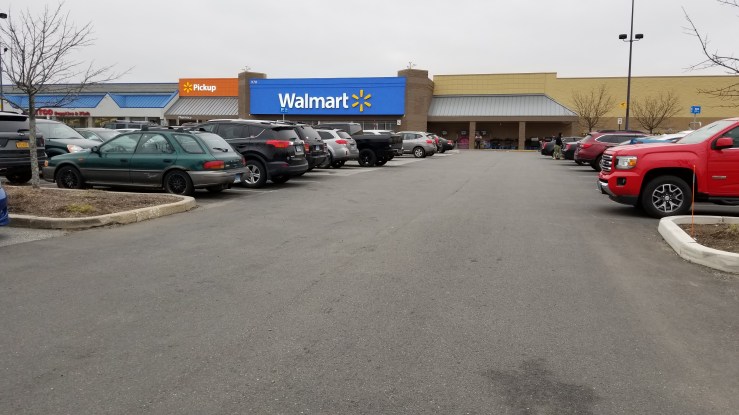
Walmart toy aisle.

T-minus three days till Christmas.

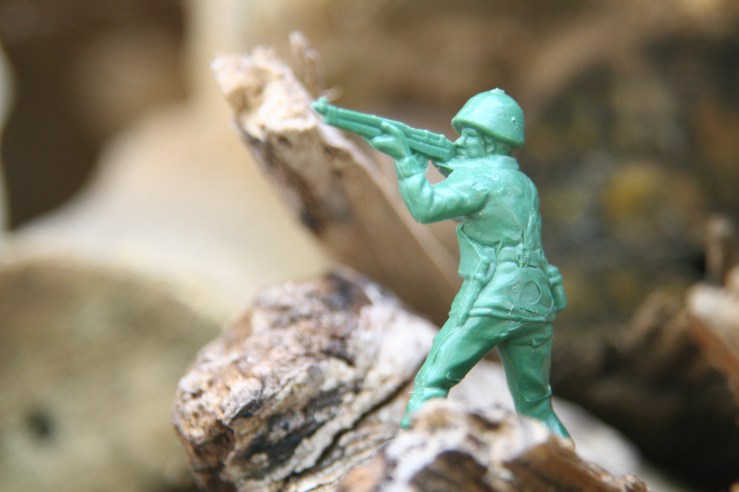
Today I am a grown man staring at a plastic military-shocktrooper-gunship playset. Looks pretty rad. Action figures sport big muscles and oversized rifles. Bright orange missiles snap onto the side of the chopper. I recognize it as just the thing mom and dad would have given me for Christmas when I was a kid. My folks were something else. They laughed at those other parents, the ones too precious to let their honor-roll darlings play with toy guns. Mom and dad loaded me up with G.I. Joe tanks and up-armored hovercrafts, life-sized plastic M-16s, WWII-style combat helmets. I’d spin circles around the driveway in a camo-patterned Big Wheel tricycle decked out with gun barrels, scanning the backyard for creeping Russian soldiers, sweeping the sky for bogeys. 

Today I am eight years old. I stuff a G.I. Joe into some random plastic car. When it comes to toys, I mix and match. He-Man rides into battle atop Optimus Prime. Barbie goes on dates with all four Ninja Turtles. I pretend the car runs over a bomb. Boom! I flip the car into the air, watching it spin circles before slamming against my bedroom floor. I fish the brave soldier out of the vehicle. Disaster. The rubber band connecting its legs to the torso has snapped. My G.I. Joe is an amputee, split cleanly in half. 

I rush to my father. Wake him from a Sunday afternoon nap. Dad can fix anything. He’s that type. Square jaw. Reliable. He fought in Vietnam. Infantry. Volunteered for it. I don’t think he saw much action, but he received the Purple Heart twice for wounds suffered when landmines detonated nearby. For the rest of his life, a pattern of dark blotches remained visible on his arms—a grim pointillist masterpiece, black marks from the heat and debris of explosions. If you’d glance at his arms and didn’t know, you’d just think it was a million freckles. Faded black globs, seeming to flow, combining into some kind of super freckle. Only they aren’t freckles. They are the fingerprints of landmines.

Dad examines my bifurcated toy. Fiddles with it, tries to loop the split ends of the rubber band around a small metal hook in the torso. He asks what happened. I tell him about my game, the imaginary bomb. Dad shakes his head like he understands. Tells me it’s fine. His voice sounds strange, like he’s speaking from far away. He tells me he saw the same thing in Vietnam. Some guy he’d known. A bomb. Explosion. Dad was right there beside it. When the smoke and noise cleared, the guy lay on the ground in two halves. 

Dad fingers both pieces of my toy like an old woman with a Rosary. Frowns. Hands them back to me like he doesn’t want to touch them anymore. Tells me he can’t fix this one. Sometimes people break, he says. Sometimes you can’t put them back together.

Today I am a grown man writing a story about my father.


Alex Miller is a writer and graphic designer who lives in Denver. His fiction has appeared in Pidgeonholes, Maudlin House and Rabbit Catastrophe Review. He is the author of the short story collection, “How to Write an Emotionally Resonant Werewolf Novel.”

“Fell Out of the Car” by Lanny Durbin

6387085809_0514c48144_o.jpg

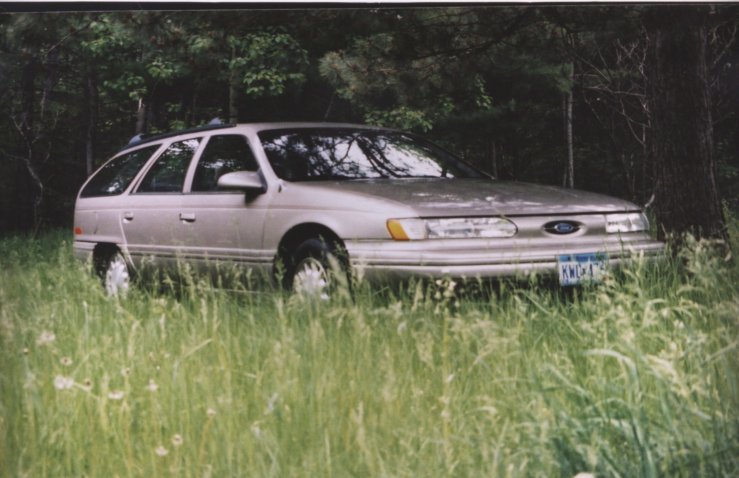
Fell out of the goddamn car. Can you believe that? Really made me think, honestly. Made me think, man, what the hell am I doing anyway? The things I did to lead me to tumbling out of my 1994 Ford Taurus and eating shit on the pavement—I probably shouldn’t have been doing all those things. Maybe I deserved it then? As I walked in the ditch by the side of the road towards where the car finally stopped rolling and hit a tree, I really wondered if I deserved it.

Driver’s side door didn’t latch all the way anymore. You gotta pull this stretched-out coat hanger through the door handle and then spool it around the steering wheel or something to get it to stay shut. But I was a zombie and I forgot about the coat hanger. Leaned my head against the window, for just a second you know, and I wasn’t wearing a seatbelt, and then—baddabing—that’s how I fell out of the car going thirty. A thump, my gut slamming against the pavement, then some scratching and thuds as I rolled like a stupid baked potato into the ditch. 

I felt a little relief when no cars passed me by as I walked, a bloody scuffed up mess. I was embarrassed to be seen, for one, but it also had me thinking of this episode of Unsolved Mysteries I watched with my mom back then. This lady had a flat on a two-lane like this one. Guy in a Wrecker pulled up, bam, shot her in the gut. Didn’t rob her or touch her or nothing—just wanted to shoot someone. She didn’t die, just lied there and bled until another wrecker showed up and didn’t feel like shooting someone. Never found the guy. And this lady was a nurse or a veterinarian, can’t remember, and I’m just some bum who pours my paycheck into the video poker machines. My episode of Unsolved Mysteries wouldn’t make the cut!

Got to my car. It was toast. Some drippy hissings coming from the hood, some smoke, front end absolutely creamed against a tree. I grabbed my wallet and the handful of change out of the center console and the sack lunch I’d brought to work and left the car. The sandwich was fucked but the can of Sam’s Choice Cola and the bag of Cheetos were both doable. Not all bad, considering. Left my dead car and dead sandwich there in the ditch and kept walking.

Knew I wasn’t far from town proper, could see the lights of the little strip of a neighborhood that sat on the cusp. There was a NASCAR bar there. Figured I could lay low there for a while. And they’d have to have a couple video poker machines. The sun was still up when I fell out of the car but I couldn’t tell you how much time had passed. Was for sure night time. I got into Duffer’s and I was right—a couple video poker machines. A lot of things I thought would always be around, well, they weren’t around anymore. Things like helpful friends, self-worth, ambition, or a clear signal to a good feeling. If not gone—hell if I know where they were hiding. But there was still something I had that, at least, gave me something to focus on for a while. Video poker machines. The Slots. You put the money in and maybe some more comes out if you press the right button, or land on the right number in the algorithm. There’s nothing else to worry about when sitting in front of The Slots. The Slots were the last thing I had around.

The Slots and booze.

Maybe you come out in the black. Maybe you win big as hell and drift on that high a while. Also, maybe you really shit the bed and have to work doubles for a month to climb back out and then you fall asleep at the wheel and fall out of the car like a stupid baked potato. But that can’t be the norm. Plus, how the hell else was I gonna get a new car?

I started hot, like red hot. Stayed in a groove for a couple hours. Started greasing up, ordering gin and tonics for myself and rounds for the few patrons that shuffled in and out. Hey, thanks, pal, they might’ve said. Some looked at their free drink sideways. What is this about? It is kindness friend, kindness that exists only when my hand is HOT and I’m lining up the little treble clefs inside the Rock N Roll Dice game. I was the king of Duffer’s Bar and a benevolent one at that. Duffer himself came out from behind the bar to marvel at my winning ways. Slapped me on the shoulder and laughed, said what are ya gonna buy my bar with those winnings? 

I said, maybe! 

We laughed again and then he left. I sat and waited for my own personal wrecker to roll by—a slug in the gut or a ride back into town. Was just like the Slots. Who knows what was gonna happen! 

And I thought about the next car I’d buy for 1,200 bucks and in which ditch it would look best, rotting away.

A stupid carcass.

A real worthless thing.