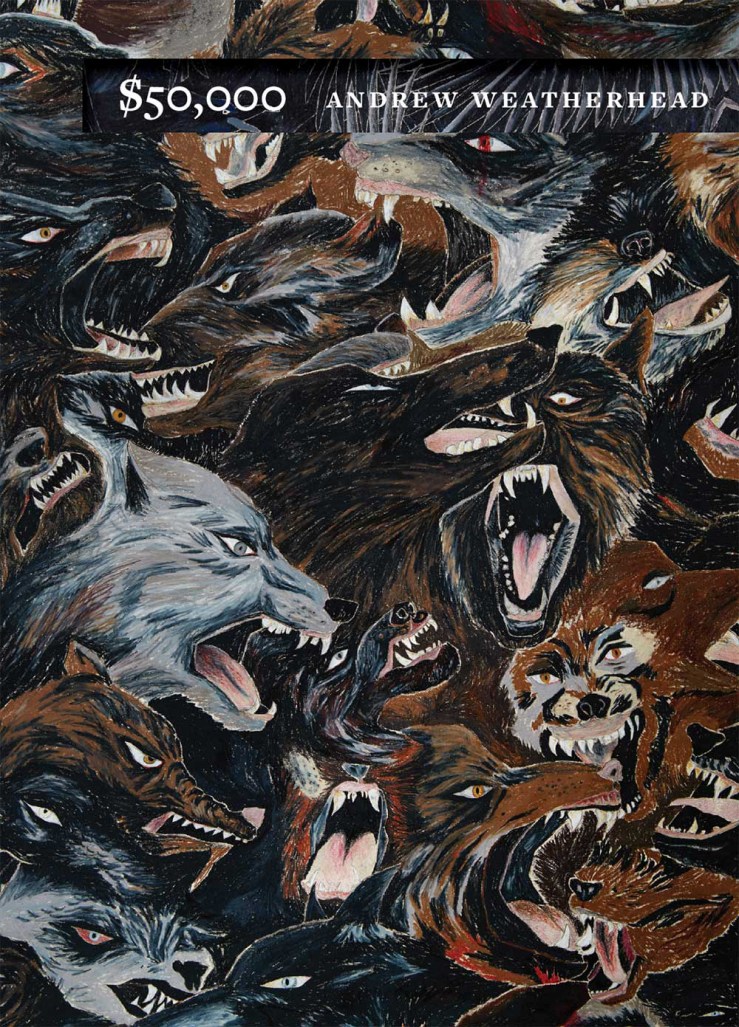
Review of ‘$50,000’ (Andrew Weatherhead) by Alex Weidman

9781945028267.jpg

I hate to start this way. I hate to start a review of someone else’s writing by talking about my writing, as if I’m writing in any kind of way that can be taken seriously, but lately anytime I’ve gone to write something I’ll reach a point where a thought strikes me. I’ll be writing and suddenly I’ll stop and think: “What’s the point?” And usually, or always, my point is to make some kind of point, which ends up boring me so much I don’t continue. And if not exactly a point, the most innocent thing I might be doing with my writing is trying to be clever, or smart, which fills me with a boredom even more overpowering. What does it matter? What could I possibly have to tell anyone about? Seriously, we could be underestimating the permafrost thaw by as much as 50%. The United States Army’s internal research suggests societies could start collapsing within 10 years. How much could anything I have to say matter?

This feeling has leaked into other people’s writing as well, mostly—obviously—fiction. It’s as if all I see in other people’s writing is their striving to make a point or to be clever. I quit reading more fiction books in 2019 than I finished. It’s like, oh, you put a Chinese Muslim immigrant and an Iraq War vet together in New York City? Guess I don’t have to read the whole thing, because what else are you going to say besides the world has made a mess and therefore human connection is complicated? I use this example because I’m sure it’s not about the book being bad necessarily, but I can no longer convince myself to suspend acknowledging where the writing seems to be going. I don’t have the patience anymore. I understand the antagonism between the US and China. I know what we ask soldiers to do to Muslims. I know how fucked up immigration is in this country. It’s not that you can’t write about those things in fiction anymore, I don’t think, but setting up stories against realities like that is not only not interesting to me right now, it feels corny. It’s like, I know where the world is going, and it’s to shit, so I don’t know how you could say anything else with premises like that. To try to extract anything else, let alone something like hope or happiness, out of those enormous premises feels like an outright lie. Or it’d take nonfiction. The bad is becoming so big it’s outpacing our ability to even comprehend it, let alone escape from it. The American war economy is a hyperobject. The relationship between the last two superpowers at the end of the world is a hyperobject. Climate change is a hyperobject. You’re not getting anything out of it. You’re not subverting it with daily life because daily life is swallowed up in it. You can throw in all the tricks you want, but that won’t obscure the fact that almost everything at that scale is horrifyingly vacuous right now. Most things at that scale are where the world’s real nihilism exists. Allusion, realism, fabulism, dirtbaggery, whatever one might use to try to get anything more out of reality like that is crushed under the actual weight of it. And the same goes for poetry. Metaphors, similes, bizarre forms to mirror confusion and chaos, to signify a way to understand the text, to signify a way one is supposed to feel reading the text, for me it all gets crushed under whatever reality is being hinted at. If I see a poem going all over the place I don’t even bother. Your poem is in two columns and can be read in three ways? Is that not just a gimmick? In fact, devices like these feel so shallow compared to what they’re going after that they have not only been landing flat, I can’t stop seeing in them the attempts to be clever or make a point that I can’t seem to stop doing myself.

But then something like this comes along: 

“Tater tots, untouched, in the trash / B-roll of hell / Stock photos of people losing the will to live / Every few hours a man with one eye walks by my desk / He sees the real me, eating lunch alone” 

There are 741 lines of this, 741 unstructured, standalone, non-narrative lines. 

“A music without sound / Michael Jordan crossing over Larry Bird / Allen Iverson crossing over Michael Jordan / Light from the computer screen while the city turns to dust / Hours pass… / Lie after lie delays the truth” 

It’s immediately readable, and the readability, how fast you’re drawn in, is refreshing. There are no tricks. There are no gimmicks. There’s more blank space than text, which may be the way it’s supposed to be done. And it’s not that it’s just a bunch of nonsense. It’s not that it’s not going anywhere. I’m not saying that you need to be incoherent to say something interesting, because there is an absolutely recognizable feeling as one get deeper into it. There is an arc, however sporadic. It’s dark and sometimes funny. There’s no story. There’s no real build or climax. It starts to dawn on you that it’s like your life. It’s like my life. It’s probably like Andrew’s life. The peaks and valleys (especially the peaks) have been grinded down into a more or less straight line that just goes on and on. $50,000 is the most honest book I read last year. It was the best book I read last year. It felt like it was saying something important. It felt like it grappled with the question, “what’s the point?” and wasn’t crushed. But how could such a simple book do that?

“Facts can’t change us; beliefs are too resilient / Agreeing to disagree may be all there is / Even though scientist guess we’re all just guessing / Because if knowledge, then ignorance and fear / So I mistake spilled coffee for a shadow”

It’s right there. Facts don’t matter. You’re not persuading anyone. “No answers only interpretations” he writes later, aping Nietzsche. What’s the difference between answering and interpreting? I think the difference is in $50,000 Andrew isn’t going to give you spilled coffee as a shadow, or a shadow of spilled coffee. He’s just going to give you him mistaking spilled coffee for a shadow. Why would you take spilled coffee as a shadow, anyway? They’re hardly the same color, and not even the same thing. One’s a drink and the other is an absence of light. What would you get out of that right now? Would that tell you anything about the world? I don’t believe it. In $50,000 all you get is Andrew mistaking spilled coffee for a shadow, and is that alone not something you can appreciate? Is that not good enough? While I don’t think many people would disagree that right now all we have is each other, and that we need to be there for each other, I think hardly anyone is willing to take the implications of that seriously. Implicit in that sentiment is the understanding that we are totally alone with each other, that there isn’t any sort of transcendence to look forward to or any tradition to fall back on. It implies a lack of any deeper connection to each other and to the world. Our relationships with each other and the world are not metaphorical or transactional. What that means is you don’t get spilled coffee as a shadow. The best you can do is try to appreciate that someone has it at all. It’s not mine and it’s not yours. What we all uniquely have or experience isn’t a metaphor, it isn’t something to be bartered and traded, nor should it be. If it sucks it sucks. If it’s hard then it’s just hard. I think this is where the misunderstanding of identity politics, or intersectionality, or representation occurs, when they’re seen as based on metaphorical relationships instead of literal experiences. If we can’t get to a point of appreciating the inherent experience each of us have in a way that might not affect us at all—or if we can’t present our experiences without attaching signifiers of ‘intelligence’ or a ‘better’ understanding—I don’t think we don’t stand a chance. As humans we’re all as disparate as the lines that make up $50,000. Why shouldn’t everything be this simple? There’s no real connection. We’ve got to make do with whatever kind of ‘one’ these lines, or we, form. Even if they don’t form a coherent narrative. Even if it doesn’t make sense.  

Baudrillard called this world Integral Reality. Absolute reality, all there is is all you see. There’s nothing left behind all the faces and signs, there’s no greater, or more concentrated, or truer meaning. “Colville died last night,” Andrew writes in one of his lines. Colville is dead, and you can put together as many facts and anecdotes about his life as you want but you won’t make a metaphor out of it. All you’re left with is feeling bad for his parents. And if you can’t find a metaphor in something like a friend’s death, what chance is there of finding one anywhere else? It’s best to just quit trying. Just give us what you want to give us. Strip it all down. $50,000 does it literally. Line after line after line. Metaphors and similes minimal if they’re there at all. Of course I don’t know if this style has the kind of momentum and/or pliability to become a form, something that can be done again and again, but I also don’t think literary devices are inherently signifiers of fake things. They just feel, in face of all that’s going on right now, useless at best and lies at worst.

I hope people read $50,000 and try to strip their perspectives of all pretensions like this. Although it might be ironic that this places all the emphasis on individual voice and experience at the same time I’m saying I don’t care or want to hear your metaphor, it is more an act of trust, a trust in oneself and a trust in the other to be radically honest. I hope all writing, not just poetry, goes this way for a little bit, even though I obviously have no idea what that would look like. I guess it’s something you can intuit. And clearly I didn’t read all the books last year. I’m sure other people are writing in a similar way, but I struck out more often than not. The only other thing I read last year that wasn’t nonfiction that felt as real as $50,000 was Nick Drnaso’s incredible Sabrina, which is illustrated and written in Drnaso’s similarly bare form. It’s this bareness that feels interesting right now, this Benzodiazepined, how-much-longer-are-we-at-this kind of bareness. I’m talking about not pretending your writing has made things less fucked up. I’m talking about not lying. I’m talking about how Andrew opens $50,000 saying, “No matter how depressing this book may get, just think about how much positive thinking it must have taken me to finish it.” I’m talking about Joy Williams saying, “One of the great secrets of life is learning to live without being happy.” Or maybe I’m talking about Joy Williams saying this: “Imagination is nothing. Explanation is nothing. One can only experience and somehow describe–with, in Camus’s phrase, lucid indifference.” The big picture is morbid. Maybe Andrew has figured out that right now anything more, like happiness or hope, can only be gotten at fleetingly, in the minuscule, mundane cracks in between the pummeling the world gives.


you can by $50,000 HERE.

Alex Weidman works at a co-op and lives in West Virginia.
3 Flash Pieces by Michael O’Brien

4058012881_1b9ec4fcb9_o.jpg

sack of meat netflix special

The producer, the camera man and the sound guy start to shove the meat into a see through bag. The meat is unidentified; none of them know which animal or what part of the animal it came from. They don’t discuss this. The sound guy picks up his sound equipment. The camera man goes to his camera. The producer picks up the sack of meat and props it on a chair behind a desk in front of the camera. The producer makes sure he is out of shot and starts to prod the sack of meat with a stick. It squelches and other sack of meat noises leave the bag mass. They non-verbally decide to put a grey suit on the sack of meat. The producer starts the prodding routine again. Squelch. Sack of meat noises. Five minutes pass. Then fifteen. Another fifteen. And then words start to come out of the sack of meat. All three of them smile reassuringly. The prodding continues. And the words continues.


the earth IS flat, bro

So you are unemployed for six and a half years and then you finally get a job. The job is in advertising for some big burger chain. Anyway your first major task is to draw an earth. You ask about the concept behind it but you space out and don’t hear what they want. So you just draw the earth as if it was flat for the lols. Strangely everyone loves it and you get promoted to prince of the burger advertisers. WOw! But slowly you become mad with power and a flat earth fetish grows deep inside. Firstly you spend all your free time drawing flat earths. Then you spend your free time looking for the end of the earth. And as if by magic, one sunday while sunday driving, you find the end of the earth in Bolton, Lancashire. But you accidentally drive off the earth and fall into space and die. And now people still say the earth is round. Fucking losers. I think your ghost would be pissed at all these round earthers and their horizons but ghosts aren’t real. Bro.


feeling like shit in the happiest place on earth

I had scheduled an interview with the post office but I couldn’t make it due to the fact I’m finding it hard to breath. Likely story. Anyway, I’m at the doctors now – more accurately I’m in a queue to see a receptionist. My number comes up. She gives me a torturous time. I am sweating and dying. Wonderful. On one side of her cubicle are two pictures of cats. One is smiling in a photoshop kinda way. The other is a cat in a more natural pose. Seems like it might be her cat. Maybe her cat that died. I don’t really know.
She thumps away at her keyboard. She thumps away at me with questions. All I say is here is my European health-card. I am sick. Let me see a doctor, please. On the other cubicle wall is a picture of a woodpecker in a lovely pastoral setting feeding its young. I get the sense the receptionist is not into woodpeckers. I get through the questions and forms. I see a nurse first and she takes bloods and that kind of thing. Finally get to see the doctor. He is thorough, competent and polite. A good boy. He doesn’t waste words and tells me little. He sends me for more bloods and a throat swab. I head back to my flat. At the flat I take a nap. Wake up and drink coffee. I wait for blood results. I hear the woodpecker. I think he is smacking against the lampposts again. It’s also raining.

Michael O’Brien is the author of, most recently, Silent Age (Alien Buddha Press). His writing has been published widely in print and on the internet, and translated into other languages. An extensive list of these publications can be found here. He is also the curator of Weird Laburnum. You can follow him on twitter @michaelobrien22

2 Poems by Josh Sherman

how to tell stories to children.jpeg

HOW TO TELL STORIES TO CHILDREN

How to Tell Stories to Children
was originally published in 1905
Sara Cone Bryant wrote it

She was an author of children’s books

Sometimes I think my life is being written
by an author
of children’s books
like Sara Cone Bryant

Things are oversimplified
dogs play a disproportionate role in the plot
there is whimsy that just seems sad
to normative adults 

Anyway, you were reading
How to Tell Stories to Children
on April 19, 2017, around 9:45 p.m.
while riding the streetcar

Your pants were pea-green and wide-legged
Your hair brown-like blonde
You were probably an art-school student
Your major, probably conceptual

You’d just sat beside me
because there was an empty seat
But maybe also because I was reading
But maybe not because I was reading

The streetcar driver was a comedian—he asked
“What kind of room has no windows or doors?”
And right away you replied:
a mushroom

It wasn’t rehearsed at all
Your brain just worked like that
Nobody else had answered or even tried
Then you went back to How to Tell Stories to Children

I continued reading Landscape With Traveler
A novella by Barry Gifford published in 1980
I wanted to get to know your brain

I wanted to be a streetcar operator
But you got off at Dovercourt

And I took the streetcar to Lansdowne


BODEGA

I feel like sad corner-store fruit
I’m a little bit expired
I’m a little bit bruised
I wasn’t always like this
but it’s how I am now
You’ll find me beside the Lays chips

and the gummies
You’ll find me under unflattering light
You’ll find me at unexpected hours


Josh Sherman is a Toronto-based journalist with fiction previously published online in Hobart and in print in the Great Lakes Review.


Art by Julienne Bay

“Transmutation of Waste” by Leah Mueller

30466369651_9e13f73349_o.jpg

Recycling your IRS
pay or die letters
is an essential part
of being a good American. 

They were made from trees,
ground into pulp, flattened.
Emblazoned with words

like “forfeiture.” Sent
through the hands
of dutiful couriers
from the US government–

postal carriers in
year-round shorts,
sturdy men and women

who avoid your eyes
while they command
you to electro-sign
their sinister plastic devices.

Never keep these notices,
you don’t want your
friends to see them.

Don’t burn them,
it causes global warming.

Don’t throw them away,
they’ll end up in landfills.

Reuse the letters by
putting them in your
blue recycle bin

beside those spent bottles
of wine you couldn’t afford
but drank anyway.

The letter will leave
your hands and travel
to a facility for its revival.

Its smooth, mended surface
beckons false promise,
reincarnation as toilet paper
or perhaps a love letter.

Instead, it will be transformed
into yet another postal edition
of terrible news, since

nothing good ever comes
in the mail anymore.


Leah Mueller is an indie writer and spoken word performer from Tacoma, Washington. She has published books with numerous small presses. Her most recent volumes, “Misguided Behavior, Tales of Poor Life Choices” (Czykmate Press) and “Death and Heartbreak” (Weasel Press) were released in October, 2019. Leah’s work also appears in Blunderbuss, The Spectacle, Outlook Springs, Atticus Review, Your Impossible Voice, and other publications. She won honorable mention in the 2012 Wergle Flomp Humor Poetry contest. Her new chapbook, “Cocktails at Denny’s” was published by Alien Buddha Press in November, 2019.

3 Prose Pieces by Rickey Rivers Jr

3066430109_b00659be9b_o.jpg

Funeral

Thank you to the obituary but the funeral wasn’t as funny as it should have been. You see, it should have been hilarious. There should have been dynamic colors and sounds. There should have been animals and puffy outfits. There should have been something worthwhile. Instead there was nothing, suits and tears. Imagine being told of a clown dying and expecting a speculator funeral showcase but instead receiving mundane mediocracy. It was enough to make me sick. I felt like I’d been tricked. A bunch of suited men and women without face paint, they probably weren’t even clowns. I had more make up on than anyone there. You understand how embarrassed I was? And this was a closed casket funeral too. I wanted very much to open the lid and see what the big deal was. Imagine if the clown in the box died wearing a funny face. Wouldn’t he want people to laugh one last time before his burial? Am I the only one with a sense of humor anymore? I know some people are afraid of clowns but the idea is so foolish that I absolutely refuse to acknowledge the phobia further. After the burial I walked around the cemetery looking at the gravestones. I began to make faces at them. Every single row of bodies received a silly face. I was so angry that I had to do this, childish as it was. I was so angry that I began to laugh hard and loud. No one came to me in concern and I ruined my face with wetness.


Care

I’m a nurse. I’m in the business of care and pain management. I’m firm. Pain relief should be priority. Even when the doctor doesn’t agree I still help the patients. I have to. It’s my job. I don’t want them to suffer. It’s cruel. Being in a lonely hospital bed, staring at the walls, ceiling and television is no way to live. Imagine being surrounded by so many beeping machines and such, of course you’d want relief. They’re fragile. I feel that way. Of course they’re in pain and if I can relieve then I relieve. I won’t let them suffer so needlessly. If they buzz I run. I relieve. Trust that doing so doesn’t lead to addiction. No. I’ve never had a patient become a slur. Doing so instead leads to thankfulness and oh, such euphoria. Why buzz when you no longer suffer? Why buzz when pleasure has left you unable to lift even a finger? I satisfy. I relieve with the care and gentleness of a mother. When you’ve suffered for so long of course you’d want someone to whisk away worries and manage your pain so sufficiently that you’re left in brilliant states of bliss. As an angel, dress certainly doesn’t hurt, alas no wings for me. Oh, I do live to serve. I do live to assist. I care so dearly for them and I notice their affinity. It is accepted, respectfully, as are they.


Streets

I’ve been walking up and down for a while. These streets are lonely. People are cruel. They give dirty looks as if I’m a beast. I know this isn’t true. I am who I am. My life has led me here. Yesterday evening I saw a little boy sitting on the path. The boy was crying. I planned to walk on by but the boy’s crying began to anger me. What did he have to cry about? Past approach I stopped in front of the boy and asked what was wrong. The boy looked up at me, his eyes were stained red. He told me that his parents were fighting again. He said he left home because he didn’t want to see what would happen next. I looked behind him and asked him if his home was the one that seemed to be splitting down the middle. The boy nodded confirmation. I asked him if he had ever been struck. He nodded again. I wanted to take that boys hand and lead him to a better place, a place where he could be free from such violence, a place where he’d never have to cry from pain again. I felt for him, so much so that it physically hurt me to speak with him further. The boy asked where I was going. I said nowhere. He said “that sounds nice, to be nowhere.” I told him that’s wrong. He insisted, said “I want to walk with you.” I told him no, because my road doesn’t end. Cruel as it was I had to leave him there. He deserves a future, no matter if troubled.


Rickey Rivers Jr was born and raised in Alabama. He is a writer and cancer survivor. He has been previously published with Fabula Argentea, Cabinet of Heed, Back Patio Press, (among other publications). https://storiesyoumightlike.wordpress.com/. You may or may not find something you like there. His third mini collection of 3×3 poems is available now: https://www.amazon.com/dp/B07VDH6XG5

Twitter: @storiesyoumight

3 Poems by Leah Mueller

25030385431_0035102cc9_o.jpg

Why You Won’t be Getting a Refund

Thanks for leaving
my rental house
trashed with your emotions.

You can’t have any of your
security deposit back. 

Those many ersatz moments
when you mentioned loving me
will all count as damages.

I’ve kept track of each one,
in case you want
an itemized report.

The carpet cleaning bill
from your meltdowns
was bad enough, 

but then you put your fist
through my window,
jumped into the yard
and took off running
before I could catch you
and hold you accountable.

Rest assured; I’ll make sure
I find you, even without
a forwarding address.

Meanwhile, I’ll take comfort
in knowing your reputation’s so poor
that even the landladies
in your hometown

would rather see you starve
then ever rent to you again.


Lullaby

Someday
you’ll understand

what it means,
and then you’ll forget:
like when the sun
comes out 

right before sundown:
brilliant half hour,
then darkness.

Sleep, and wait
for the next one.


Metastasis

One wish:
to go backwards

in time, and
stop the army

from invading
your skeleton

before it captured
your cells:

that wish
never granted,

your chance forever
blown into shrapnel,

scattered like
bits of detritus:

burnt sacrifice
to indifferent gods.


Leah Mueller is an indie writer and spoken word performer from Tacoma, Washington. She has published books with numerous small presses. Her most recent volumes, “Misguided Behavior, Tales of Poor Life Choices” (Czykmate Press) and “Death and Heartbreak” (Weasel Press) were released in October, 2019. Leah’s work also appears in Blunderbuss, The Spectacle, Outlook Springs, Atticus Review, Your Impossible Voice, and other publications. She won honorable mention in the 2012 Wergle Flomp Humor Poetry contest. Her new chapbook, “Cocktails at Denny’s” will be published by Alien Buddha Press in November, 2019.

“I Wanna Go Shooting” by Kyle Kirshbom

24304800938_bb2b2d617d_o.jpg

Tom Levy ran out his house waving his dad’s .45 in the air. On top of the hill, I was in my driveway scratching my belly and looking for a quarter I dropped. I looked around embarrassed someone was watching the ridiculous scene. At school last week Tom bragged how he knew the combination to his dad’s safe. Tom never took a math test he never failed, so the thought of him being able to memorize even 3 numbers was cute, at best. Yet, towards me he ran with the piece in hand—his stupid crooked smile shined brighter than the gun. 

As he ran I thought about a couple weeks ago when I was talking to Samantha outside school when Tom yelled, “Just fuck her already,” in front of everyone. Samantha walked away with red on her face. Tom flashed his crooked teeth and ran off. 

A month earlier Tom came over and handed me a bottle of amyl nitrate. 

Anal nitrate?” 

“No, Amyl nitrate, not anal. But it does loosen your asshole.” 

“Why would I want that?” 

“It’s for buttfucking.” 

“I’m never doing that…it’s gay…”

“Yeah it’s pretty fucking gay. Wanna do some?”

“What do you do?”

“Sniff it. Take a big whiff and you’ll feel like you’re flying.”

I put the bottle under my nose and sniffed like he told me to, passed it back and laid down on my bed; feeling lifted. Tom strongly inhaled and released a big sigh before cracking his neck like an actor playing a deranged person. He looked around my room he’s been in a hundred times as if it were his first, and then at me with the same vaguely menacing look. He jumped on top of me and began grabbing at my hips and pinning my body with his weight with his mouth pressed against my face. I pushed him off and said, “What the fuck Tom,” but Tom got up and ran away without saying anything.

A few years ago Tom slept over. We’d met at camp and got along okay. We joked about girls and liked the same death metal bands. After my parents went to sleep I flipped the channel to find the late night soft-core porn. We watched, then I asked if he minded if I jerked off a bit. He said, “Yeah I don’t care, but could I do it too?” I told him sure and grabbed a pillow. 

“I’m going to create a barrier so we can do it without looking at each other.”

“Yeah, cool.”

Three women fondled each other in a bathtub. I couldn’t tell what Tom was seeing, if it was the same thing I saw.

A half hour later I limped up to use the bathroom. When I came back, Tom was asleep on the floor with his cock still out. I put a blanket over him, turned the tv off, and went to bed. I didn’t see Tom again until the end of summer when we both walked into the same middle school. We didn’t talk about what happened for the rest of our lives. 

Tom’s curly brown hair bounced as he ran up the grassy hill—his eyes barely open. I stood and watched as he got closer. Right before he reached the driveway he tripped on a rock, pulled the trigger and shot himself in the head. His skull landed on the pavement. Blood poured out from his curls, flowing down and around the quarter I thought I lost. I walked over and his eyes were already shut; I couldn’t reach him. 

An ambulance picked him up, the sky was black. Tom’s dad looked at me like I took his son and planted the gun. I wanted to yell what the fuck do you think is going on here? A game? Something passionate? Something psychotic? Like accidents don’t happen? That there’s a reason for this? He got into the ambulance with his son and I got in a police car with a couple cops.

I got questioned by police for a few hours. I told them what happened. They said I could be in trouble. They talked about cooperation, the truth. They asked if I was upset with Tom, or ever thought about hurting him. I knew by telling the truth they’d put pieces together that didn’t actually fit. So I told them he was my best friend. Told them he never mentioned the gun. Told them I never wanted to hurt him. I even cried a little bit out of self-preservation. They carefully studied me, and in my pocket I rubbed my fingers against the quarter with Tom’s blood while I lied through my teeth. 

After waiting in the room by myself they came back to say that judging by the placement of the bullet and the way he fell and where the gun in his hand fell that there was no way I could have planted the gun. A million in one chance. They let me go with my parents. We walked out of the police station, got in the car, and drove home—I never knew a night could be so silent.

I planned on skipping the shiva. Technically I wasn’t invited, but my mom said that Tom’s dad didn’t mind if I was there, which was a good enough message I immediately picked up on. But I still wanted to go to the burial. 

It was overcast, and a good sized crowd. I hadn’t realized all the people Tom knew. Family, friends of family, people from school and their families. So many people, an eventful mourning. I walked into the crowd from the back, making my way to the front. Tom’s dad was delivering his speech when he saw me, paused, and continued. I stared at him, then at the casket Tom was in. The rabbi said a few prayers, then Tom’s dad and the other pallbearers lowered Tom into the ground. The rabbi said a final prayer, and everyone threw bits of dry dirt into the grave. People left to sit shiva at Tom’s house and suddenly I was alone. It began to rain. I reached into my pocket and tossed the quarter to lay with Tom. I called heads, but couldn’t tell what it landed on. 

As I walked home in the rain, stepping on cracks in the sidewalk, I felt like a movie was being played in an order that didn’t make sense; I couldn’t shake it, but my life up to this point hadn’t felt the slightest bit linear (instantly I craved something to soothe me out, something that’ll focus everything on a fixed frame that has no backwards or forwards, just to exist without existing, be, but not continue) then my fucking phone started buzzing; it was mom, asking where I was. I told her I was going for a walk, that I didn’t know when I’d be back, she  said she put money in my bank if I got hungry, “ thanks,” I said and that I’d see her maybe later, and she told me she loved me and so I said it back, then all at once, after hanging up, I remembered Tom without a firm grasp on any single memory we may have shared together, and in the haze of this memory collapse I dropped my phone and felt the screen crack and shatter. I tried walking, but couldn’t lift my legs, I tried standing, just couldn’t, I tried bending over to reach for the broken phone, and couldn’t, so, and as the wind picked up and the acidic rain pelted my coat, blurred my vision, and all the street detritus carried off the ground, whipping itself in a gust away in the distance, finally, a sinking, I sunk to the ground, into the cracks of the sidewalk, my body melting and spreading itself into the seams of the broken concrete where everybody walked on or over, and suddenly felt everything I am and everything I’ve encountered becoming increasingly connected, and permanent. When the city paves me over with fresh crushed rock and sand mixed with water and cement I’ll drown into oblivion like every spider’s web that’s washed away by a storm that seems to never end. The end is a deletion, an edit. Cemented.

Kyle Kirshbom is an American writer. He recently broke down and published his entire manuscript onto its own instagram page @DogShitPoems. His writing has been featured in SCAB, Holler Presents, and Sybil Journal. 

“A Methodical Approach to Sleeping Alone” by Hallie Nowak

37996850565_399dd1a2cc_o.png

Step 1: Light a candle. Break some incense.

Step 2: Admire the pile of dirty clothes at the foot of your bed. (Look, but don’t touch.)

Step 3: Turn off the lights to hide the pile of dirty clothes at the foot of your bed.

Step 4: Sit down on your bed that is too big for just you and barely close your eyes.

Step 5: Remember the fingertip of the first snowflake of winter on your eyelash.

Step 6: Remember the time that you locked yourself out of your apartment on Christmas Eve.

Step 7: Forget that you’re alone.

Step 7: Forget that you’re alone.

Step 7.5: Remember that you’re alone under the swollen moon and the pinpricks of stars and the cold, clear voice of winter. Everything leaks through the hairline crack in your window. A breeze bursts against your sallow midriff.

Step 8: Pluck the petals from your skin and carefully stack them on the corner of your bedside table. Admire the way they wilt, that dusty scent of your loneliness.

Step 9: Are you alone,

Step 10: Brood about the way you squeeze the toothpaste the wrong way.

Step 9: Or are you lonely?

Step 11: Get out of bed. Check your dim reflection obsessively. Note the discoloration under your eye. Note that the discoloration under your eye is the ashen scarf tangled in the bare fingers of branch in Moody Park. 

Step 12: Stroke the sad subtle indent his body left in your memory foam mattress.

Step 13: Make yourself cry.

Step 14: Weep until you feel a spirit leave your gasping mouth. 

Step 15: Flip the damn pillow over.

Step 16: Remember that the human capacity for love is infinite. Remember to lock the door to your house. Remember that your roommate makes breakfast for dinner. Remember to watch for shadows of men in the street. Remember that IHOP is open 24/7. Remember to brush your teeth. Remember the inky kindness in your cat’s eye. Remember the warm breve latte in your hand at Old Crown. Remember to feel everything. Remember to feel nothing. Remember that you are a Scorpio. Remember that everyone is alone: that no body is alone.

Step 18: The snow outside the window collects onto the glass pane next to your bed. The portable heater says 79 degrees. Your loneliness collects thin shards of ice. Your bed is warm. Your pillow is cold. How beautiful it is to be warm in a room collecting snowbanks. How beautiful it is to be not lonely; to be completely and irrefutably alone: 

in dreams; in sleep; within; without; alone.


Hallie Nowak is a poet and artist writing and residing in Fort Wayne, Indiana, where she is in pursuit of her undergraduate degree in English at Purdue University Fort Wayne. She is the author of Girlblooded, a poetry chapbook (Dandelion Review, 2018). Her work can also be read in Anti-Heroin Chic, Honey & Lime, Okay Donkey, and Noble/Gas Qrtrly where her poem, “A Dissected Body Speaks,” was awarded runner-up for the 2018 Birdwhistle Prize. 

Twitter: @heyguysimhallie
Instagram: @hallie_nowak


“The Skylight” by Abigail Stewart

39970426861_898a5c35e0_o.jpg

Her new job was a quiet place, exactly what she wanted after five years in food service — the soft tapping of keyboards, muted music piped through ear buds, an occasional outburst of laughter, undertones of conversation. 

She answered email queries and took her shoes off under her desk. She ate turkey sandwiches on white bread in the break room. She drank the free coffee. 

At first, the office seemed too bright, sunlit where she expected shadows cast by fluorescent tubes. Until she noticed the skylight. A 3’x3’ cutout of outrageous blue against a cream ceiling, light beamed down onto her wood composite desk like a beacon. She felt beatific, a barefoot saint tending to the needs of the disembodied masses. 

Clack, clack, clack. 

Someone had left a jade plant, discarded, at an empty corner desk. She brought it with her into the light, watched it straighten and lift its arms up toward the sun. 

She dutifully checked her inbox.

“Are you a boot?” an emailer inquired. 

“I’m sorry, I don’t understand your question. Please refer to our FAQ here,” she responded, per company guidelines. 

“Are you a bot? Are you real? I’m not giving my information to some Russian hacker.” 

“Yes, I’m real. How can I help you today?” 

The contact went quiet, as they so often did, the invisible lines of cyberspace irrevocably severed. Perhaps she had given them the assurance they needed in order to sleep that night. 

Clack, clack, clack. 

Keyboards, as always, and an undertone of something new, more insistent. 

Her eyes trained upwards. Two pigeons were scrabbling against the plastic covering of her skylight – she thought of it was hers now. From underneath they were inflated rafts, bug eyed, overstuffed, and grappling on a clear ocean. One had a piece of twine wrapped around his tiny, orange foot, buried deep into the flesh, a functional part of him now. 

She watched. 

His other foot, the good one, shot out like a gasp, vengeful and quick. The smaller pigeon fell, his bug-eyes pressed against the glass, looking down at her. A small rivulet of blood trailed from his chest. The other pigeon, no stranger to pain, gave one last nip to the neck of his deceased enemy before disappearing. 

The lifeless bird cast a long shadow on her desk. 

Her email pinged, a response from the emailer: “Russian hackers interfered with the election, so I need a picture of you to prove you aren’t a bot. Hold up three fingers.

No one else noticed the dead pigeon until it began to smell, only then did maintenance remove it. 

Abigail Stewart is a writer from Berkeley, California. She lives in an apartment filled with plants and books and breakable things. Her poetry has appeared in literary magazines, but mostly on bathroom walls. She writes a blog about books and dungeons & dragons: http://www.ageektragedy.net. She tweets at @abby_writes. 

“APHORISM REVIEW: GIVE A MAN A FISH…” by Ferdison Cayetano

15435572367_64e303e1d1_o.jpg

Complete it! Go on. It’s 100% true, and definitely one of my favorite sayings!

I don’t know what the big deal is, though. Giving men fish. What’s the harm, if you have the fish, and he does not? Generosity is a virtue. Teaching? Teaching takes time, effort. It could take years. Taking a fish out of your front jacket pocket and slapping it into a man’s hand, however, happens in an instant. You can keep giving him fish and giving him fish, for weeks and weeks and weeks. For ever.

It’s no problem, you say, even as you see his enthusiasm for fish and the light in his eyes dim with each passing day. His family can’t remember the last time they didn’t have fish for dinner, he says, and they tire. But you do not tire. You never tire. His polite attempts at refusal turn into outright attempts at avoidance. But you find him anyways. 

You always find him.

One day he sees you on the street and he runs the other way, but you run faster still. He trips, and on his knees he begs for mercy that will never come. You stuff a flounder down the front of his shirt. He limps away, sobbing. No matter. He’ll appreciate the next one more.

You open your mailbox and find a restraining order. A couple of hours later you are on the grassy slopes behind his house, exactly three hundred yards and one inch away from his back porch. You aim a jury-rigged t-shirt gun into the sky and fire, again and again and again. Fish arc through the sky. 

Thunk. Thunk. Thunk. 

Tilapia shatter his windows. A light breeze carries the screams of his children.

Fish delivered to his workplace. Fish ordered to his table at restaurants. Fish in his bathtub. Fish in his son’s cradle. Fish in the trunk of his car. Tiny guppies come pouring out of his cereal box instead of Wheaties. He looks in the mirror and he’s greeted by the dead-eyed stare of a mackerel tuna. 

The months of fish stretch into years, and you never miss a day.

It’s too much. It’s tearing his family apart. His wife takes the children out of state while he’s at work, and when he comes home that day he finds a rainbow trout on his living room table, twitching on top of the divorce papers.

Forty or fifty years into the future, on the very second of his death, you slash your wrists open and bleed out on your kitchen floor. 

In the formless void between worlds you flare your nostrils and catch the scent of his soul, which is ascending to Heaven. He’s almost there. He’s so close, but now you have him by the ankle, and he kicks helplessly as you drag him away from the light. You haul him into the black depths of the ocean, and you haul him deeper still, down into the earth. The darkness and the cold and the pressure, a million million tons of dark and cold and pressure– it all would have broken him, if he were not already broken. 

And in that suffocating madness something is pressed into his hand.

Give a man a fish, and he’ll scream. He’ll scream forever.


Ferdison Cayetano is a current student at the College of William & Mary. You can connect with him on LinkedIn and give him a real job before he commits to being a writer