3 Micros by John Sheirer

77032415_ec9cf42e7e_o.jpg

Happy Holidays

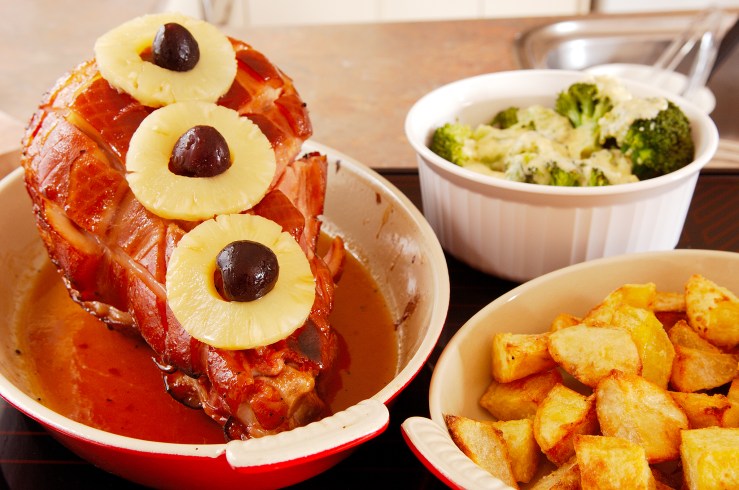
When she was twelve, April’s father was transporting the Easter ham from the outdoor grill to the kitchen and dropped it onto the breezeway’s concrete floor. April’s mother, of course, was furious. Moments later, both parents screamed at each other over the ruined meat. Pineapple glaze, April’s favorite, oozed into the pores of that rough floor, built so many years ago by the original owner of their ancient farmhouse.

From that day forward, nothing was the same. Her parents’ holiday arguments grew more common as the years passed, making fancy meals an endangered species in April’s home. Thanksgiving turkey drumsticks were wielded as weapons. The Christmas roast was lobbed like a grenade and left on the floor as luxurious dog food. Jellied cranberry sauce dripped from walls like Technicolor blood at the multiplex.

Now, so many years later, April has a family of her own. But she’s more careful. Her family battles are fought over ordinary plates of fish sticks or peanut butter sandwiches or mac and cheese. Her children will grow up with happy holidays.


Sign

Jessica eased the car to a stop at the traffic light. She and Wayne had never been in this part of town before. The GPS told them that they were just a few minutes away from the new restaurant where they were meeting friends for dinner.

“What the hell?” Wayne said suddenly.

“What is it?” Jessica asked, following his gaze out the passenger window.

“Who would give something that name?” Wayne asked.

“Where?” Jessica said as she focused on a large sign between two bushes. “Oh!”

In big, brown, capital letters on a beige background, the sign read, ANAL PLACE.

“That can’t be real,” Wayne said.

“Must be some kind of joke,” Jessica replied.

From the car behind them, someone tapped the horn, a polite reminder that the light had changed to green. Jessica and Wayne both kept their eyes on the sign while she inched the car forward. As their perspective changed, they saw the letters move out from behind the bush on the left.

“Ahhh!” they both said as Jessica fed the car more gas, and they sped on toward the restaurant.

“I think the waterfront is over that way,” Jessica said.

“I guess there’s a canal around here somewhere,” Wayne replied.

“Yeah,” Jessica said. “And we’ll have a good story to tell at dinner.”


One Thing

“There’s one thing that always works,” Marty said as he steered the car along the interstate. “One thing that always cheers me up if I’m feeling down.”

He could feel Debbie looking at him from the passenger seat. They’d been dating for three months, and things seemed to be getting serious. There were no enormous “red flags”–just a few small ones, barely pale pink, nothing that they couldn’t deal with.

“It’s something dirty, right?” Debbie asked, not laughing. “Is it something dirty?”

“No,” Marty said, chuckling. “Nothing dirty.”

“What is it?” Debbie asked.

Marty inhaled and was about to answer, about to tell her that a simple hand on his shoulder was all he ever needed to feel better, when Debbie interrupted: “Wait! Don’t tell me. It’s too much pressure! I don’t want you to be disappointed if I don’t do it.”

One far off day in some indefinite future, Marty’s daughter or son would ask him, “How did you know you were really in love? How did you know you were with the right person?” And by then Marty would have found the right person because that’s why he would have a daughter or son. Maybe by then he’d be able to answer his child’s question. Maybe by then he’d know about finding the right person. Marty envied that future version of himself.

But for that moment, as Marty steered the car toward the freeway exit and Debbie changed the subject to whatever their plans might have been for that evening, the only question he could answer for certain was how he knew he was with the wrong person.


John Sheirer lives in Northampton, Massachusetts, with his wonderful wife Betsy and happy dog Libby. He has taught writing and communications for 26 years at Asnuntuck Community College in Enfield, Connecticut, where he also serves as editor and faculty advisor for Freshwater Literary Journal (submissions welcome). He writes a monthly column on current events for his hometown newspaper, the Daily Hampshire Gazette, and his books include memoir, fiction, poetry, essays, political satire, and photography. Find him at JohnSheirer.com.


“The Party” by Anthony AW

44042402421_714220dc2e_o.jpg

Katie invited me— she lost her cowboy hat, but her friends found it, as some girl almost stole it & was caught. Katie rolled around while Kana & I did coke & afterwards we all danced to 1999 in 2019, while my black Chelsea fringe boots swayed with the mood. I was new to the group. Sydney sat on the couch & watched. Fernet left of the stove, Hanna welcomed me to the party. She’d be the shroomsgirl. In her room, four of them lounged on a full bed. Their limbs kept touching each other’s in that kind of close you only see in highschool friendships. It was there that Patrick corrected my pronunciation of ‘Franz Kline’ in an assholic fashion, but I found it sexy. Jacob mentioned that he was heading back to Indonesia sometime soon, & I didn’t care. He kept going on about ‘finding himself’ there. I lost my Kachina Doll ring at the party & suspect one of those mentioned above to have taken it— probably Katie.


Anthony AW (he/they) is an LA-based writer. Their work has been or will be published in Boston Accent Lit, Drunk Monkeys, FIVE:2:ONE, & Mojave He[art] Review. His micro-chapbook, Pantoum’d!, will be published by Ghost City Press for their 2019 Summer Series.

twitter: @an__o__

“The Dawn of Spectator Sports” by Thad DeVassie

4639201803_350e0c126d_o.jpg

There are feeble-looking man-ferrets running in circles, many endless ovals. They are thin, emaciated and reeling; clearly unkempt. Onlookers get the sense they’ve been at this for an excruciatingly long period of time, marveling at this spectacle without definition. They are equally perplexed when a man who drops his arm next to a chalked line trampled many times over suddenly means victory.  

There are huskier fellows throwing weighty parts of a forgotten pulley system around the infield, in concert with more nimble ones who invert themselves on poles and become primitive catapults reminiscent of when humans were artillery in those ancient, epoch wars. Opportunities for carnage escalate with each jump, with every throw.

Then there is the man with the javelin whose activity will someday struggle to translate well to modern playgrounds. Unrefined, he calls it what it is – a spear. He looks the part: suspicious and bloodthirsty. A thrust of his weapon guarantees a win of different sorts, but he knows better. He is the penultimate gladiator, the lure and the bait, tempting a growing field of spectators whose collective interests mount with the potential of soon-to-be impaled running man-ferrets.

Make no mistake: this is what puts butts in the seats, what really gets a crowd roaring.


Thad DeVassie is the author of the forthcoming collection THIS SIDE OF UTOPIA (Cervena Barva Press). His work has appeared in numerous publications including Poetry East, New York Quarterly, North American Review, West Branch, NANO Fiction, and PANK. A lifelong Ohioan, he is the founder of a brand messaging + storytelling studio in Columbus, and the co-founder of JOY VENTURE, a podcast and platform for sharing stories of unlikely and risk-taking entrepreneurs.

2 Micros by Rickey Rivers Jr.

15112370529_f5f6d21701_o.jpg


Clean

This year’s company orgy was a disaster. The concept of hygiene seems lost on several employees. How are you cleaner at work? Why would you even allow your spouse to leave home in such states of stench? I’m not in the business of relations with the unkempt. Though orgies are naturally filthy there’s a certain organized chaos within. We are not animals. We are co-workers. Therefore we should behave as such. I won’t stand for this sort of unclean behavior for much longer. I hope to see improvement next year. Baths beforehand, everyone should smell like assorted soaps and lotions. No matter your size, you shouldn’t be sweating before disrobing. I don’t care how anxious you are. Be professional and above all else be clean.


Backroom

There’s a woman on stage. A man is next to me. He leans over and says “She’s hot.” I nod because having a conversation in this place would be difficult unless you’re in one of the backrooms. I’ve never been there but I’ve heard tales. At some point the woman comes from the stage and stands in front of me. She’s beautiful though it’s difficult to tell in this light. Her energy feels almost tangible. She says something to me. I can’t hear her properly. It sounds like gibberish. The guy next to me says “Lucky you.” The woman reaches for my hands and pulls me to my feet. Well, I allow her to pull me. I’m bigger than her though she does seem to have a sort of strength unmatched. In the same way ballerinas are strong. You know what I mean? Now I am walking along with this woman, who has strong legs, strong arms and flexible parts, she leads me to a backroom. The lights are colored here, looks like Christmas mixed with Halloween. “What’s going on?” I say as I am pushed onto a couch. She puts a finger to my lips and leans forward. I can now smell this woman. She smells fantastic. With pillow-like lips a whisper hits my ear. She says my name and then I am taken.


Rickey Rivers Jr was born and raised in Alabama. He is a writer and cancer survivor. His work has appeared in Three Drops from a Cauldron, A Twist in Time Magazine, Neon Mariposa Magazine (among other publications). Twitter.com/storiesyoumight / https://storiesyoumightlike.wordpress.com/ His mini-chap collection of 3×3 poems is available now.

“Institution” by David Mayoh

4270194267_c6e58752ba_o.jpg

Slammed into a cold hard surface, dribble and amniotic fluid spews across it.

Primordial ooze.

An entrance, from the void, in this dense, cold realm. Aliens attend to me. Cold, sterile, fluorescent beams warping my innocent flesh. I have arrived and the situation is grave. I squirmed, whaled, beat my delicate, unformed fists, on the confining structure.

Later on they will say I signed up for this. We needed to wipe your memory, your knowing, so you can grow and experience. You are here to arrive where you are meant to. Follow the promptings. Good luck.

Father, I have strayed so far

Help me get back.

You are voiceless and tired, but you established the template long ago. You have called me forth to carry it on, but can I? You needed to show me the old way so I could help build something new? Is that it?

Some of us struggle existing within this interstitial grid, a finely maintained balance between Heaven and Hell, girdled by wounds, dominated and dislocated, attended to by agents of doom – subdued, medicated, beaten and throttled, they stop at nothing to eliminate our purpose and potential. Others seem to integrate seamlessly: machines.

Align and Obey.

Our cuts and scars, scabbed over, caste into bone and debris, no opportunity to heal. We have suffered, the men, women, ancestors, the collective pain is surging forth now. It is beyond me but now my own, mine to attend to, to clean up and rectify.

I have always wanted to die, to kill myself, or to bring death about through wreckless living. Return to the ooze. Some unknown force inhibits my efforts, forcing me to go on.  

Your lessons, father were so mired in confusion and our depressed souls flailed and waned, begging for expression.

My head slams into the enamelled wooden surface. I have survived the first stage and am cognizant now. Injected in to this system, the numerical hierarchy of learning. I suffer and wane as the unwitting agents perforate my essence with instruction, as they condition on behalf of the master. Those who serve are compensated well, they lead a tidy and comfortable life. Their souls are doomed.

Fluorescent lighting beamed at me once again, my flesh has strengthened since the last bout. I am more clear, more lost. The boredom and subservience. It is wrong. Is that not obvious? I struggle and resist, powerless, unable to speak up or initiate anything at this point. The master cackles and gives me a C- .

Something did not take effect early on. I wish it had. If it had, this would be easier. Raise your hand to take a piss, eat now, k, listen to the buzzer, follow the commands of your approaching technotronic overlords, submit boy.

Stifled and subdued, we cried. Silently at first, but with ever-increasing volume and magnitude. I know you struggled father, I can see it now. I feel it and I am here with you now, no longer your combatant, but your ally. You were tasked to continue building and participating in the structure. It tore at you, but no other way was available. I am now tasked with augmenting it, rearranging it in to a new order of life, of nature and balance. I’ll take what I have learned, and will apply it. I’ll die doing so. You guide me. Many have condemned and faulted you. I will catch your tears and transform them into harmony and cohesion. I get now what I am here to do.

My first memory, metallic and dead, rises back now. I see it was the first step among a process designed to create a certain type of human.

Inoculated with fear.  

Because I was not right, something was not right. This birth process institutionalized and marauded over by specialists and clinicians, test, meters, tubes and anesthetics. Devoid humans.

We had been fooled I now see.

Those attempting to dominate nature were doing the same to us, they had to.

The struggle has been present all along. They say be happy, it is a choice, focus on what you want, they give you tasks, exercises, manuals and protocols. Marketing, it is all marketing. It dominates, disguised, detrimental. Truth, why do I seek you, why do you complicate my life and weave this cyclone of growth and decay, awareness and ignorance?

We’ve had a lot to process and heal father. Our ancestral line, our genetic conglomeration rooted in abuse, death, depravity and self-destruction, they cry and wallow. We needed to answer the call, so we do this work now, and it will be apparent to you father, one day, in a higher place, as you transcend the doom.

but wait,

Finally, my head smacks into a slightly-less enamelled surface, a richer, darker wood. I have value now, I have gone through the stages and can contribute and participate. Rewards lay beyond the door of service and subservience to an external agent and organization. After it all, how did I end up here? Fear and death, failure and poverty, despite my narrative the program wove in and here I am now.

I am angry, it grows with the day. Why in the fuck am I here?

That light is back, the false one, the fluorescent one, it vibrates into my depths, enlivens the scars and wounds, the knowing,  finally inspiring the purge, rage and release I have been seeking, slamming into me, an anvil of terror and bewilderment. The cloak removed, despite the tailored fit and comfort.

I thought everything was okay, I knew it wasn’t.  

A complete break

I was sent away. I left to search. I did not know this at the time father but I came here to piece it back together. 

I must now go. I finally see as you never have.  

It has been slow and arduous, layer by layer. Their prodding and machinations have lost all power, pain is no longer feared.  I have felt true torture on those dark nights, mournings and afternoons. The prolonged submersion in to a world of toil, hastily trying to escape at first, eventually realizing that I could not. 

Left to me was only the weak fragile capacity to sit still and feel. A slow alienation from all things worldly. I sought answers and found none. The mass, the complex bore no understanding for me, or I for it. All lead back to the last place any of us want to go or look. That region, or place, they tried to dissect and digest on that hard cold table. You were watching though father, you protected me, you preserved that dim light, that motivating impulse which would lead to our salvation.

Now, our hearts merge, we are one. This was the point. 

Rest soundly father.


David Mayoh is a person for whom all has burned down. All illusions and confusions rose and passed. He is now interested in creating and collaborating with those aware that something is up. His dysfunction, perspective, and ramblings have been laid out at www.retrievethysoul.com.

Attachments area


“Cultural Appropriation as an Attempt to Find Meaning and Escape Loneliness – A Grand Review of Noah Cicero’s Give it to the Grand Canyon” by Dale Brett


GrandCanyon-NoahCicero.jpg

To review Noah Cicero’s latest book, I went way back. Right back to the start. The Human War, The Condemned, Burning Babies… I wanted to see how far Noah had traveled. I wanted to see how far I had traveled. To re-visit those words that I eagerly consumed several years ago. When I heard there was a new Noah Cicero book coming out, I was crippled by a deep yearning to re-commence my viewing of Noah’s lifelong quest to show the beauty and pain of human existence through his words. With Noah, it always feels like hitting the play/pause button when I pick up his latest book, as if I am picking up where I left my favourite TV show, the honest voice warm and familiar. Give it to the Grand Canyon, his most recent offering published by the excellent A Philosophical Idiot, is no exception. 

Before critically engaging with Noah’s most recent text, as I said, let’s go back to the start. In The Human War, his first published book which came out in 2003, Noah writes: 


“Someday I will walk free again. 

I’ll walk in the desert of Arizona, smiling,

with a bottle of cold water.

I’ll laugh at these days… 


[I]’ll walk to the bottom of the Grand

Canyon. I’ll stand there like I’m in 

heaven. I’ll be strong and powerful

standing there with my feet in the

Colorado river.”  


More than a decade ago, when Noah the writer was still wallowing in suburban angst-ridden existentialism, he was already thinking about the themes central to his most recent novel. Fast-forward to the here and now and it is apparent that Noah is still obsessed by the mythical power of the Grand Canyon. He still believes it can take your pain away. He still writes about what it means to escape our reality and be at peace with what we have. Give it to the Grand Canyon is Noah’s magnum opus. His ‘full circle’ effort. A story of the protagonist’s, and one senses the author’s, journey across the globe that leads him back to where his adult life started, the Grand Canyon. A place where he first realised there was more to life than the mowed lawns and high school football games of his childhood in Ohio. 

“Culture in Ohio, was it even real? Men would mow the grass, the grass had to be mowed. The leaves fell in the fall, the men would rake the leaves and put them in piles in the backyard. Everyone had basements, some basements were made into extra living rooms, as in, rooms where people lived, watched television and played video games.” 

Noah’s works have always resonated with me. I have often felt an inherent, deep connection with his words when consumed by them. The scenes of his novels and poems have helped me learn to live in a white, middle class Western world knowing there are others that share my apprehension and anxiety. Like Noah, I also felt fundamentally lost growing up in a similar low to middle class suburb in a Western democracy where the local no-hope population was fixated on mortgages, marriage and making babies. Where the car wash and the flat screen television were considered true titans of culture. As Noah says in Give it to the Grand Canyon, he “couldn’t find a dream there” and neither could I. One displaced soul in the suburbs of the Anglofied northern hemisphere, one in the suburbs of the Anglofied southern hemisphere.  

Like Noah, I too escaped to live in Asia, an attempt to live more anonymously in a place where we could ‘opt out’ while still maintaining our self-esteem. A place where we could both test our nihilism, reduce external expectations and somewhat control our anxiety. As Noah writes: “In Korea they called me waeguk, in Arizona I became a bilagáana. At least I was something. In Ohio, I wasn’t anything but “that guy.” Replace the word ‘Ohio’ with ‘Victoria, Australia’ and that is pretty much how I felt growing up. Nothing more than “that guy.” 

Ever since finding Noah’s work at the height of the alt-lit boom whilst engaged in a creative writing minor at university, his words have always given me comfort that I am not the only one who feels entirely displaced by the consumer-culture of the West. His early works punctuated by existentialism and nihilism made me feel solidarity through our shared belief that the suburban dream of Western culture is not for everyone. His later works tinged with Buddhist and Navajo teachings made me feel hope that one can improve their seemingly incurable chronic depression by travel and learning from other cultures in an attempt to find yourself. Give it to the Grand Canyon maintains that motif of finding yourself through the lens of other cultures. Noah is here to tell you that even if you feel terribly alone at the top of this hopeless world, there are still people somewhere on earth to share this unbridled feeling with you. 

The journey of Give it to the Grand Canyon begins when a young man named Billy Cox crumbles and leaves everything in suburban Ohio behind to head out for the Grand Canyon, then California, then Portland, then Korea, then Cambodia, then back to the Grand Canyon. Anyone who is aware of Noah’s own private travels, both physical and mental, will obviously see the link between Billy Cox’s world and the author’s own in what could be considered a largely autobiographical text. After an absence of fifteen years, it is Billy Cox’s account of his second time living and working at the Grand Canyon that forms the bulk of this novel. 

Like most of Noah’s books, Give it to the Grand Canyon is a novel about cultural appropriation. Not the bad kind though. The kind where you don’t fit in very well with your own culture, and start to borrow learnings from other cultures, in an effort to find meaning in the world. Or perhaps just to feel a little less lonely. Reading Noah’s works over the years, I have always got the feeling that he is a writer that is striving to find beauty and meaning in a world where there often is none due to the banal, commodified culture we find ourselves in. Noah does this largely by exploring and interpreting other cultures in which he, and we in Western culture, can understand and make sense of other cultures. Buddhist, Taoist, Navajo and Hopi ideas are all prevalent in Give it to the Grand Canyon. These themes play on the mind of the protagonist and author consistently throughout. Though most white male writers of a ‘privileged’ background who attempt to explain the merits of other cultural beliefs fail, providing uncomfortable and insincere readings, Noah’s respectful and honest words merge differing cultures with his own heritage as a white, educated writer seamlessly. At no stage do you feel that Noah’s appropriation of these cultures into his thinking is disrespectful or negative. The reader accepts Noah’s presentation of these appropriations as necessary upgrades for a person who does not have the tools to function in modern society. Noah’s classic non-judgmental approach, which makes him such a relatable and likeable writer (and person), is fully on display here. 

Perhaps Noah’s message regarding cultural appropriation is most apt in a passage where the protagonist Billy Cox encounters a Haruki Murakami-infused artiodactyla apparition as his mind starts to blur deep into a hike to the heart of the Grand Canyon. In a nod to Herodotus, an image of a bighorn sheep manifests and makes a comparison between two happy men of disparate cultures in Marcus Tullius Cicero, the famous Roman statesman and philosopher, and Dazu Huike, the Second Patriarch of Zen. It is clear that these two figures represent the current mish-mash of Noah’s cultural legacy. 

Firstly, Marcus Tullius Cicero, bearing the same name as the author and representing the values of Noah’s Western childhood comprised of responsibility and conformity: 

“He believed in the beauty of each citizen, and how each citizen could contribute and make a strong commonwealth. He had a wife and children, he worked in society, he was a moral man. When the soldiers came to execute him, he didn’t complain, he didn’t plead for his life, he didn’t scorn the government for killing him even though he spent his whole life trying to make that government better.” 

Secondly, Dazu Huike, representing all Noah’s learnings and appropriations of culture that have contributed to his being and ‘career’ as a writer: 

“He had no wife, no children, he had no money and never had any power. He spent his life seeking and perfecting his enlightenment. And spent his later years spreading the dharma, not waging wars and getting into controversies.”

The message at the culmination of this vision for Billy Cox is that both these men, the one that represents responsibility and conformity and the one that represents revolution and virtue “knew how to live and how to die, one for society and one for enlightenment.” At this point, Billy Cox smiles. One gets the sense that Billy Cox, and by extension Noah Cicero, have come to terms that both genetic lineage and appropriation of other cultural values are equally important parts of us. That this is not a negative, but something unavoidable we must accept to live out our days in this hypercapitalist shitstorm without being drowned in chronic depression. 

Noah’s writing has also changed, and improved, since the aforementioned early works outlined at the beginning of this review. In Give it to the Grand Canyon, Noah’s previous anger and resentment regarding existence have been replaced with a calming, zen-like attitude. His musings less political now, his thoughts more passive and introspective as he matures to complete a full transition to bipolar cowboy. Noah has always been considered a minimalist writer, however, downloading mindful Buddhist, Taoist and Navajo teachings to his brain have resulted in even further refinement to his style and greater clarity of his prose, ridding the text of any unnecessary detritus. Only Noah himself would know if this distillation of content is a conscious or subconscious effort. 

Either way, throughout the novel, Noah’s words sparkle with lucidity. Each sentence and word crafted in the present – a precise passage for the reader to follow the signposts to the here and now. The magnified clarity and sparseness of Noah’s writing, and by extension Billy Cox’s actions, come across as an attempt to escape their collective past, to focus entirely on the present. Nowhere is this more apparent than a scene in which Noah describes a 4th of July party at the Grand Canyon’s infamous Victor Hall, where a native American tells a drunken story of his time during the Vietnam War where he recalls burning babies. There is an almost exact replica of this story in The Collected Works of Noah Cicero Vol. I, put out by the dearly missed Lazy Fascist Press. If you wish to see how far Noah’s writing has come, it is a rewarding experience to read these accounts of virtually the same story side-by-side. A void of fifteen years of loneliness, learning and acceptance squeezed in between. 

Ultimately, Give it to the Grand Canyon is a story of isolation, but also a story of intimacy. A story of people from various cultural backgrounds and demographics moving to a place they believe will make their pain go away. The pain of lost love, the pain of responsibility, the pain of waking up every day knowing you cannot meet expectations. Give it to the Grand Canyon is about trying to find yourself in an increasingly unfamiliar world. As Billy Cox says when he returns to the Grand Canyon for the first time since he was a teenager: “I knew the feeling of trying to adjust yourself, of trying to get the world aligned.” 

Billy Cox must appropriate culture to become unified with other ostracised misfits regardless of where they are from. The novel highlights the importance of finding people to relate to in a world where buying things is increasingly our only shared identity. Billy Cox, and the other characters in the novel, discover this realisation while living and working ordinary lives at the Grand Canyon. 

“We all knew why we were there, we didn’t have to worry anymore… [W]e’d saved up our money, we’d counted our pennies, we’d put things on credit cards that we shouldn’t have, and we’d taken long uncomfortable plane rides, but we got there, we got to the rim of the Grand Canyon.” 

Noah even takes the concept of cultural appropriation one step further, closer to something akin to ‘cultural unification’. In that virtually almost all culture is creeping closer and closer to an inevitable singularity of shopping malls, iPhones and skyscrapers regardless of ideology and geography. This is most evident in a passage between Billy Cox and Kaja, a beautiful Polish girl that he slowly builds a relationship with at the Canyon. 

“Kaja would say, “Everyone is same.” I would reply, “But there are cultural differences,” and she would reply, “Everyone is same.” She didn’t have a grand theory on why everyone was the same, as far as she would go was, “I’ve been to several countries, everyone is same.”

It is through these characters from various parts of the world that Billy Cox begins to comprehend that we are, indeed, all the same in this globalised world. That we all feel a little lonely. That we all feel a little anxiety. That we all stare into the terminal cultural abyss together as one. That we need to realise and accept all of the historical learnings from culture and travel that have been part of our existence – the good, the bad, the blissfully indifferent. 

As Noah says, the future of our culture is already inside of us, whether appropriated or whether inherited: “Kaja was young, naturally she still had naivety and innocence, but just like the young Taiwanese women, the young Filipino women, the young Jamaican women, and the young Navajo women, the future of her culture was inside them.”

Give it to the Grand Canyon lays bare the paradox that we are all different, but all alike. We have so many things we fixate on wanting to be, but we never desire to wake up and be ourselves. Like the characters in Give it to the Grand Canyon, like Noah Cicero, like Dale Brett, we need to learn to be ourselves, from all of our global learnings, from all of our travels. We need to learn how to let things go and be fine with them. 

To collectively declare there is no reason to exist and be okay with it. 

To achieve transcendence, you don’t need a meditation app. You don’t need to visit the Grand Canyon. You just need this latest novel from Noah Cicero. These words will help you learn to be okay with yourself.  


you can snag a copy of this beautiful book here!


Dale Brett is a writer and artist from Melbourne, Australia. 
He is interested in exploring the melancholic malaise and technological ennui of the 21st century. His work has been featured on Burning House Press, Surfaces.cx, Misery Tourism, Expat Press and Nu Lit Mag. Hypertextual artifacts found @_blackzodiac.
“Mind Decay” by J.T. Edwards

3709844178_8dcd4d0133_o.jpg

Rage was wafting in my mind as the birds chirped gayly in the evening air. I popped an antihistamine and smoked a joint as I mourned the passing of my hamster. I lit a cigarette as the neighbor’s dogs were grating on my nerves, barking like possessed banshees.

I leaned forward. Swinging my head back and forth in a head-banging like fashion. Bashing my forehead into the patio table until my ears were ringing just how I like them. The neighbors across the street were watching me with binoculars. I know they were. They are always watching.

It was dark outside then. The crickets were chirping. I could smell violence in the air. I checked The Drudge Report on my phone because I hate myself.

17 DEAD; SHOOTING IN NY SUSHI BAR

I tossed the phone from my porch in disgust. I heard it land softly in some tall grass. I should have just stomped it. I sat in darkness seething, praying for a sudden impact event as the moon mounted the darkness like a necrophiliac on a fresh corpse.

A nearby street lamp turned my porch into a lighted stage. I disrobed and climbed atop the patio table. The night was a foul whore. The cool air nipped at my testicles. I cursed in unending blood curdling screams to drown out the wailing dogs next door. The neighbors were surely entertained.

Nothing is ever solved.

I can hear the feeble minded primates copulating in the bushes. We can only hope that the coming war blossoms into nuclear suicide.

Until then I’ll sit here under constant surveillance. As low as a man can be; invoking murder fantasies of disemboweling the earth with a sharpened piece of mammoth bone. Watching Mother Gaia bleed out from afar as I drift into the sun, chain-smoking cheap cigarettes the whole way.


J.T. Edwards is a misanthropic hilljack hailing from the Southern Appalachia. He’s had poetry published in Spectral Realms. You can find him on twitter @JT2688

2 Poems by Frank Karioris

16743482466_3fc6ace7c6_o.jpg


Sometimes, life is really good


Sometimes, life is really good.
A warm and sunny late spring early evening.

The roof is the perfect place to have a beer. Overlooking
the neighborhood, all its peoples,
                                                     buildings, places.

The massive tree at the edge of the parking lot looks fuller
from up here, two red birds flirt
                                                     among its branches.

The church bell’s ring, across the railroad, rings a little clearer
from this height. Street noise a faint but intermittent hum.

The fire truck’s siren echoes on all sides; two of them.
converging towards an unknown point;

yet the echo still trembles through the air, song birds
sing for each other, awaiting their meeting.


♦◊♦


Awning


Tiny tears in the awning look like stars
raining down.

Shedding cloth and cloak for heaven’s
lights.

Even the rain falls through it like angelic
drops of joy

that is the way that the tears in the awning
remind me

of the tears in my self that need to be mended,
rain washes it all away.


Frank G. Karioris (he/they/him/them) is a writer and educator based in Pittsburgh whose writing addresses issues of friendship, masculinity, sexuality, and gender. Their work has appeared in wide ranging publications, including the Hong Kong Review of Books, Burning House Press, Truth-Out, Chantarelle’s Notebook, Maudlin House, and the Berlin Review of Books.

“Today, I Was Someone Else” by Dale Brett

12918225245_0bcd527aeb_o (1).jpg

Today, I didn’t go to work. Decided I didn’t want to couldn’t bear to.

My wife went to school. Our children went to childcare.

I drove to the mall and parked in the section labelled ‘pram parking’.

I have booster seats. Shhh – don’t be concerned for me. No one will ever know. 

There is twenty dollars in my wallet. I want to buy something artistic. Something ‘fulfilling’. Something tangible that I can hold devour and consume.

I am also hungry. But I will save the twenty dollar note for material goods. I can buy food later with the small amount of zeroes and ones remaining on the debit card of our joint bank account.

My wife says: Food is acceptable. Food is permitted. Food is good. 

She also says: Art, music, books… These things are not permitted. They are not okay. They do not help me raise a young family.

I don’t know why one is approved and the other is not.

People need both equally to survive.

But I decide to silently submit to her view and opt to purchase a compact disc with the legal tender I hold, without a digital trace.

That’s right. I have learned how to avoid questions.   

She is probably right, I don’t need to buy these things. Maybe. 

I decide to eat lunch at TGIF. Not because I like the food, not because it is cost-effective – just because I want to feel like someone else. Someone who likes to eat shit and spend their disposable income at a burger franchise from America in the middle of a one-in-a-million suburban wasteland in metropolitan Australia.

I also feel the aesthetic, the vibe, accompany the contents of the book I am reading best. And, at this moment, these are important factors when choosing a venue to eat.

Yes, there is something wrong with me. Maybe.

After I finish my meal, I pay my bill and walk to the elevator. A middle-aged man entering a gym nearby stops me.


—How’s the food here?

Um.

—Oh, sorry – do you work here?

No, I don’t work here.

—Oh, okay then. I never eat here. How’s the food?

Why? What do you mean?

—I mean, are the meals good or just okay?

Um. It’s okay.

Just a meal?

Just a meal.


The man turns and leaves through the sliding doors of the gymnasium. He will never know the truth during his workout.

It was not just a meal, it was a one-time experience necessary to avert personal crisis.

But how do you tell someone you went to lunch at a simulacrum of a diner from the other side of the world out of nostalgia, because of its shitty aesthetics, because you wanted to pretend you were someone else?

To tell someone you want to feel something alien, have an out-of-body experience, be sent back in time to an era when you had no responsibility – people don’t want to hear these words.

They want to hear that the food is okay.

They want to hear that life is more than just a meal.

They want to hear your recommendations on how to rid themselves of their hard-earned.  

I get back in the car. I drive to the doctor to get a medical certificate. Tell some lies. Spread some obligatory evils to remain employed. I forget to even take the CD out of the packaging and put it on the stereo in the car. The cellophane wrap still intact. Most likely neglected for weeks. Another trivial object destined for the scrap heap of my compulsion.

I guess my wife is right. I don’t need to buy these things. But maybe I do, those times when I try to be someone else.


Dale Brett is a writer and artist from Melbourne, Australia. 
He is interested in exploring the melancholic malaise and technological ennui of the 21st century. His work has been featured on Burning House Press, Surfaces.cx, Misery Tourism, Expat Press and Nu Lit Mag. Hypertextual artifacts found @_blackzodiac.